‘Earth Is Alright’
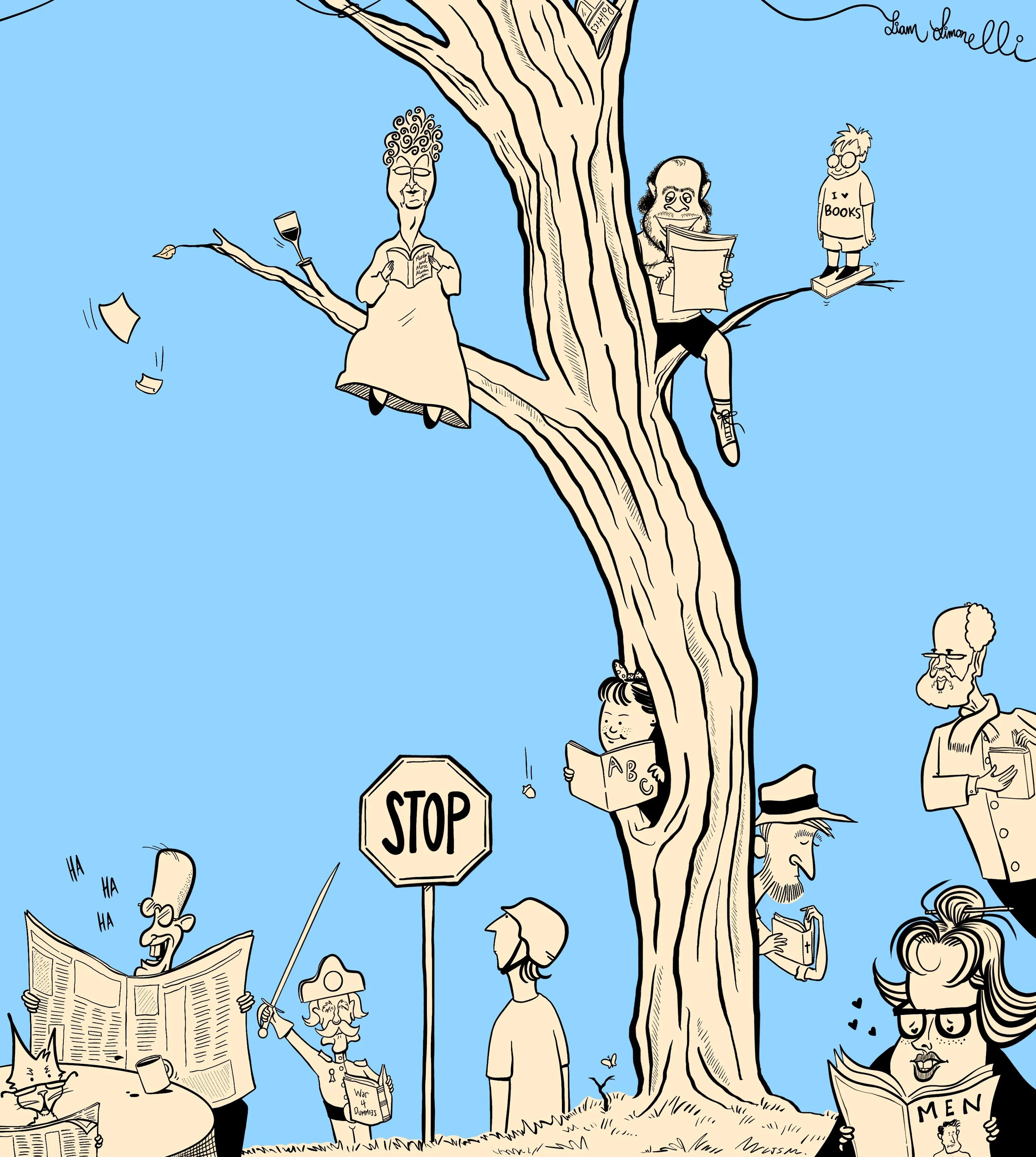
Liam Simonelli is a cartoonist and illustrator located in his home state of New Jersey. He is 23 years old and has been drawing since he was four. He holds a Bachelor of Fine Arts with a specialization in Graphic Design from The College of New Jersey. Prior to that, Simonelli graduated from Mercer County Community College with an Associate’s Degree in New Media Communications. He has had his work featured in numerous publications across the country.
Earth Is Alright
Billions and billions of stars ago, there was a planet called Earth.
This planet Earth was unlike its neighboring planets in their nine-member solar assembly—eight, now that Pluto was out—because Earth boasted a remarkable population of swimming, crawling, walking, flying, talking creatures, whereas the other planets couldn’t boast anything much beyond noxious gases and insane temperatures. This was unfair to Jupiter, being the king of noxious gases and insane temperatures, and comparisons are odious.
Earth was an orb of water, warmth, and weather. It rolled in the galactic district of what its inhabitants would term “the Goldilocks Zone”. Goldilocks was, according to Earth legend, an opinionated little girl who wanted things just the way she liked them, particularly her porridge, which was to be: not too hot, not too cold, but just right—hence, the perfect habitable conditions for a planet like Earth. Goldilocks always got her way, even when confronted by a family of bears. This was just according to legend, of course, because when the real Goldilocks tried to pull a fast one on an actual family of bears, she got mauled to death.
Earth’s human inhabitants, popularly known as Earthlings, were historically and perpetually in a constant state of agitation. Everything any Earthling could ever want could be found on Earth already. But that was not enough. The pickle of the problem was the human brain—it just would not stop thinking. Once it picked out a thought, it had a tendency to weigh it, swing it, toss it, grab it, chew it, spit it, catch it, grope it, sling it, wing it, fling it—and the thought would just keep on slinging and winging and flinging until it spun into a thoughtful combination of brand new agitation.
Meanwhile, Uranus burped out methane.
One of the most persistent questions Earthlings kept on wondering time after time, generation after generation, was: “Are we alone?” That was the eloquent version of the question, usually asked out loud by somebody who wanted to boast how they could think out loud. More often, people asked the question closer to the tune of, “So, are there, like, aliens and shit?”
Oh, there had been photos, recordings, anecdotes, even movies depicting the arrival of extraterrestrials, but alas, aliens just never showed up. Not factually. No cold hard evidence. No undeniable rock-n-roll light show for every pair of starry eyes looking up.
So, time rolled on, and so did Earth, and so did the endless agitation of thinking, which soon thought past the planetary bounds it had hitherto obeyed, and painstakingly developed high-velocity interstellar vessels, to get closer and closer to the speed of light, to finally, at last, voyage outward beyond the solar system, to colonize anything and everything that could be found out there that was neither a noxious gas nor an insane temperature.
Multitudes of Earthlings took the one-way ticket to terraformed colony planets. But the gap of light years between Earth and those faraway colonies was so huge that time and space eventually slipped away from all parties involved, and those who had voyaged beyond the stars became their own people. No longer Earthlings.
If Pluto had had a voice, it might have said: “Don’t do it, fellas! They’ll forget all about you! It’s a racket, I tell you—you’re part of the cool club until you’re not. Think I’m joshin’? You’ll see! Take it from me: Pluto. ‘Member me? Used to be a planet. Number nine, baby. Now? Just look at me: Has-been! N’ soon, all your children n’ wives n’ husbands will be has-beens!”
But being so far away and having no voice, plus being an ex-planet, Pluto’s urgent message went unheeded by the millions of human beings leaving home forever far behind them.
Which brings us to where we are now. Universal time.
Aliens have arrived! Well, hold on, not really aliens, per se. More like, Earthlings so far advanced and evolved into the future folds of outer space that they would appear alien. And these future-evolved Earthlings had no clue that they were descended from an original people on a planet called Earth. How could they? Nobody chilling upon a long-established chunk of ground would just blindly believe they could distantly be from any other long-established chunk of ground apart from the precise chunk they’ve long chilled upon.
And they, like their Earthling ancestors, also had an itchy agitation that no cosmic reach could scratch, so that they, too, flew beyond their own stars to find out what else is out there.
Land ho, they found Earth.
Yes, after all this space, they finally arrived.
But not after all this time. They got that part wrong. Really wrong.
What most Earthlings had hoped for, even expected, was that aliens would arrive at a convenient time in Earth’s history, when people were evolved enough to communicate with them on a mutually intelligible level. The aliens had mutually hoped for and expected the same thing.
Ah, such mutual hubris.
If the aliens had arrived at a time when they could meet their earthly ancestors, then there might have been some form of parlay. However, they had arrived at a much earlier era, when their ancestors’ ancestors roamed the earth, and these pea-brained ape-people did not parlay. They grunted, foraged, reproduced, and masturbated. No parlay.
Quite disappointing to an advanced race of three-eyed, three-nostrilled eunuchs.
Just above Earth’s atmosphere loomed a spaceship the size and shape of what would eventually be Brazil. At such a massive scale, one would think that thousands of souls were on board this vessel. One would have to think again. Two. Only two souls were on board.
The commander, S Kronos, stood by the bay window, brooding at the sight of Earth.
His assistant, M Hermes, stood by the computer, typing rows of Christmas light buttons.
In their distant intergalactic culture, they still had Christmas.
Both of these three-eyed, three-nostrilled humanoids were wearing full-body leotards.
S Kronos wore an orange leotard with a white chest imprint of an exclamation point.
M Hermes wore a black leotard with a red chest imprint of a semicolon.
S Kronos was rather stout, and sort of looked like a creamsicle in charge.
M Hermes was rather slight, and sort of looked like licorice in attendance.
They both had shaggy bowl cut hairstyles that an average Earthling living in the twenty-first century would have approximated as, “Hella 80s.” That would be incorrect, however, as these hairdos were more characteristic of 1977—the real beginning of the 80s.
Additionally, they had mustaches that some would have termed, “handlebar mustaches,” or more raunchily, “porn ‘staches.” Both handlebars and mustaches were respectively featured in enough porn as is that neither descriptor would be insufficient.
Both men were eunuchs. Anybody could have guessed that by their constrictive leotards.
This was neither punishment nor accident: for them, genitalia were no longer in vogue.
Being that they sprang from humanity’s past but were sourced so far in the future, it was difficult to determine why this was so. Popular belief believed they privately thought themselves into thinking, therefore becoming, so by that measure, who needed to be coming? Life hack.
S Kronos was brooding to the boiling point and suddenly boomed, “Status report!”
M Hermes had just stepped up to deliver the status report anyway, only to get slammed in the face by the commander’s volume. Wincing his three eyes shut, he patiently replied, “Sir,” then handed the computer readout sheet to his superior.
S Kronos snatched the report and read it with such intensity that it crinkled.
“Are you,” he said evenly, “attempting to confound me?”
“Most assuredly not in the least,” his assistant responded.
“Then why is this written in code?” He shook the sheet. “You know I can’t read code.”
Spewed and splattered all over the sheet was such symbolic logorrhea as would make a software engineer seek narrative therapy.
“Regrettably,” M Hermes said, bowing his shaggy head, “the computer suffered an aberration during the hyper jump into Earth’s solar system.”
“Meaning?”
“Meaning it lost its meaning.”
S Kronos huffed through his three nostrils. “Very well then. I’ll ask you to interpret.”
M Hermes waited.
“What are you waiting for?”
“For you to ask me to interpret.”
S Kronos thought, Help these days, then grumbled, “Just give me the basic translation.”
“Actually,” M Hermes brightly replied, “I can give you the exact translation. It says,” he summed up the symbols in their entire sequence: “Earth is alright.”
The outer two eyes of S Kronos blinked while his middle eye stared straight ahead.
“Earth is alright?”
“Earth is alright, sir.”
“The computer said that?”
“I said that, sir.”
“You said that?”
“I said what the computer just said.”
“You don’t have to say what you just said.”
“Are you saying I should say something else?”
“I’m saying you should stop saying anything.”
“Whatever you say, sir.”
S Kronos had to think. Earth is alright? He did not like the sound of that. Not one bit. The minute they’d discovered Earth, the debate over what to do with it had dragged their entire galaxy down. They couldn’t simply ignore this planet. Something had to be done about it. Their kind was a parsimonious lot, so it all came down to one cutting query: should Earth stay or should Earth go? No clear Yes or No. Not yet. And now, when the puzzlement had been deferred to technology’s best judgment, it told them, Earth is alright. Just alright. Not good. Not great.
“Not worth keeping,” the commander mused miserably.
“On the contrary,” his assistant suggested, “‘alright’ does not automatically signify a middling review. This could be the informal use of ‘alright’ to indicate a status quo of wellbeing, such as, ‘The kids are alright’.”
“Kids?” S Kronos scoffed. “What kids? I ate up the last one.”
“Nevertheless,” M Hermes said, disregarding that, as he took a bold step toward his superior to further explain, “the computer might be telling us that Earth is just fine. As is. Without any interference from us.”
S Kronos frowned. “And you’re quite sure that you’re not overstepping your bounds?”
“Yes.”
“Then why are you standing on my foot?”
“Oh,” M Hermes said, taking a step back. “I’m sorry, sir.”
S Kronos now paced the control center, hobbling a bit.
“I cannot judge the fate of an entire planet if considerations keep getting in the way!” He gestured to the control deck. “The destruction protocol could easily be activated, you know. Beep, and then we can finally go home—but oh nooooo, you start cozying up to computer hangout language—”
“I know you dislike considerations, sir,” M Hermes stated, also pacing now, sans hobble. “But consider this: Research supports a new hypothesis that we are descended from these Earthlings—morons though they be. If we were to obliterate them along with the rest of their planet, we may risk severing the one and only link to our origins. Just think,” he stopped his pacing to be facing his superior, “Earth could be the umbilicus to our cultural heritage.”
“What are you saying?”
M Hermes raised his index finger to say: “Destroy the past, and you destroy the future. That’s all I’m saying.” He pointed forward and up. “Simple as that.”
“And you’re quite sure that you’re sane?”
“Yes.”
“Then why is your finger up my nose?”
“Oh,” M Hermes said, retracting his index finger from the commander’s middle nostril. “I’m sorry, sir.”
“Yes, well,” S Kronos said, snuffling, “your rhetoric is duly noted. However, I simply cannot see how the past has anything to do with the future when all I can see is the present.”
M Hermes, who had become distantly fond of planet Earth, murmured in its defense, “Just because we can blow it up doesn’t mean we have to.”
“True,” S Kronos countered. “But just because we don’t have to doesn't mean we can’t.”
“Well,” M Hermes conceded.
“Really,” S Kronos reasoned. “Who’s going to miss a bunch of monkeys who won’t stop masturbating?”
M Hermes shrugged philosophically and said, “They’re our grandparents.”
S Kronos shuddered. “That settles it,” he decided. “Activate destruction protocol. Now.” And he resumed his brooding post by the bay window.
M Hermes thought, ’Tis pity, then obeyed the command. There was an immediate jolt.
“Tell me,” S Kronos said dryly. “Are you entirely loyal to the mission?”
“Yes.”
“Then why have you activated the self-destruction protocol?”
“Oh,” M Hermes said as everything faded to blinding white. “I’m sorry, sir.”
They, along with the spaceship, exploded into quantum particles of soundless entropy.
Planet Earth turned the other cheek.
As the dust slowly settled in the vast vacuum of a careless cosmos, a voice was heard.
It was a radio announcer’s voice, carried on the back of a radio wave. It said:
“Some people fix cars. Other people fix a race. But have you ever heard about the man who fixes space? Here he is now—from the Miami Space Transit Planetarium to outside of Earth’s atmosphere—Hoyt Jackstellar!”
A man appeared in space. Robust. Jolly. Anybody else would have been dying of spatial asphyxiation, but not Hoyt Jackstellar, the host of Space Fixer with Hoyt Jackstellar—he simply walked down a star staircase and happily shouted across the void, “Salutations, salutations!”
Hoyt had a walrus mustache, a hamster posture, and a beaver chuckle. He was dressed in a pair of white tennis pumps and khaki slacks, wearing a Martians Only jacket.
Essentially, he was everybody’s favorite dorky uncle. In space.
“I know, I know—I’d be surprised to see me again, too, believe me!” He spoke with good-natured amusement in the starry emptiness. “Ever since my show, Space Fixer with Hoyt Jackstellar, was taken off the air in 1996, you might have been wondering, ‘Hey, what’s ol’ Hoyt been up to?’” He chuckled, “Well, let’s just say, I haven’t exactly been in retirement!”
He walked in a shuffling, waddling fashion, kicking up puffs of interstellar dust.
“You see, a funny thing happened on the way to being taken off the air—I myself went right back on the air. Heck, I went beyond the air and straight into orbit. Talk about a severance package!”
He chuckled again and dropped down from where he stood, now standing next to planet Earth as if it were a glowing exhibit in a space museum.
“First off, let me give a special hello to our new audience from the past, way down there on Earth as it was long ago. To you, our human ancestors, I say: Ooga-booga and Me-Not-Jane.”
He suppressed his chuckle a bit on that one, as he suddenly worried he might have just been culturally inappropriate, so he proceeded. “On my show, I used to fix all the hypothetical problems of our solar system, like how to repair a dying star, or how to refit a ring on Saturn, or how to shut the gas off on Uranus. But during all that stargazing, I lost track of maybe the most important part of our beloved solar system: Home!”
This brought out such a chuckle from Hoyt that he fell into a temporary wormhole, then fell back out onto the space above the opposite rim of the planet. He seemed to mean to do this, and went on, unfazed.
“You folks may not be able to understand it now, but your entire future was just one bad second away from being vaporized by a pair of unhappy campers. Lucky for us, I fixed all that. Hey, no sweat—what did I tell you all the way back in 1977, on my very first episode? The Space Fixer never fails!”
This got a snort out of Hoyt’s customary chuckle, which startled a comet off its course. Hoyt continued.
“This coming week, pay close attention to the skies. There’s gonna be a reconnaissance squadron of our alien descendants showing up, and they’ll be sending in the bigger guns. But have no fear, fellow Earthlings: I’ll be waiting. Right here. Our mother has already been through enough in the future, I’m not gonna let anything else happen to her in the past. Despite all of the crazy events that already happened and will happen all over again, I gotta say…” And he clutched himself with the biggest chuckle of them all: “Earth is alright!”
Serenely, he saluted and took his exit, ascending the star staircase.
The radio announcer’s voice concluded: “Earth Is Alright was written by Alex Rogers and is dedicated to the loving memory of Douglas Adams and Jack Horkheimer.”
Back down on Earth, a barely-evolved human race looked up at the stars with a collective expression of profound idiocy. They didn’t understand a single thing that had happened, was happening, and would happen all over again.
But that’s okay. They’re family.
Alex Rogers is a satirical fiction writer whose words range from goofy to grotesque to unexpectedly grounded. His stories have appeared in The Write Launch, Santa Barbara Literary Journal, Starlite Pulp, Grub Street Online, Bizarro Circus of Madness, Foofaraw Press, Internet Angelz, and A Thin Slice of Anxiety. He lives in Los Angeles with his two cats, Merlin and Osha (the Tuxedo Twins).