‘A Satirical Study on the Linear Process of Grief (Or Lack Thereof)’
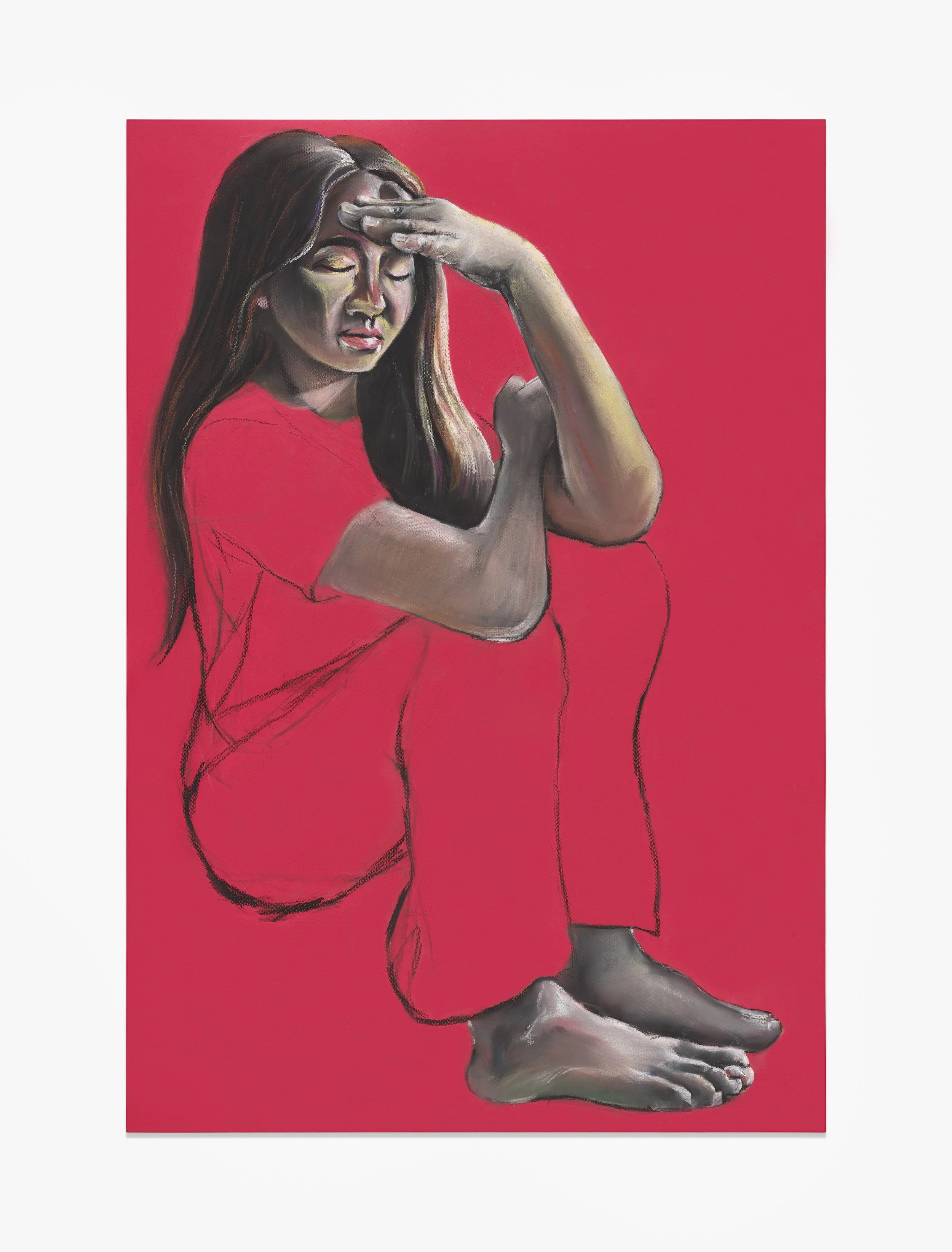
Hyewon Shin is an 11th-grade student at Newton Academy. Her concept explores fashion, arts, psychology, business, and glocalism through an anthropological lens, examining cultural, social, and environmental dynamics
A Satirical Study on the Linear Process of Grief (Or Lack Thereof)
ABSTRACT: This completely serious, no-bullshit paper investigates the phenomenon of grief as experienced in the single-subject case of my life, following the loss of my uncle. Traditional models propose a predictable, one-size-fits-all sequence of denial, anger, bargaining, depression, and acceptance. However, my data, informally collected over several years through late-night introspection and iPhone notes strewn into messy poems about him, suggests otherwise. Note that this paper is entirely self-funded, self-sabotaged, and self-reported. No external reviewers were consulted, unless you count my bedroom ceiling (which I’ve been talking to since he died).
Keywords: grief, closure (?), forgiveness, self-discovery (although that’s a little… debatable), writer’s block, a few tears, a bunch of rewrites & existential dread
RESEARCH QUESTIONS
1. What are the typical and atypical behaviors to expect from children and adolescents shortly following a loss?
2. What types of social support are most vital during the process of grief, and how does a lack of it impact the individual?
3. Okay, I’ll drop the act. Please, tell me. How is an eleven-year-old girl supposed to deal with a phone call from her dead, announcing the death of her uncle, when just the night before, she’d made a promise to call him, but never did?
4. What do you do if you never got the opportunity to tell your uncle how much he meant to you before he left?
At the time of his death, eleven-year-old me, who had never lost someone before this moment, had constructed a NULL HYPOTHESIS based on these questions: [H₀] The death of my uncle will lead me to follow the five stages of grief (denial, anger, bargaining, depression & acceptance) because grief—although confusing at first—is a universal feeling and can be neatly mapped by these five key phases.
However, when I fully comprehended the fact that I had never said goodbye to my uncle before he’d passed away–when I’d let the notion uncomfortably settle into the crevices of my hollow ribcage, the gravity of the situation had already made itself known to me and refused to leave. That was the day I had to face the ugly, bitter truth: I had no concept of what grief looked like until its real and monstrous form finally materialized, staring at me in the face and taunting me.
I didn’t have the faintest idea of what grief was until it chose me. And when it did, it made a mockery of every hypothesis, every framework that I had so desperately clung to–leaving me face-to-face with something I could neither measure nor contain.
INTRODUCTION '
The five stages of grief have indirectly created a master narrative of how people are supposed to handle grief. The model itself was an unintentional domino effect–Elisabeth Kübler-Ross originally described these stages to outline the emotional experiences of terminally ill patients, not to prescribe a universal script for grief. It was never meant to be treated as a linear pathway for every person, but over time, it became warped to serve this function. People began to judge their own grieving processes against a false standard, leading to a narration that dictates what “proper” grief should look like. Likewise, individuals who do not follow the prescribed path begin to feel alienated, believing they’re grieving “improperly” or past the “expected” time that one is supposed to spend on one stage.
Although the model’s original intentions were ultimately misinterpreted by popular culture, its harmful impacts persist to this day and cannot be overlooked. I was one of those people affected by this framework hovering in the background, and the dangers of this narrative only exemplified after I lost my uncle. It felt like every emotion I experienced had to be held up to a certain standard, and I had to measure my feelings against a ruler that I never adhered to or aligned with in the first place. Every time I thought about him, I wondered: Is this denial? Is this the “bargaining” part that everyone’s talking about? What box am I supposed to check off next? What box am I even on?
The five stages were supposed to provide order, but I only felt myself getting further tangled in the labyrinth of my own emotions. When I was supposed to feel denial, I felt empty. I didn’t feel a single thing, especially after that phone call. What stage was that supposed to be?
METHODS
The study consisted of waiting four years before visiting my uncle’s grave, as well as cycling through the different stages completely out of order (along the way, I had even formulated my own stages, something that slowly became familiar to me). In that time, I came up with several ideas for how I might fulfill the “unfinished goodbye” I felt that I owed him, and settled on the idea of closure: an ultimatum where I’d forgive myself, and I’d imagine that he would forgive me too.
For as long as I can remember, my unchanging refuge has been to write. It helped me get through my uncle’s passing, but even though I consider it one of my greatest strengths, I also ironically think of it as poison. Writing feels like an obligation at times, and sometimes it can even suffocate you. I write about him out of sorrow. But at times, I find myself writing out of guilt–as if the poems themselves were a kind of penance for the deadliest sin I had committed. Ultimately, though, I write because it feels like the only way out: that putting pen to paper was the only way I could get him to forgive me. Bringing awards, certificates, and medals home became the physical manifestation of the only retribution I could think of to make him proud.
So when I finally decided what closure would look like, I chose to gather my best pieces over the years, things scribbled in journals, poems stored on my laptop (sometimes half-finished), and read them aloud at his grave. My plan was simple: to bring my words back to the person who inspired them, and in doing so, return something that had always felt one-sided.
Instead of writing in isolation, trapped in the endless cycle of grief and guilt, I would finally let the words leave me and meet him, even if only in spirit. To stand in front of him, after all these years, and offer something tangible in return for the silence that had been weighing on me.
On the 23rd of August, I was finally standing in front of my way out after years of guilt and self-imprisonment. The first time in four years that I wasn’t running from the monster that I thought would consume me whole one day.
RESULTS
I spent a significant chunk of those four years imagining this moment in my head. I rehearsed my words in the shower, on the bus rides to school, and while staring at a blank Google Docs page–repeating everything I wanted to say, over and over, until those words practically became a part of me.
In a perfect reality, I walked away from his gravestone with a lighter heart. I wish I could say the rock that’s been wedged on top of my chest finally loosened, and I’d gotten the closure that I had so desperately longed for.
But that isn’t what happened.
It took me four years to realize that the one thing I had been chasing all this time did not exist.
That’s not metaphorical, by the way. I mean it in the most literal way possible. Closure does not exist for me. Much like the five stages of grief, closure became a concept that I had begun idealizing as a somewhat twisted narrative to try and “forgive” myself for never saying goodbye to my uncle. The problem was, closure was never a destination to eventually reach. It was simply another mirage that I had fallen into. Regardless, it became a process I obsessed over, one that kept me running in perpetual circles. I convinced myself over the years that once I spoke the words I had written, it would get a little easier to breathe. If I wrote the perfect, award-winning piece and showed it to him, I thought the pressure would finally stop.
But when I finally stood in front of him after all that time, I froze. My throat went dry, and I felt my chest caving in on itself. Instead of breathing easier, I could not breathe at all. And in the end, the only thing I managed to say to him was two words:
“I’m sorry.”
Sorry for being unable to do what I swore I would. Sorry for never being able to say goodbye. Sorry for all of it.
Despite all the poems, memoirs, and the years I had spent writing and grieving, those two words said more than anything I was able to conjure up after all that time. Maybe because part of me realized that it wasn’t about everything I’d done for the sole act of forgiveness. All that mattered in that moment was that I was finally reunited with my uncle, like I had promised him all along. And while that feeling of simply being present didn’t solve all of my conflicting emotions or quell the permanent, ever-raging storm in my chest, none of it really mattered.
All my uncle most likely wanted was for me to be there. And maybe that was all he ever needed from me to begin with.
DISCUSSION
To be honest with you, I have yet to find the answer to my third research question. How did I survive that phone call? I don’t know. On some days, it feels like I didn’t, and that I’d died as well the night I’d received the news. I just clung to my original hypothesis, because it was all I’d ever known. And even though my null hypothesis had started failing me, I began to rationalize over time that if grief was a process, then surely there would be an endpoint–a final stage where the pain finally subsides. That began my new chase of closure. It took me two words and the opportunity to finally visit his grave to realize that no such endpoint existed. There was no metaphorical bow to tie as goodbye. Not for me, at least. My experiment did not confirm my theory. Because in my non-linear, unfinished path of grief, I realized that something else entirely was happening.
In the wake of closure, an ALTERNATIVE HYPOTHESIS has been formulated: [Hₐ] The death of my uncle will lead me to eventually realize that grief will always be a part of who I am, of my identity, and the way I let it sit with me at night when my thoughts run free.
This alternative doesn’t come with a neat chart or a clean conclusion to map everything out. Sometimes I’m still angry, sometimes I feel disappointed, and I’m far from ever reaching forgiveness with myself (if that’s ever something I can truly even reach), but I’ve learned to sit with the notion of loss without letting it consume me entirely. Loss feeds on me; I feed on it in return by writing about my feelings. It’s parasitic. It’s symbiotic. The path feels linear, and then the next day it’s anything but. Sometimes, it’s confusing. Yet it’s easy to understand, and all of a sudden, every word that I pen on paper makes sense. And then it all falls apart again, because you never know what to expect. But you know exactly what to expect.
Four years ago, I never would’ve known that there was even an alternative hypothesis. It was something I discovered instead of reaching the closure that I had so desperately wanted. I had to give a piece of my soul to find my alternative hypothesis, but my findings are something that I would never want to retract. Perhaps this is what closure looks like for me. The beauty about it is that I’ll never truly know.
To summarize my findings:
The NULL HYPOTHESIS is REJECTED.
The ALTERNATIVE HYPOTHESIS is ACCEPTED.
The beauty about grief being a fickle thing is exactly that–it’s fickle. To not disregard the five stages completely, I’ve found some semblance of acceptance in my life. I think about him on February 29th during every leap year, because that’s his birthday. I thought about him when I went out with my aunt and her family for dinner following the visit to his grave–and mused to myself about how many plates he would’ve eaten at the buffet (since he had quite the appetite). There are times when grief doesn’t feel monstrous or asphyxiating. There are times when grief is just remembrance, and then it starts to feel like, for a split moment, they’re right there with you again.
Maybe that’s the closest thing to closure that I’ll ever get. Because sometimes, there is just genuinely no way to heal. The only thing you can do is remember.
ON FORMAT SELECTION
The satirized research paper format was chosen as the ideal medium for this study, since grief has long been subjected to scholarly dissection. Modern study has normalized cataloging, measuring, and charting its supposed trajectory. While not dismissing the importance of researching and learning more about it, grief is unruly, unpredictable, and ultimately immune to a single framework. Thus, this “study” is both an imitation of academic inquiry and a parody of it. It’s important to understand that grief is real. It’s a universal human experience, but far from one universal feeling or concept. It can be studied, but should never be standardized, because each subject breaks the mold. Each subject makes a new mold and smashes it just as quickly. Each subject can make something that can barely even be called a mold, but they all model what it’s like to lose somebody. In their own little ways, they all do, even though there’s no universal or cohesive picture meant to be formed.
This study is not meant to be replicated in any way, shape, or form. For someone else, the null hypothesis may be accepted. There may even be a third hypothesis somewhere out there. And that’s okay.
REFERENCES
Me, Myself, and I. Personal Experience with Grief: An Unpublished, Ongoing Case Study (That will probably go on until the day that I die, and although that notion is still perpetually terrifying to think about, it is something that I have learned to sit with. My story is not over, and my grief will keep on rewriting itself in an endless cycle of margins that I’ll never finish filling).
And nobody else, because grief resists any citation except for your own. Don’t let anyone’s framework be a dictation of yours. Not even mine.
Krysha Santiaguel is a sixteen-year-old aspiring writer based in New York City. Her work has been recognized nationally by the Scholastic Art and Writing Awards. She enjoys writing poetry and experimenting with bold formatting. You can find more of her work on Instagram, by the username @kreeshei.