‘Ilsa, 1985’
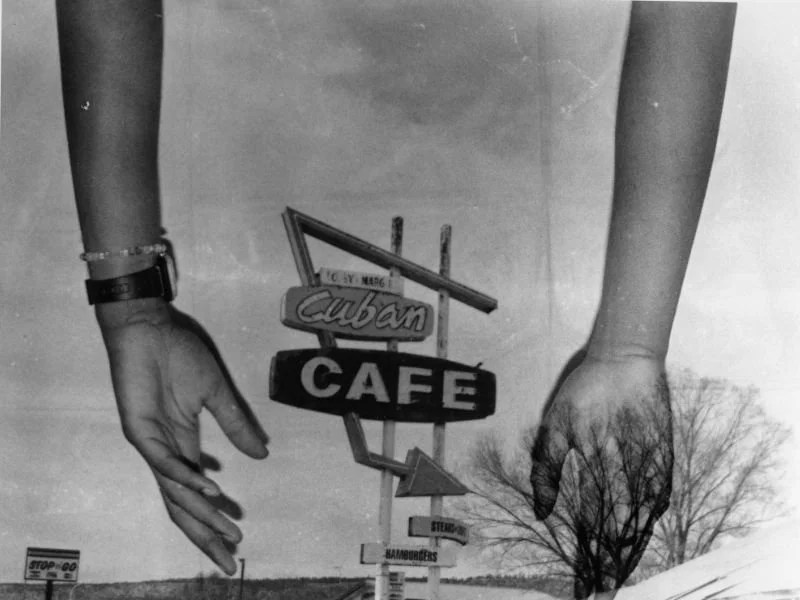
Kit Bose is a photographer based in Vancouver, British Columbia. She primarily shoots with film, developing and printing her work in a traditional wet darkroom. Driven by a desire to experience the otherworldly, she uses photography to document uncanny locations in both rural and urban environments, evoking the sense of unease that arises from emptiness. Visit her website: https://kitbosephotos.com.
Ilsa, 1985
There is a wall projecting onto the sidewalk like a door and she thinks she should go through it. Maybe it is 1061, a black hole and she'll pass through time. At 18 years old, on Madison Avenue with her childhood surrounding her, Ilsa is thinking about Alice.
All the streets are Alice.
The other day when she visited her sister in Queens, she wasn't eating. To Ilsa she looks thin as a pole and proud, wearing very short skirts and high heels. Ilsa can make out the veins over her kneecaps and elbows. Alice followed her eyes and told her she hated eating:
“I've forgotten about eating. I can't believe I ever thought about my weight. It was such a stupid thing to think about.” As if she had suddenly become esoteric when Ilsa knows the aesthetic has come from drugs. After seeing her it occurs to Ilsa that it may be time to let go of Alice a little. Her sister had let go of herself and should know better: she always had premonitions. But she cannot do it. She thinks that something will keep Alice from disappearing altogether and the more she is able to see her, the less likely that will happen anytime soon.
It is May and people are uncovering themselves early. Where were the preparatory states of grace, the hints of humid moons in the middle of Easter? She will have to adapt or give up breathing. Even in the East Village the skinheads are wearing pastel fishnets and sleeveless tunics, their tattoos throwing out warm pink and blue silhouettes in the sun. She passes the supermarket, next to the real 1061 with its antiquarian gallery on the ground floor and the thought flashes through her mind, though she is a little afraid to even acknowledge it, that she will never grow into anything full-blown, trapped as she is by the proximity of her childhood.
Her mother told her that she was supposed to be like the other Ilsa, in the old movies, Ingrid Bergman in Casablanca, loved by Rick. That was the kind of woman who would capture her mother's imagination: a healthy political saint, unlike anyone she knew. At 1061 she had borrowed the dream from her mother but now walking past she suspects that she'll never grow into anyone like that because she is a person who makes a poor impression on others.
“You're just trying to inoculate yourself” Alice told her, “By turning yourself into a freak.”
And she knows that this is to Alice a cowardly act, you had to be the thing, not just borrow the image. But it is neither here nor there to Ilsa if she looks like a freak to her sister. Though she thought about it once when she almost lost her job at the anatomical display gallery where she works. She had come to it because she was a painter and desired knowledge of the inner life of things and it was at the gallery where she discovered that anything ugly was especially beautiful in its skeletal form, bones were perfect for what they stood for. The man who owns the shop used to hunt down animals, killing them and shattering the bones but something made him change course. He was well-dressed now that he no longer killed anything, he looked in fact like a civilized man. He commissioned people to put the bones back together and he wasn't too bad at it himself: no cracks in the shells of diamondback tortoises, and birds put together without a bone missing, each bone no bigger than a straight pin.
For some reason she loves him, perhaps it is his interest in preservation or the fact that he sees through things, through flesh to their worth. The other people who worked for him, the shop assistants and curators told him that Ilsa was mutating too fast, she drew attention away from the art and discouraged the customers with her multi-colored hair and feather earrings and nose rings and black motorcycle boots against her hairy white legs. And he said, “Leave her be, she is just a painted bird”. Is it that he is after all a humanist, sees that she is harmless? That her outside is no worse than his inside once was? All Ilsa knows is that she was allowed to stay.
She has arrived at engineer’s gate on 89th St. and 5th avenue where the joggers gather to stretch their muscles and stride their health like young Greeks. She wishes there were philosophers to converse with. She stops for some water, always a surprise when a fountain is working and not verdigris and dry and feels a little guilty because she hasn't been running yet is as much out of breath as anyone. Tomorrow is Sunday, she'll have to visit Marion. No, today is Sunday. She stops in front of a tree. Sometime last week she must have taken a day off. Tomorrow she'll go.
She looks at the bark wanting to break some of it off but that isn't going to stop anything from happening. She decides to enter the park. Tomorrow is work and with it in mind she'll sit on the steps with the skinheads, watch them do their mad whirling dancers for the passersby who are afraid of them. They'll smell fear and they'll put great energy into their movements. Tomorrow she'll get to work half day stale as clay. It won't matter. The owner will be away, and the others will keep clear of her.
Monday morning, she recognizes faces at the Astor Place subway, even with their purple hair and the red moons under their lower eyelids, they are still doing the conventional thing: making a living. Every morning, like Ilsa, they must be at a place. And early every evening, no more energetic than she is, they escape it. She watches them and they seem to her dazed and stupid, hypnotized by the flashes of light outside the subway car window.
Ilsa buries her head in her hands. Life isn’t just some blurry hangover to her; it all still means something. Yesterday she had forgotten it was Sunday because she'd woken up intact. Now, knowing that she's got to see Marian at noon has her feeling like she's going to vomit. If she can make it to the shop, she'll at least have a bathroom, in the basement with the bones they keep in formaldehyde, like a vault where you can't be heard.
The train is halfway there. The owner will be out of town, it was easier in a way, yet took the purpose out of being there. She spies another employee who doesn't see her. No one seems to notice her or talk to her if they can help it. She is young, shooting her strange colors at them. It is funny to Ilsa that she sees this and at the same time knows that she is as little like her own exterior as she is like the outside of the train.
She gets off at Lexington at 77th. She passes Lenox Hill Hospital and purposely avoids looking at the ambulances pulling up, even though the drivers are probably just hopping out with a cup of coffee to report in. Marian and Alice have both done time in this hospital.
At 12:00pm she leaves work and walks west to 58th St. and 7th Ave. and rings the downstairs buzzer of a brownstone above a Japanese restaurant. She rings it again even though she knows the buzzer doesn't work. Then she lets herself in with her key and climbs the three flights of dirty metal steps to her mother's door, a green door, sloppily and thickly repainted. No bell again, she lets herself in. The light in the hall is out, she follows from habit without even thinking of switching anything on.
Her mother is in the living room, naked on the sofa, asleep. Her hair is black at the two-inch roots, and green to the dried-out ends. There are black rings under her eyes and red smears in the crevice under her lower lip.
Ilsa removes her jacket and flattens it out over her mother.
“What are you doing to me?” Her mother taking only moments to wake up and throw the jacket off.
“It's Sunday Marian.”
“Liar, it's Monday.”
“Yes, it's Monday.”
“Sit down.”
Ilsa picks her jacket up off the floor and sits carefully on the edge of the sofa. The room smells of very old, dank things. There is no furniture save the couch, the upholstery peeling like cracked plaster and over by the window a coffee table with newspapers, coke cans and a black and white Panasonic portable TV, most of the dials missing. Giant roaches cast enormous shadows from the half daylight which pokes through the two dirty windows: no shades, just bars that divide the room into blurry poles.
“Are you hungry?”
“Do I look it?”
Her mother takes out a pack of cigarettes from under the cushions. “Want one?”
“No,” But Ilsa notes she must light it for her, her mother is liable to go up in green smoke. She briefly touches the back of her hand.
“You don't look so good.”
“Were you thinking the same about me?” Ilsa shrugs and takes her knapsack off her lap.
“Have you lost your job?”
“I took the afternoon off. I felt bad because-”
Marian laughs. “Don't say it. Just go into the kitchen and get me a glass of water, I'm parched.”
There is nothing in the kitchen that looks uncontaminated. Does her mother usually put her head under the tap?
“Use anything, I'm not squeamish.”
“I'm afraid to touch anything.” Finally, Ilsa fills an old beer bottle. Her mother takes it gratefully and Ilsa notices that she drinks without sound.
“Have you heard from Michael?”
“No mother.”
“I wonder - do you think he's still alive?”
“I think so. I think we would have heard if he wasn’t.”
“That's right.”
But it was a lie. Why should they hear if anything happened to him? He was only her father once.
“That's comforting” Marian says, spilling water on her thin chest.
“Have you heard anything from Alice mother?”
“Alice who?”
There isn't anything hanging on the walls. Ilsa remembers a poster of the world fair, 1964, and a calendar that came from a bank, illustrated with a very serene set of landscapes. Now there are roaches on the walls, moving in various directions and cobwebs where the walls meet the ceilings.
“Alice is so thin.”
“We're all thin” Marian says, leaning the bottle up against her cheek.
It was a long time now that Marian had refused to speak to Alice and Ilsa cannot not recall what the reasons were, although it seemed to have happened often over the years. Maybe they didn't speak more often now than they ever spoke. But it seemed to mean more to Alice than it did to Marian.
“I wonder if you should go downstairs and buy us some more beer?”
“Do you need food?”
“No, but while you're there if you happen to see something that doesn't look too terrible bring that too.”
Ten minutes later Ilsa is watching them packing the sandwiches in the deli across the street. She thinks of the morning. She arrived at the gallery in time to vomit in a trash can. As it turned out, the owner showed up after all, while she quickly tried to distill her breath with coffee. If the gallery didn't always smell so chemically pure it might not have been detected.
“Did you have a well weekend?” her boss had asked her, and his gaze lingered when she said it had been “absorbing”. He probably just found her a curious site: her evolution interested him because it was picturesque.
“They had peanut butter mother. We are both in luck.” Ilsa looks away at the effort it takes her mother to sit up and open the aluminum foil around the sandwich. She is still undressed and looks pale and shameless like a painted nude. Her mother takes a finger full of peanut butter and smears it on her forehead.
“I’m anointing myself with peanuts.”
There is no laugh in the time before she becomes hysterical, sobs which make the veins in her neck stand out. Ilsa uses the thin napkins from their lunch, first to clean their mother's forehead, then to clean her face. Marian, with the black makeup gone looks suddenly to Ilsa like a young girl, pale and defenseless, on the verge of suicide. Ilsa notes the arch of her mother's brows, and the pallor of her curved lips. These are the things that her employer told her to seek in paintings.
“Never think of formulas or words when you look at art. Just look at the people themselves as they stand before you. There are clues all over the painting. You should be able to feel it without thinking.”
Yes, her mother's artistically beautiful. Her hair had been black, without a shadow of red, before she turned it gold and then green. She'd never had any color in her face and though her neck is lined, it is not papery like the necks of many thin women. Her life mainly discloses itself in the inability of her body to comfortably absorb movement.
“Light me another cigarette and light one for yourself. I feel awful, like some kind of bad mother when I smoke alone.”
Her mother hands her a beer bottle.
“Believe it or not I haven't had anything for several days.”
Ilsa takes the cigarette from her own lips and places it in her mother's mouth. How perverse it seemed to Ilsa that she should take this moment away from an old movie.
“You have such funny ears Ilsa. You look like a bird. It's your hair.”
They shaved her hair high above her ears, that was at the barber shop at Astor Place. Augusto. It stood out in places where dyes had stiffened it and in others it didn't have a human quality anymore but was feathery: something she had done to it she couldn't remember, maybe a perm over a henna or a bleach over a streak of purple. Something had given it a surreal quality. She did look like a bird but then so did Marian, one you would see on a curb somewhere, surrounded by strangers and dying of fright.
“Ilsa, am I forty yet?”
“Just this year mother. Don't you remember?”
“I remember.” The room is getting cooler.
“Should I close the window?”
“I feel ninety. Don't close anything. Talk to me. Make things up. Don't tell me you don't know what to say.”
“I passed 1061 yesterday. They are building over it. But they aren't tearing it down. They've got the air rights. The one they are building now is going to have terraces. They'll get a good view of the roof.”
“Are you hoping to move back in there? Is that why you're watching it so closely?”
“Do you really think I could ever live there again mother?”
In Ilsa’s mind the words are echoing loudly, live there again, after what happened? But she doesn't need to say it to Marian. She knows. Marian committed no huge crime, which had turned her daughters wary and afraid of people, afraid to assert their forms in the world. Alice and Ilsa talked about it incessantly, they couldn't be blind to it any more than Marian could be blind, no matter what she did to block out the facts. She'd given her daughters a false sense of time and was due to something nobody could really blame on her: her own extreme youth. She stopped talking to Alice because like a child she believed everything could be repeated, that somewhere, in some black hole in space, the three of them would reenter their childhoods and rearrange it.
“Alice wants to see you mother.”
“Why? Does she think I'm dying?”
“Alice is very fond of you.”
“Is she living with you?”
“No, she's in Queens with a musician.”
“Alone?”
“I just said, with a musician.”
Her mother weakly rolls the empty bottle across the floor. Halfway to the other side it starts rolling back. “Musician lost its sense for a moment.”
“I think this time Alice may have gone too far.”
At 1061 Ilsa remembers that Alice was always looking into the portholes, the three frosted panes that decorated the front door. She seemed to be trying to catch a reflection that was never in one piece. And because their mother didn't keep mirrors, any more than she did cameras or thermometers, Alice had no idea what she looked like. Ilsa found colors that resembled herself in paintings, but Alice couldn't find anything that gave her a clue.
Marian settled back against the cushions. “I'll go first.”
“She's been making herself get sick.”
“She's been doing that since she first saw her breasts.”
What could be real to her mother in a room like this?
“Won't you let me buy you a couple of things for the apartment? There's a Woolworth on 6th Ave.”
“1061. What a rotten little apartment, though the rent was low, do you remember? Eighty a month, right on Madison Ave. Try to find that now. I remember we painted the walls. We read somewhere that Edie Sedgwick painted a horse on her wall so all of us, Michael was around then, and I guess Jack and maybe the two of you, well maybe you weren't born yet, but we didn't want to be outdone so we painted cows all over, up and down, top to bottom, nothing but cows. It was very entertaining, not like your paintings of course. But it was a trip.”
Ilsa goes to the window. Everything looks plump compared to her mother: like going from a Modigliani to a Beckman. What hurt most was that her mother hadn't really aged at all, at least not in Ilsa’s definition of it. She would always be on the verge of understanding and Ilsa would always be on the verge of making her understand but her mother would always keep just out of reach. It didn’t matter except for Alice, if they weren't both so mistaken, looking at things as if misery could stop time.
One day last winter, twilight came early and somehow it turned out that of all the people in the gallery and of all the possibilities of people coming in, of fate multiplying them, only the owner and Ilsa remained. He was in his small office in the back. His door was open, she could smell his pipe smoke, and could hear the faint scratch of his fountain pen. She took the letter she was proofreading and tapped on his door.
“Oh, you're the one who is still here Ilsa? Why don't you go home and paint?”
“I’m going home soon. I was working on this and wasn't sure of the accents.”
It was a letter she was composing to a client in France. She had worked very hard, forcing herself to remember the thin rudiments of what she had studied for four years in high school. Her heart was pounding as he read, and she was envisioning something which would almost make her worthy of her name. Perhaps he would stand close to her or place a hand on her shoulder.
“Just leave it” he said putting it down. “I’ll fix it up later.”
Ilsa tiptoed out of the office.
“Are you thinking about your lover?”
“He's not my lover.”
“Why do you think of him at all?” Ilsa drops her cigarette through a crack in the window. “He seems stuck up to me. And he's a foreigner and old enough to be your father.”
“I don't know where you're getting your information from mother. He's lived abroad but he was born here, and it isn't any of your business.”
“There was an article on him in the Post, about a month ago. He's married. Does he wear his ring at work?”
“Yes, I believe he does.”
Her mother, unaware of Ilsa having turned back into the room, is searching for something under the cushions. Ilsa knows what it is. Not that she believed her mother had given anything up, but it hurt anyway, the hurt of the expected. It seemed to Ilsa that if the loss of innocence has to do with experiencing one’s inadequacy in most situations, the higher the stakes the greater the loss. This was her mother wallowing on the pillow, a high stake. But there were others, the least of which was her own life. Still, she didn't feel what she felt she should, because this was the normal course of events, hadn't her mother told her that, in the supremacy of her youth, that there was time for everything?
She could answer her mother's question to her own ear anyway: she loved him because his course of events was different than hers’. People were as different from each other as species of animal. What we are, Ilsa reflected, is something apart because of the peculiar colors and shapes we make in empty rooms. But we are not something to inhabit, to live through. She walks back to the sofa and looks down on Marian. She has closed her eyes. Ilsa thinks she can see the tissue in her mother's breast. It's hard to imagine that they could ever have been the full breasts of an adult woman, of someone who had spawned.
She cannot leave yet and be comfortable about it. If she sits on the edge of the sofa, this one fissure of peace will be disturbed. She notices as she crosses back to the window that she is sparing the lives of the roaches.
The phone is ringing somewhere in the apartment.
“Let it go” her mother says from the couch, “Probably somebody I owe money to.” It stops and then almost immediately starts up again. “Alright. Pick it up. But tell them I've moved.”
“Where is it mother?”
“Somewhere on the table over there.”
Ilsa finds the phone under a pile of old Mademoiselles and Glamour magazines. Two syllables and she knows who it is.
“Who is it?”
Two syllables from a weak voice on the other end: “Mother?”
“An admirer mother.”
“Send him away.”
“This person insists on speaking with you.”
“Tell him I died.”
As Ilsa walks toward the sofa with the telephone, she reminds herself to hold the cradle away so her mother cannot hang up. She waits until the struggle is over and the conversation safely underway before she gathers her things, leaving Marian eating her sandwich into the phone, crying India ink tears down her pale face.
The light outside stings Ilsa’s eyes. Time to admit something to herself, because she has gotten off easy: “I am not like the rest of them.”
The truth is, as the sun wounds her, that out of all of them she alone has surfaced intact. She feels ashamed of her strength and on top of that she is a freak.
No, not a freak. Just a painted bird who hopes for freedom. But that is what hurts the most.
Being just herself no matter who she loves.
Pia Quintano is a New York based writer/painter who often writes about characters who have a hard time coming to grips with adulthood. Her stories have recently appeared in Atlas and Alice, Lunch Ticket and The Tulsa Review.