‘Snail’
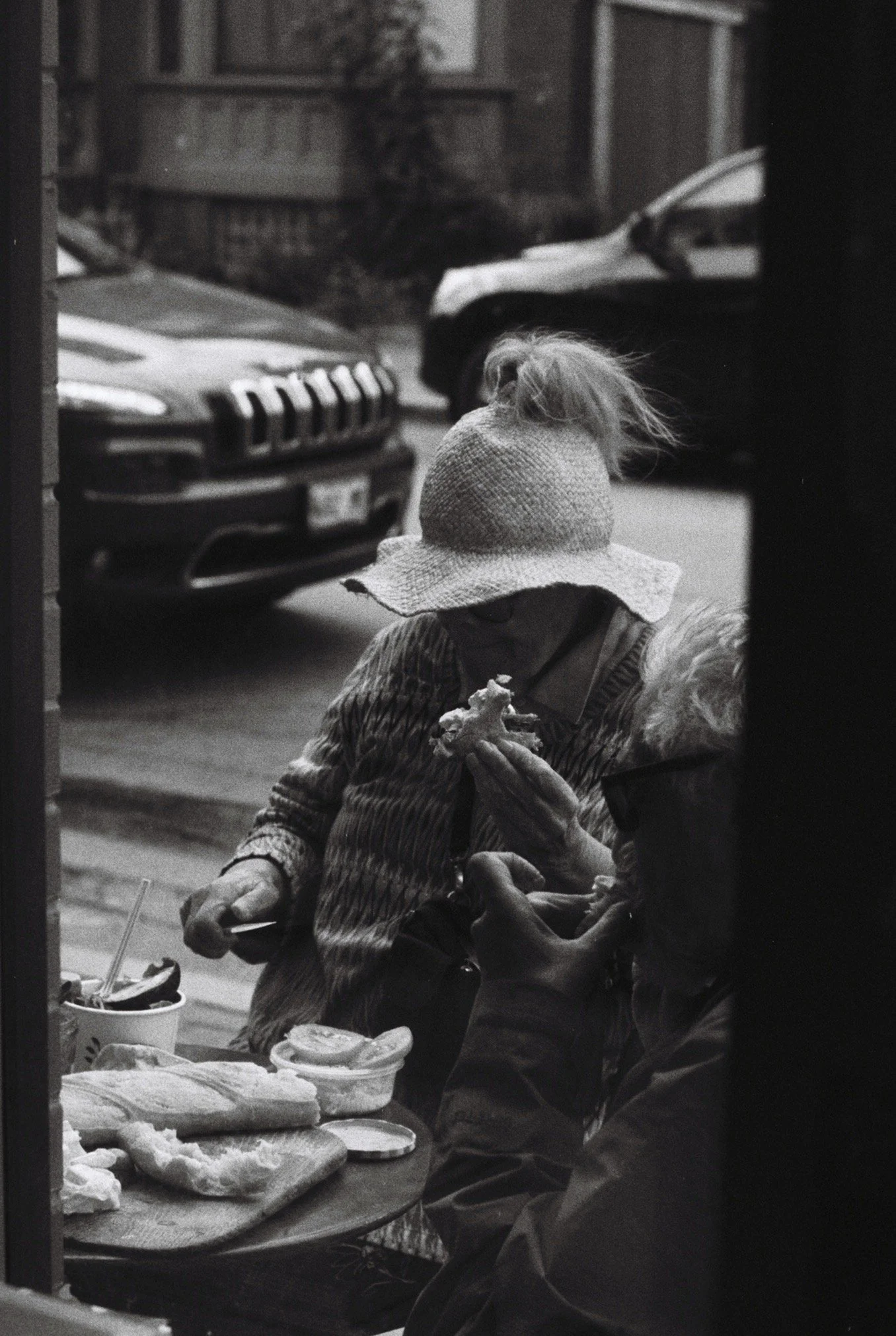
Photographer Grace Sleeman
Snail
My mother likes to repeat “when I die” phrases to me:
“When I die, make sure your sister gets this necklace.”
“When I die, this teapot will be yours.”
As if, amid my darkest grief, I will be able to look up at some stranger or family friend and say: “Where are you going with that teapot and necklace?”
As if I will be anything other than a mollusk without a shell—bulbous, slimy, pink, and vulnerable. Transformed into something ugly, something ready to be devoured, even wanting to be devoured by a predator.
I call her once or twice a week. She always answers with sounds first: rustling, a thump, running water, the beeps of a checkout lane at Walmart. Sometimes she says hello, and her voice sounds old and stale, like it was left on the shelf for too long. She hears it too and clears her throat.
“How are you?” I ask.
She always answers with what she is doing, and if it’s not a doctor or dentist appointment, it’s something no rational retired person would be doing.
“Remember how I told you a Chinese family moved in next door?”
It’s been five years. I know their names. I wish she would just say, “the next-door neighbors” already. I wish she would stop adding emphasis to “Chinese.” “Yes.”
“I’m teaching their son how to drive. He’s sixteen.”
“What?”
“Yeah, it’s going great. I mean, it’s taking a while because he doesn’t speak much English, and you know he has autism. He shouts a lot, but it’s no different than teaching your dad to do something.”
This was her life before she retired—running a community center, helping people. It was a little more structured then: giving out clothes and food, paying light bills, finding lawyers. There were a lot of knocks on our door late at night, phone calls at all hours. (“Sometimes I look at your mom and wonder if the phone has fused to her head.” –my dad, for their entire marriage.) All of the cases were sad, too sad. No one comes to a food bank because things are going swimmingly. It was mostly mothers and children, escaping things that I wished only existed in the lines of a script for a Lifetime movie.
“I’m taking this over to the center,” said my mother one evening, shoveling spaghetti onto a plate. “The girl who came this morning was kept chained to a bed by her husband.” She adds a roll, pauses, then grabs another as if thinking of this makes her want to give more bread.
I don’t ask a follow-up question because I know in thirty seconds, she will whip out the door, and I will be in the same position anyway: staring at a plate of lukewarm spaghetti that I’m sharing with a woman who has handcuff marks on her wrists.
In my teenage years, with my hormones and empathy on full blast, I had to turn up my CD Walkman to drown it all out. My headphones were always on the highest setting, my thumb always pushing on the little volume wheel even though it had nowhere else to go. I burned through several pairs. If I went deaf, maybe my mother would stay home and sit next to me and watch old episodes of Golden Girls with the subtitles on instead of going out in the world, with all the guns and cockroaches and extremely angry men who are always the murderer. “Stop it. It’s not dangerous. When I die, it will be boring. I’ll die in my sleep.” A schizophrenic man showed up on our porch one day intending to stab her, but she wasn’t home. I was home, but I didn’t answer the door. Dave Matthews Band was blasting too loudly in my ears. I didn’t hear the doorbell or the knocks. He broke a garden gnome instead. (“That was rude of him.” –my unstabbed mother.)
She’s been retired for more than a decade, but sometimes on our phone calls, it feels like I’ve tuned into a radio station that picks up outer space. I’ve reached the black hole version of her, the one without boundaries and government funding. She found a sick squirrel in the yard and she’s made it a bed in the box from her Crocs. She and dad are going to start growing a lavender farm, maybe add alpacas. What’s the association? They just like both those things. She’s called the mayor because the guy down the street won’t clean his furnace, and he’s going to blow himself up, which is his business, but some sweet little old ladies live next door with their cats and she refuses to let them explode. She’s in her car looking for the homeless woman she saw the other day when she didn’t have any cash on her. “Poor thing. Everyone has sex with her.” Any other person would say they are driving around trying to find a hooker.
My reason for calling her, if not just to check in, is typically mundane, but she acts as interested as if I am screaming from the bottom of a well or a burning house. She wants to hear what’s happening, even as someone in the background calls her name. My daughter won’t sleep at night. We decided to pull out the Japanese Maple tree because I hate how often I confuse its saplings for poison ivy. I didn’t get a raise this year at work, mom-taxed again. Or I’m baking, and I forgot what replaces buttermilk in a recipe. “Oh, I’m so sorry,” she says. Or, “Vinegar in milk or an extra egg.”
When she dies, how many years will I pick up the phone and try to call her? One? Two? All of them? “Hey, mom. You know that teapot you left me? I made some jasmine tea in it. I ordered an extra box for you, and then I remembered that you were cremated and you can’t drink anything. Now I have too much of a tea that I suddenly hate. Can you tell me, quickly while I have you, how do I get this stain out of my tablecloth? And what was my great-aunt’s name again? The one who was in the Russian dance troupe? Also, how am I supposed to be a mother without a mother?”
I try to ignore the background noise in our calls, but despite my teenage efforts, I have perfect hearing. I can tell she is needed. Her name is being shouted, or something is falling, or a car horn is honking.
“I’ll let you go, mom. You sound busy.”
“Oh, thanks, honey. Thanks,” she says, with relief.
Before she hangs up, I hear a siren. I go back to my Excel spreadsheets, my baking, my daughter’s homework: a delicate series of shakily drawn letter A’s.
*
She has a lot of “when your father dies” phrases, too.
“When your father dies, I’m going to shave my head and get a nose ring.” “When your father dies, I’m going to get a dog.”
“When your father dies, I’m going to buy whatever I want, whenever I want.” The last one terrifies me the most—the thought of her, bald and be-nose-ringed, using their retirement savings to buy everything in the Dollar Store so that she has stuff to give away, while outside sits a bright yellow VW bug, a dog yapping in the window. Dad is the cork in the bottle of her energy. If he pops out, there is no guessing how high the soda rocket will shoot. But it doesn’t matter. She will go first. With her week-long fad diets of canned string beans and rice cakes. With the cigarettes she quits only if we are actively looking for them, usually hidden on window ledges or in the drawer of her sewing machine. With her heart chambers a doctor deemed “troublesome,” as if they were rundown, about to be condemned. She once broke her arm and kept it bandaged in a roll of gauze from CVS for thirty-two days before she had it examined. They had to re-break it, and now one of her fingers on that hand has a strange bubble and won’t bend. She will certainly die first, but she may wander around for a while like her favorite person, Jesus, before any of us realize that she has already checked out of life.
I have been afraid of her death since I was old enough to understand the concept. My mother is the cushion of my existence. Especially when I was very young, if things were hard or uncomfortable, my school days sharp and jabbing, it was her that I’d settled into, her that I chose to rest against. I could bury my face in her and scream. I could press and tear and pull the feathers from her seams, but she would not come apart. An embroidered cushion, her stitching says, in neat thread X’s: “This too shall pass.” As a child, that was a comfort and also an additional fear, because if everything will pass, one day she would pass as well. And then there wouldn’t be a person to pull the blankets up around me and give me a tiny porcelain plate of Ritz crackers. There wouldn’t be a person to tell me, with the convincing tone of an actress playing Lady Macbeth, that my new bangs look fantastic. There wouldn’t be a person left who could tell me that I am good in a way that makes me believe it.
So, from the age of eight, with dogged determination, I’d interrupt her day. I’d make turkey sandwiches on white bread with the mayo spread lightly, thin enough to see through, and only one leaf of lettuce. “If I teach you anything, it will be how to handle mayonnaise.” I’d bring her food with glasses of water she refused to drink. She’d look at the water like she was a saltwater creature and touching it would make her skin sizzle. “Can you grab me a Diet Coke?” she’d say, frustrated. The Diet Cokes she’d chug.
“Why don’t you take a break?” I’d say. “Take a bath? Go to bed?” Try to live? But no, she had places to run to. Things to do. Lots of work. Like a tornado with a house to tear down, she would take two bites of her sandwich and spin away from me. Sitting alone, I would sip the water, finish the sandwich, crunch the empty can, recycle it. Now that I am a mother, I have dark daydreams about dying myself, but they only last a few seconds at most. Leaving my daughter alone in the world is a speculation that my body refuses to produce. My mind makes a few drops of it: I see my little girl in my parents’ house, growing up with the sharp points, the Ritz cracker plate that I later learned was painted with lead, the weak bookshelves ready to rip from the wall and crush her. (The fact that I grew up with these things, with splinters and blood blisters and bruises and soft poisonings and mild electrocution, and made it out alive is irrelevant to me.) I see my mother telling my daughter stories about who I was as a person, but they are wrong because they are who I was at fourteen and not who I was when I gave birth at thirty-three. I get about this far before my ears begin to buzz and the edges of my body: toes, nose, fingers, begin to vibrate. If I go too far, I will convulse. To think of my daughter at my funeral would send me spiraling in circles like the bizarrely fast teacup ride she loves at the amusement park.
I read once that a frog does not have a gag reflex, but that doesn’t mean it never needs to vomit. If a frog is sick, it throws up its entire stomach, wipes the food out with its webbed front foot, and then retracts its empty belly. When I have thoughts about my death, I can feel my stomach rising to my throat. If only it could come up and out of me so I could examine it myself, see for myself how weak it is, this thin stomach that can’t picture a future where I am not a mother to my daughter. I would wipe everything away, shudder, re-swallow it, and return to my day. That my mother can say “when I die” phrases to me with the casualness of a “sometime next week” or a “let’s get that on the books” is the defining difference between us. I picture myself saying the same words to my daughter, and they feel too serious to be said so flippantly. “When I die” is as harsh as the curse words that I now only use in abbreviation. I hear it, and I clench my jaw.
Dying is on my mother’s to-do list.
And when the death car comes for her, pulling up to her bench with the squeal of cab brakes, she’ll be looking at her watch and tapping her foot. And when she gets in, will she turn and watch me from the rearview? Will she wave? Will she shout not to forget the teapot while leaning out the open window? Or will she, as I suspect, lean her head against the backseat and close her eyes?
For all the time I spend thinking about who I will be after she dies, I rarely picture her death itself because it can happen in such a multitude of ways: heart attack, lung cancer, murder, car accident, sodium poisoning (if that is a thing). When I drive, my speedometer hovers within one digit of the speed limit. My eyes are wide, my hand motions forgiving: no, you go first. You stopped at the stop sign a hair sooner than I did. Go on, go on. This is in direct opposition to my mother, who has never driven a length of distance more than two blocks without anger, a woman who does not use turn signals because “it’s no one’s business” where she is going. When the seatbelt alert was put into vehicles, it was one of her life’s greatest annoyances. Instead of clicking the belt in place, she lets the warning scream at her, amplifying her road rage. When I was finally old enough, I started asking if I could drive—she always said no. I’m too slow.
She had a heart attack at the age of forty. I was twelve. Before the wail of the ambulance even left our block, I lay on the floor in my bedroom, curled up around the phone, waiting for it to ring and tell me she was dead.
“I’m sorry, but your mother won’t be there to teach you how to drive without a seatbelt on,” the doctor would say to me on the call. “You’ll have to learn about first kisses and periods and wedding dresses and why you should never use Sun-In from someone else. Do you have an older sister by chance?”
“No,” I would grumble. “I’m the oldest.”
“Ahh, that’s a bummer,” the doctor would say. “Welp! Gotta go. Lots of people alive over here. Buh-bye!”
I cried and slept and then woke up and made sure the phone was working and cried and slept and woke up and made sure the phone was working and cried some more. I would be the matriarch at twelve. How would I teach my sister to do the things I’d never learned myself? (My sister, my mother’s carbon copy, had also cried but had moved on to the backyard, where she was painting stones for the future gravesite.)
My mother came back ten hours later, looking tired and annoyed.
“It was nothing,” she said when I lapped at her. “They said I need to eat more bananas.” I never could ascertain if this was real advice or not, but for the next six years, until I left for college, I brought the turkey sandwich, the water, the Diet Coke, and a banana.
*
Once you stop living at home, your parents age like fruit. It’s terrifying. You leave behind a red shiny apple, and you come back for Christmas break or on holiday from your first job, and there’s a rotting lump on the floral upholstered couch. That’s our couch, that’s our living room, but who the fuck is this raisin? Why does she suddenly not know how to use the remote control? When did all of the sunscreen expire? Why is there Tylenol where the knife drawer used to be?
It takes years to get used to how shocking these time lapses are, and it’s only having a child myself that leaves me distracted enough to dismiss them. I see them, believe me—I see her making mounds of pasta salad and telling me it’s my favorite when even the smell has always made me gag. I see her confused as to why she walked into the room. I see her holding her arm strangely, the one that broke twice. But I am in my late thirties, and I have to pee and check in with the office, and someone flipped me off while I tried to park the car, and all I can do at the moment is log those details away. Later, when I’m trying to sleep, hot and uncomfortable in my old twin bed, I’ll pull them all out and study them. I’ll turn around and add them to my massive detective wall, where I have pinned up all of the clues, red string zigzagging across them. I always solve it the same way: she’s going to die. She’s going to die, and the person I know myself to be is going to be murdered.
“Come here!” she demands the minute we walk in the door for a visit. “Come see, come see.” I can barely put my bags down, my daughter needs lunch, but my mother wants me to see how she has rearranged a room. Her greatest pleasure has always been moving every item from one wall to another wall. I have never been able to recognize a difference, but I smile and say, “Wow! So different,” and I wonder how much effort she had to use to move the couch, if my dad helped her or if she just pressed her back against it, hunkered down, and shoved with all the power in her legs as I’ve seen her do so many times.
“See what I did? With the doily? Doesn’t the teapot look nice? This teapot will be yours when I die.”
*
And then she does. It’s years later, but one of her more famous lines: “When I die, I’ll be so old and have annoyed you for so long that you’ll be happy I’m gone” ends up being a lie. My phone rings while I am hanging a picture frame in my master bedroom. I answer it with my power drill in my hand, and when the tinny voice in the speaker says the words I’ve feared since I was five, I almost drill a hole through my leg as I collapse. Someone, probably my husband, puts the safety on the drill and stores it in the garage where it belongs. Someone moves me to the bed. No one hangs the picture frame. The lights go out and I remain in the same spot, assumedly while my family starves and my houseplants die and my cat scratches angrily at the door. I don’t know because I don’t know what day it is. My only concept of time is that it is too soon. I feel my bones dissolving like my mother’s Alka-Seltzer tabs in the cup by her bed. And while I shed and disintegrate, I hear her voice. It’s high and silly, like she sipped helium. She has sock puppets on each of her hands, and she’s making my sister and I double over laughing. The sock puppets she made herself, and it’s an understatement to label them as such because they are beautiful—with unique faces, eyes with eyelashes, and long braided coils of hair. The sock puppets are what I would have wanted when she died, but they were thrown away at some point. We were too old for them anyway, she’d said when I asked where they’d got to. I hear her, dismissive and honest, forgiving me for taking her jade necklace (the heirloom, the one her grandfather carried in a wooden crate from Poland to New York), and for wearing it to the school dance where the heavy beads slipped from my neck and disappeared, swept up at the end of the night with paper streamers and other trash. “It’s just stuff. It doesn’t mean as much to me as you do.” I would have wanted the necklace when she died if I hadn’t stolen it too soon.
I feel her hand on my forehead, the way it softly brushed aside my hair before checking for a fever. No fever. I’m cold, clammy, my skin already secreting an oil that will make me bitter and inedible in this vulnerable state.
I hear her say my name loudly in my ear like I have to get up for school, and that is when I slip from the bed to the floor. It’s been a week or a month or two decades. When I finally emerge, I am not a daughter anymore, not a woman, not a human. I am a wormy gastropod, fleshy, exposed, slow, weak. I am a detestable undefined creature, a slug or maybe a leech. Look at me and cringe, wonder at how I can survive with so little faculties. The transformation I feared is complete. I am motherless slime.
I am motherless slime and I have to do inventory.
I’m alone. My sister is rising from beneath a pile of decomposing leaves, and when she finally emerges from her cocoon, she will get on an airplane and fly home, but she needs enough time for her wings to erupt from her shoulder blades, for a flight to show up with no connections. My father has gone to the VFW, grabbed a glass of ginger-colored beer, and filed himself behind a stack of widowers. They sit in a row, arranged like pool balls. Crack them apart and they will scuttle back together. Aim them for the dark pocket; it’s where they want to be. None of them talk, and it is what they most like about each other.
I peer up at my childhood home from my tiny slug body and it is immense to me. Fifteen or twenty stories high and packed floor to ceiling, intangibles filling in any open space not occupied by tangibles. All of her things are left behind, including the memories of the times I shouted at her—suddenly, my memories alone. The time I told her she chewed gum too loudly. The time I told her I can’t stand it when she leaves toast crumbs in the butter. All of the times that I corrected her words. “It’s ‘good,’ not ‘well.’”
I move about her house with the pus of our relationship trailing me, every object a reminder of how I wronged her. Fresh guilt squelches from my body as I open the refrigerator or turn on the television, dragging myself from room to room. Slurp. Slurp. Here is where I didn’t listen. Here is where I didn’t listen even more. Here is where I screamed at her that she cares more about crazy people than me.
How will I sort through her belongings without working arms and legs? With an amoeba’s mind?
I won’t. I won’t. I won’t.
Where are my dad’s things in all of this? I can’t see him anywhere. When she died, he picked up his reading glasses and his laptop and the latest National Geographic, and then all traces of him were gone from the house. It’s just her. Her scribbled recipe cards with no measurements. The clothes that were only for cleaning, and then all the good ones still heavy with her sandalwood perfume. Her handwriting on the calendar. Her jumbo-sized container of cheese balls, sitting on the floor next to her side of the bed so she can reach an arm out for a midnight snack. The clock that’s too loud, each number a breed of bird, each hour a screech. The Danish cookie tin filled with needles and thread. Jars of Oil of Olay that I can smell without even opening. Her journals—untouchable, might as well be toxic waste. Tweezers. Shoes. Eyeglasses. Decorative angels, decorative angels everywhere. My childhood home is an explosion of her, bits of my mother splattered all over the walls, absolutely unbearable to look at. And there I am, invertebrate sludge, half-orphan wretch, making my way slowly, so slowly out, because (frog stomach rising) I can’t be there.
I pass a mirror but see only a sliding shadow. What am I? How will I find my borders and collect myself? And what is this numbness, this tingling where my spleen or heart used to be? I enter my childhood bedroom. I pick up the phone, the same one installed when I was ten, clear, so you can see its colorful rainbow phone guts, extra-long cord so you can evade a listening sibling. I call the doctor. The one from the heart attack.
“What is this feeling?” I ask him.
“It sounds like relief,” he answers. I can hear him clicking his pen. “You’ve been preparing for this for decades. Now it’s here. You’re relieved.”
“That’s not what it is. I don’t know why I called you. That banana thing? That was bull shit, too.”
I slam the phone down and look at it. It has a massive, curling cord connecting end to end and then another cord connecting the whole thing to the wall. My daughter has a cell phone. There is nothing to tie her to anything.
I’m dizzy. I have to be careful not to be crushed because the walls are tipping in, folding like the stacks of laundry my mother folded for decades, but they don’t smell like cotton and lavender—they smell musty and stale and rotting. I smell books kept in the dark. Dust. Something mechanical that rusted. Something that needs attention, desperately. I hold my breath. I move quietly down the stairs. I want to run, but no matter how I urge my body, it can only move in drips. Just a little further. Slurp. Slurrrrrp. I make it to the bottom, then down the hallway, but I can barely see. My eyes are slits, red and puffy. I squint and find the doorknob, but only because it is so shiny. I open the front door—just a crack.
SUN. THE SUN!
It’s too bright. I can feel it sizzling hot and revealing. It’s cooking my tender skin, roasting my eyes. I back into the hallway. I’ll be too exposed. I can’t leave like this. Slugs die in the sunlight. Thirty seconds out there and I could degrade even more. I could be confused for a cat turd. For cigarette ashes. A bit of lint. What to do? What to do? I fret and look around. Ahh, of course.
Then I remember.
I move back into the shadows of the house and find the object that I need. It’s right there on the doily.
I slip myself, a gelatinous ooze of pain, into the teapot. Firmly pull the lid on behind me. On the drive home, I don’t buckle my seatbelt. My new shell is too round and fragile. After a few miles, I forget the warning bell. After two hours, I am humming along with it.
“How are you?” my daughter asks me, when I come in the front door in my new form. My weak voice rises from the spout with a ceramic echo. I answer her in a tone just above a whisper: “This will be yours when I die.”
Sara Maria Greene is a fiction writer living outside of Philadelphia with her husband, young daughter, and a clowder of adopted cats. Her prize-winning short fiction has been published internationally and featured on NPR. Find out more about her at SaraMariaGreene.com.
Grace Sleeman is a poet and photographer living and working in Portland, Maine. Her photographic practice is focused on intimacy between subject and photographer. Her work has appeared in Koukash Review, Bardics Anonymous, and Noise Magazine, among other publications. You can find her online at @myrmiidons.
