‘Mrs Sikalala’
Mrs Sikalala¹
As with memory: there is no such thing as ‘objective’, no such thing as ‘truth’;
As with subjectivity: everything is real and none of it happened.
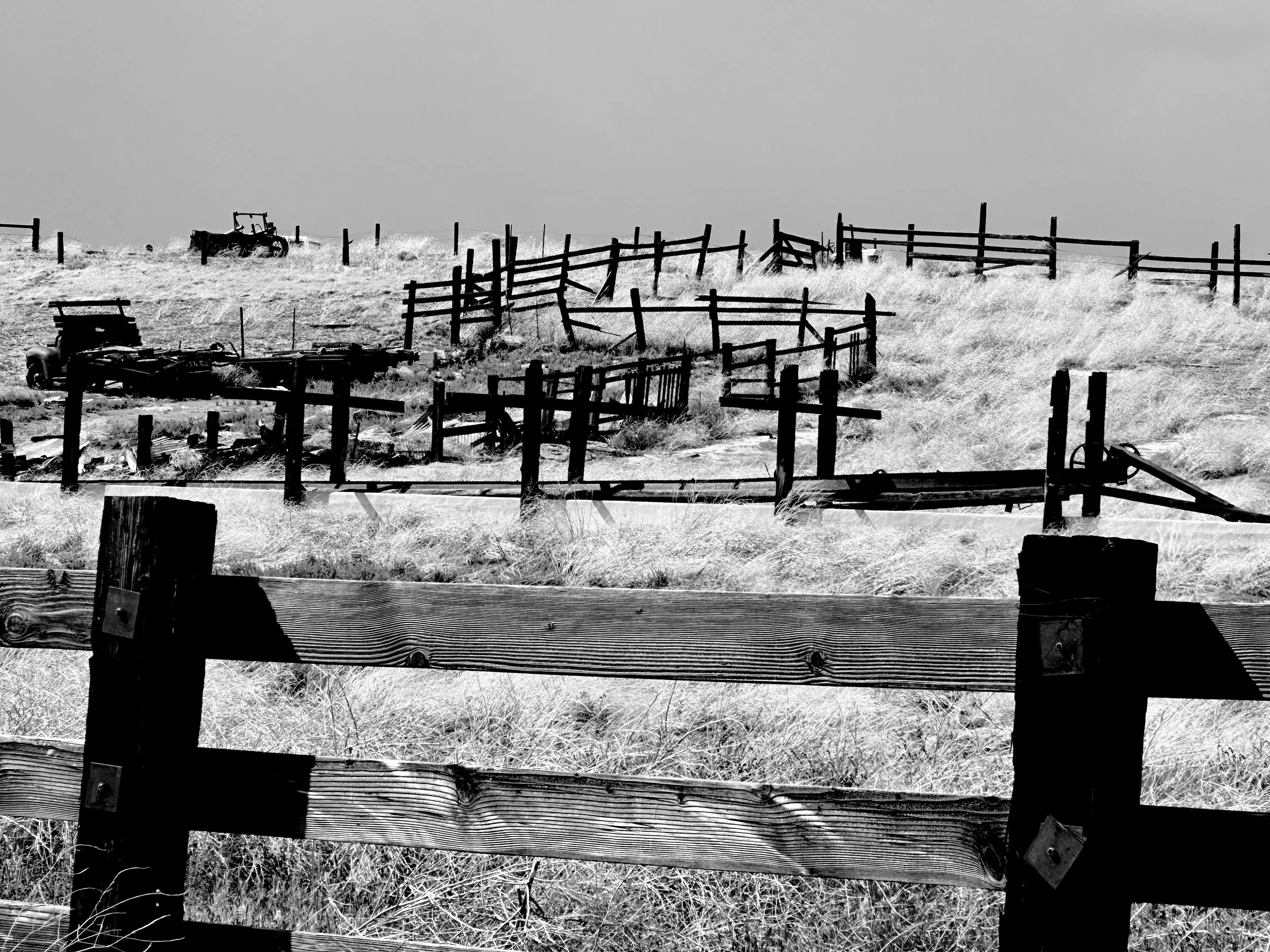
Photographer Lawrence Bridges
That morning, it is not my mamma who wakes me, but the dogs.
The cold is enraptured with my extremities—fingers pale, toes recoiling from the stretch, yearning to return to the warmth under the dyne (joyful dancing bears on the dynetrekk).
Peach-pink walls catch no light from the encroaching dawn. The window—veiled by a layer of lace and another of thick curtain—is forever shaded by the veranda on the opposite side of the glass.
Through puberty and menstruation, across the depressions of youth, I rest my head in a place that is artificially bright, barred by white painted bars that curl as vines do across every window of the house. I am to grow in a room that inhales natural light only from midday, when the sun hangs low. Usually, this is around lunch hour; the rays bisect the day like an equator does a globe then. Beams dance around the mirror of the vanity to the music of the old acacia tree swishing its leaves. The one which belonged to my grandmother, Mzimayi’s mayi (Mother’s mother). Dark wood. Both vanity and tree.
Above me, my own iconography attempts to find its way through imitation. The half-finished mural, painted in cheap acrylics, will remain as it is until the roof of our home is removed and the cats abandoned. To this day, I am uncertain if it was ever painted over.
It is here, in these ruptures of vibrant memory, that sharp claws galumph their way into my oldest room.
A warm, hot tongue licks a stripe across my face. I wave my hands out to pat the thin, long-snouted head. Pupils near purple under the ceiling fan’s fraudulent light. Energy-saving.
Thunder, a purebred Doberman trained by Mamma—who will live until he is fifteen, his last years marked by arthritis—nudges me with his wet snout. (His son, Hugo, whom I will raise and train and love, floppy ears and all, will live until he is eleven, four years less than his father—kidney failure.) Hugo follows after his father, copies the same gestures: lick, shake, nudge.
It still harrows my bones to know I will learn of Hugo’s death when I arrive home from school one day. And I will cry knowing he died alone, down by the algae-rich pond where Urungu, Garman and Dark-sided toads host their tadpole ecologies, possibly searching for me. As if a sacrifice, the year that Hugo dies is the year I leave for college. But that is still many film releases, box dyes and school exams away.
Mamma enters my memory—enters the scene. She tells me to prepare for school while she walks the farm’s perimeter with the dogs.
Mornings are so very cold. Colder than the night. We have no water heater, no pressure booster, so water trickles out thistle-sharp and freezing from the antique faucet. There’s sulphur in my soap. Targeted against acne, it says on the box. The world learns later that acne wasn’t the primary reason for added sulphur but a byproduct of skin brightening, of colourism. I brush my teeth with toothpaste that is not dermatologically tested on women’s teeth. The tube suggests closing the tap while brushing. Conserves water that way. It doesn’t mention that the toothpaste’s parent company once sold toothpaste to Asia under the brand “Darkie” (with a minstrel caricature on the logo to boot).
I change into my uniform—cotton from socks to tie. I don’t bother with my hair (it has been in braids all week, and it will be till the end of the month) and smile unexpectedly when I see my shoes from where I stand on the kitchen chair, hand on the knob of the high cabinet. The shoes are already polished. A small kindness from my uncle, who shined shoes so well they might as well have been made of obsidian. No one would ever replicate the industrious way he wielded a brush. Such frugal use of polish from the Kiwi tin. No one drank like him, too.
(Kiwi Shoe Polish is no more, but its competitor’s slogan lives on in the youth, who still tout “chunder” but not “spew”.)
Breakfast is Kellogg’s cornflakes with white cane sugar and unpasteurised milk. (Milk gets delivered each morning by the milk farm's farmhands.) There is a maze, as well as trivia, printed on the cereal box. Nowhere on the cover does it disclose the use of child labour. In 2021, an article by Lottie Limb for EuroNews will circulate under the heading: Nestlé and Kellogg’s linked to shocking palm oil abuse in Papua New Guinea; its subheading will read: An undercover investigation by Global Witness has linked the use of child labour on oil palm plantations to household brands.
Marketing. This new-age deity pushes its agendas as slyly as a grasshopper in the green. Unless you know to be still, to watch and listen, you will not notice there is a whole other order of things moving about in the fields with you.
School’s start is ushered in by queuing for assembly. Uniformity. Stand before your grade teacher, where you belong, separated by class, by gender, by height.
All children line up in front of the flag at full-mast, singing the national anthem written by the persevering spirit of “N’kosi Sikelel’iAfrika.” Sing of Pan-African liberation, but know not of Thomas Isidore Noël Sankara; know not of Communist ideology, of Black Marxism, of the fact that maps drawn in geography classes were not drawn by forebearers, nor those forebearers’ forebearers. See how freedom has erased the prefix ‘Pan-’ and replaced it with a new adage, a hyphen-free name that now stands alone.
Come: “Stand and Sing of Zambia, Proud and Free.”
Post assembly is a civics class. This study of citizenship turns all of us into a “thing”—a meeting to discuss matters of the people, for the people, by other people’s designs of civility. During this meeting, we form a caucus around the concepts of bills of rights, unanimous voting and veto power. Next is history. It is divisible as a subset. One set (A) is tribal histories. Another set (B) is colonial; frequently, these two sets intersect: ((A)(B)).
In Set A, I am graced by Mbuyu, Mwana wa Mwambwa, founder of the nomadic Lozi people. In my exercise book, I write her name whole. Mwanawamwambwa. (And if you are not nomadic, not Lozi, then she must be translated as something for the cotton in your ears to seep through, like the water of memory, so know she can become Mbuyu, Child of Mwambwa, but also know that none who speak her language call her by such a colonial dismemberment.) In Set B, I learn that our country gained freedom in 1964, on the 24th of October. It’s harder still to contextualise that my grandparents worked to help form a young, new government nearly a decade after my father was born north of the equator.
Maths is where things get tricky. Not the addition or the subtraction, but the blackboard eraser that is whacked against the tips of my fingers. My unkempt nails break. Hands shaped into an orchid’s bulb with fingers touching, I am to be disciplined for something I can’t quite remember. Tardiness, noisiness, performance anxiety, could be any of them. As I cry, my teacher makes a remark that always sounds humorous, no matter the distance of time elapsed. She says:
“Do you know the purpose of tears? They are produced to clean the eyes when foreign particulates enter past the lashes. Why waste your tears crying when your eyes don’t need cleaning? You should all learn to conserve your tears for when they are necessary. Go! Stand in the corner until you are sorry.”
By first break, I forget all about the reasons I need be sorry. Now I can play marbles and spend my tuckshop money. Except, the school tuckshop doesn’t have the spicy flavour Nik Naks I like (all MSG, preservatives and artificial colouring number 5—everything a growing body needs!), or those fresh Long John doughnuts with buttercream down the centre. A bunch of us gaggle like geese and sneak out of the school’s walled-in compound to head for Naik’s Corner Shop.
Crossing the road without supervision will eventually get us into trouble when we return. We expect as much. While outside, a man ogles my ‘maturing’ body. This steals childhood from me faster than it should. Skin crawling, I avert my gaze and ignore him, waiting impatiently for my friends to hurry along and make their purchases.
“Iwe! Mukalad!” the ogler shouts from the safety of distance. “Eh, Kazayellow, mulli che?”
I nod to be polite, but don’t engage him further by making sure our lines of sight don’t intersect. When we leave Naik’s, I’m bifurcated by having been called two separate (yet similar) racial identifiers.
Mukalad: Possibly a contraction of “muntu” (a person, often Black), and the addition of “Coloured” (a South African term for someone who is light-skinned; it doesn’t have the same racially-charged derogatory connotations found in “colored” from US history).
Kazayellow: another slang term denoting someone is light-skinned.
To that stranger, and many others to come, I was arranged by skin colour first, maturing body second and child dead last. The lightness of my skin made me an ivory bracelet. Status symbol. An arm-piece. Sawed off from the carcass of sexless youth to become an unwillingly sexualised mantlepiece.
With no air conditioning units, no ceiling fans, the rest of the school day is hot and long. Roofs are made of metal, floors of cool concrete.
I often wonder if we’d have sweat less had cement not been shipped to our doorstep with manacles and industry. I wonder what our cities would look like if we laid our skyscrapers horizontally, built them out of red clay. Would we learn of mechanics and algebra in our very own Rose City of Petra? Would the school’s administration building have protruding wooden bones like Mali’s Great Mosque of Djenné?
Wonderous wonders!
More than ever before, I imagine an African continent that bears different bones in archaeological dig sites opened far into the future.
Can we not make Zanzibar again? After all, we still build nsakas. Still make shelter.
Within the largest nsaka on school grounds, children await pickup below the roof thatch and half-walls of the bolus perimeter. I, too, spend much of my youth waiting there, never aware of the fact that I will wonder about such things as these constantly.
Mamma is always late for pick-up. When she arrives, I do not tell her about the duster cracking my nails or the fact that I snuck out of school and felt uncomfortable in my developing body. I am too excited. Home is nearer than before, and time is shortening quickly—I have homework to do and then the chores; the hours with which I can slouch and eat salted, raw tomatoes while watching DVDs from a box-set are limited.
As soon as I look at Mamma, those dreams are quashed.
Something’s happened. I don’t remember what. A tertiary death, perhaps. Then again, is death ever tertiary? Sickness. An affliction of loneliness. Whatever it is, it hooks itself to the thin skin under Mamma’s eyes, over her browbone, and pulls back her face to reveal that a shifting piece of herself is trying to hold all her micro expressions in check.
The umbilical cord we shared must not have been severed cleanly, despite my small bellybutton shape. I can tell we will not drive straight home. I will not get to change out of my thick cotton uniform or starchy socks. Mamma is asking for patience from a child without giving a reason. She doesn’t bother to explain herself when the Hilux’s indicator starts to blink in the opposite direction to the way home.
“I want to go home; I’m tired!” I whine. “Why aren’t we going home? You’re already an hour late!”
“There’s someone I have to pick up first,” Mamma answers as if she is a Sergeant-at-Arms and I am her parade-day rifle, which she gets to twirl like a baton for as long as necessary before setting it back down. She then pulls down the visor and lights a cigarette (or maybe she doesn’t light one; either way, every childhood memory is rolled in tobacco and ash to the point I feel I was born in the smoker’s area of Sykehuset Østfold HF).
“Who?” I nag, peering up from the passenger seat. I slink my arms out of my checkered blue shirt and pull it over my head so I don’t have to button it up again. The vest I wear under the uniform is light, made of well-worn fabric. I feel less stuffy with my arms exposed.
The car makes another turn and, suddenly, I know where it is we’re heading.
“Mrs Sikalala,” Mamma clarifies a second too late; revelation has already struck me.
I sigh softly enough that Mamma can hear, but not tart enough for her to be irked by my restlessness. As if a compromise was ever truly in my cards dealt, I say to the card dealer: “Fine. But can we buy nshaba on the way?”
Groundnuts. I’m bartering for roasted and salted groundnuts sold in small, clear plastic bags. Salt seems a harmless enough barter to make for time and patience; it was what our ancestors traded for.
Face weathered by the spindle-like shadows of thin shade and extended thirst from hoeing fields since dawn, Mrs Sikalala’s face is every wizened face imaginable. Mouth like a source; a source full of words to spill, with reserves to spill out even more. History is present in each tooth she is missing—molars and canines mostly, but none of the wisdoms or the incisors. Her eyes are sable-rich, deep as community boreholes. She always wore a chitenge wrapped around her head. If she had hair, I never saw it.
I open the car door and greet her in place of Mamma (who has her foot on the brake). The Hilux is banked on the shoulder of the road by market stalls made of industrial plastic sheets and wooden poles. Mrs Sikalala greets me with a smile. Calls me, “mwana wanga”. My child. Out of respect, I take Mrs Sikalala’s hand in both of mine. Conch shell cove made by young palms, I grasp a black pearl. I then bend my knees and bow my head as if I were addressing, instead of the Maharaja or the Last Shah: Amanirenas, or Al-Kahina, or Mbuyu, Mwana wa Mwambwa. (Irony is, I only knew of one of these women at the time, for the world was readily suffused to the brim with free-flowing texts from every westward corner, instilling knowledge of kings, sheikhs, shahs and maharajas; archdukes, emperors, prime ministers and at least one of every Louis and Henry.) After this salutation, I share the backseat with her. She smells of Johnson’s baby oil—glitters volcanic glass clear next to my ashy hands and chapped lips.
We three, as if a theological numerical fractal, commune in the living room once at home. The TV, mounted on Pappa’s carpentry, faces the reflection of the world beyond our windows as if a scryer’s veil. This way, the glare demands the TV—and all its illusory witchcraft—remain off during the day. Day is for exploring and cultivating, and getting sunburned. That is the time we turn over the overturned tortoise and feed maize bran to the matriarch-headed herd of sheep. But, as with breaking fasts and the re-gathering of strength needed to finish the working day, bellies full from mutton luncheons and sweet guava juice, so too are there breaks within the breaks.
Regather for the wagging of tongues.
Whispered faith and oral traditions, for the west, make a doctoral thesis, a publication. For me, it is this specific afternoon that is a blending of countless afternoons, years superimposed in the unreliable memory of the encephalon, told and retold in faith and monologue, that marks tradition.
In tradition we join together in the amphitheatre of my home (post- and pre-colonial in design), centred by the architecture of Sony, Phillips and Panasonic; in an architecture of technological hyoids and larynxes made from the dusty record player, the static music speakers, and a nervous system of cable spaghetti hidden behind the cabinet which stores Pappa’s vinyl collection (just like the lymphatic system hides behind skin and fat). For ribcages, we have a library of DVDs facing us. Titles like: Laurence of Arabia, The Secret Garden, Schindler’s List and the Norwegian-favourite Dinner for One/The 90th Birthday, which itself is mandatory watching every 23rd of December.
This is the future of the past, in all its heavyset design. And yet the future remains disconnected from the power socket. No amperage or voltage passes into insulated cables. To preserve the sanctity of what is about to take place, the future cannot progress in this moment. The machines must stop. Understand: in this time of quiet, undisturbed sanctuary is not sacrosanct; it is incidental. There is only one hydroelectric dam, the cracked and underserviced Kafue Dam, that must ignite every house’s tungsten filament in fire. Unfeasible. Load-shedding is paramount to normalcy; it is anticipated like a guest’s arrival.
Mistranslating peace for boredom, I simmer in this black-out afternoon, paring the need to do anything but remain still. Suddenly, we exhale into an oblong prayer circle. My knees are prickled by the Moroccan-style carpet. I keep my eyes trained on one of the geometric patterns laid out in beige, red and deep green. Some days, the carpet’s geometry is a Maya god come to bridge the cultural divide—come to whisper ancient stories of star mapping while I nap under the coffee table. Other days, the geometry means nothing, just simple mandalas to be mass-produced and hung up in college dorms. Rarely, the pattern bears warlike repetitions in the red, red hues. For now, it hibernates; it’s a cold July. There will be thunder and rain in a few hours. The smell in the soil is rich with this premonition.
Mrs Sikalala says, “Let’azi pray,” and Mamma squeezes my much smaller hand when she notices my eyes are not closed all the way.
Mamma makes a noise of ascent when I finally comply, closing my eyelids to make space for projections to fill the black.
Mrs Sikalala misinterprets Mamma’s throaty noise to be a signal for the practices to start. So she gives one of her own in reply; something guttural, straight from the back of an Urungu toad’s throat.
Could that have been the sound of God?
Eyes fully shut; I lean back on my haunches and hope that time flies by faster. Foolish thought. It’ll be a while before I can open my eyes and rise to my feet without causing offence, but once that moment arrives, time will soar faster than I can think to name her constellations. So fast, in fact, that I would have aged enough to roll my eyes at all theology, touting science and rational thought as evidence enough to ignore prayer, to disturb silence, and, eventually, silence mysticism. But I’d do this only when challenged. And only when my back was turned from polite company.
Mamma, anticipating this change as one that is associated with teenage tantrums, affords me new freedoms later in life. For her child to respect the faith and all who commune through it, she gives me leave to close myself in my bedroom, wear my headphones, and block out the recital of such fervent affairs.
Lo! What was once a boon is now my handicap.
I did not ever think to consider freedom a potential regret. Why ever regret the ability to choose which words I could deem powerful enough to steer my life past capsize and fortune?
In the simulacrum, freedom—choice—is often the first double-edged blade to pierce while cutting you free. The bleed is often slow, so slow you don’t notice the hollowing of your tin. (A parable loved by many of my teachers: “The loudest tin makes the most noise when it drops”.)
What I regret most is not listening.
The words. The language. They were mine. My Mamma’s. Mzimayi’s mayi’s. Mrs Sikalala’s. Ours.
Some words have stayed. They are fused to me as metacarpals fuse to the smaller bones that make the lengths of fingers. Fused again like mended bone does around a break, one which is not physical in manifestation, but there all the same. Words like “mwana”, “m’phamvu” (Mm-PAH-mvoo) and “Zantu zino”. Child. Strength. And: Us, the people, our things: yours / These things that belong to you.
Did you know the word “thing” was once the time/place for the coming together of elders to discuss matters of grave importance?
Stortinget. Folketinget. Altinget.
Big Things. The People’s Things. All Things.
“Thing” came from the Proto-Germanic “thengan” (time) and the Old English þing (assembly). What fun it must be for material possessions to now have power over time of assembly to the point they have become “things” unto themselves!
In the room from which I type, there is a camera, a mug and a notebook. Have I not traded time for the ability to afford them? Can I say for certain if the price was worth it in the end? I do not know. What I do know is that Zantu zino is not the “things that belong to you.” Zantu zino is “all that you encompass, that which is in your possession and makes up a piece of your scaffolding, remarkably unique to you.”
Other words slip from precipices. Spilt in white washes of milk, impossible to salvage unless someone else lends a bucket from their own repository of language to start a dialogue.
You speak. I speak. We spoke. And we did so in front of posterity, so now they speak:
O, marvel at how the future still remembers your colours and patterns woven in our textiles.
But without such a dialogue, languages become worse than Latin. Worse than dead. Latin may be said to be dead, but it keeps its privilege; like the privilege of preservation, emboldened by antigens of esoteric rite, which inoculate against mythopoesis. When brown languages die, there is no gravestone from which to read, translate or study. There is only word of mouth.
After prayer, we drop Mrs Sikalala off at home, near the shoulder of the road where we picked her up from. Mamma sends Mrs Sikalala on her way with enough pocket money for the week, as well as bread, milk and a bag of sugar to tide her over for three days.
When she disembarks, Mrs Sikalala blesses us, and we bless her back with gratitude. Straight from mu’mtima—from the “heart”. She hands me two packets of nshaba from a hidden pocket on her person. She does this as though she is trading a secret with me.
The time and patience I bartered with earlier is reimbursed by salt.
Through the salt of taste, I learn that the languages of my peoples—the words and mnemonics carried by an oral culture—aren’t the only thing slipping from my grasp…
The first thing that leapt out of reach was, in fact, Mrs Sikalala’s name.
Don’t misunderstand. There was a Mrs Sikalala. There had to have been. After all, the name comes from somewhere. Like Mr Phiri (pronounced: Pee-Ree), the bricklayer who built and shaped countless foundations with redbrick and clay. Or Naik’s Corner Shop. Or Mrs whatishername?, a woman of bedlam who would beg for spare change and a cigarette if you had them. But the Mrs Sikalala of this story is not actually “Mrs Sikalala.”
It hounds me that I cannot recall her name.
It was one of many things I used to know.
I used to know how to read the arithmetic of sheet music better than the keys of my grandfather’s piano. I knew how to use a multimeter from watching the electricians read the circuit breaker every billing month. I could hook the best of the bait on a fly fisher’s line while wading in the shallows of a dam with my Pappa. And I could swim in the open ocean waters without fear of drowning.
I knew backgammon, mancala, marbles and double-jump (the kind played without skateboards, but rather with a long rubber band tied around the ankles of two bodily pillars, each level of difficulty raised the bands higher, from ankles to knees, and then thighs to waists).
I knew Mrs Sikalala’s name.
What are the knowledges I have gained from trading in these things, I wonder? Inflections of a British accent? Low cadence of a Trans-Atlantic accent learned from TV? To smile and feign flattery whenever I am compared to one of the three actresses popular in mainstream media who share my skin-tone but not my pronouns? The ability to be queer in the west without fear of prosecution, exorcism or beatings, even though white man introduced a belief system in the south that prosecutes, exorcises and beats into submission those who defy these teachings?
Audre Lorde wrote, “The distortion of relationship which says ‘I disagree with you, so I must destroy you’ leaves us as Black people with basically uncreative victories, defeated in any common struggle.” She spoke of the Fon of the Dahomey, and how women of independent means married other women in the tribe. Any conceived children belonged to the independent women’s bloodline, regardless of who carried the child to term. Immoral and ungodly had nothing to do with the matter of these “things”. Don’t let a pastor tell you as much.
Such incredible histories, yet I cannot name each bartered fragment of my Self with its corresponding boon or disadvantage. What I do know is that we are all becoming too much a part of an isolating machine, one that demands we assimilate and remain isolated, all at once.
Mrs Sikalala’s lost name remains ossified in the parts of my memory she was severed from; it’s a strange trauma, knowing of a scar’s formation right as the operation is occurring.
“Mbuya,” I should call her.
Grandmother. Elder who leverages a part of my sense of self, and that of the whole urbanised neighbourhood, she connected to the past. A bastion from a different age.
The Big Thing. The People’s Thing. All Things.
___________________________________
¹ N.B: This story uses cross-stitched words salvaged from the wreckages of time. Primary dialects identifiable are plucked from the memories of spoken Chichewa, Shona, Bemba and Lozi, as well as Xhosa—spellings may not be accurate. Other words, such as Mamma, Pappa, dyne and dynetrekk, are transplanted from the much more accessible and easier to translate Norwegian language.
INDEX OF NON-ENGLISH WORDS IN ORDER OF APPEARANCE
dyne
Norwegian-type winter duvet often stuffed with down
dynetrekk
Norsk word for “duvet cover”
mzimayi’s mayi
mother’s mother
azimayi is the plural form of “mothers”/“women”
mayi is one of many iterations of the word “mother”
*N’kosi Sikelel’iAfrika
Xhosa phrase meaning: “Lord Bless Africa”
(*N’kosi or Nkosi is a name with etymological roots to Nguni languages like Zulu, Xhosa, Ndebele, and Swazi, it means “king” or “ruler”)
*nshaba
roasted and salted groundnuts
(*pronounced: n-SHA-bwa)
nsaka
a rondavel or mud hut, often with half-walls made of clay, with wooden poles structured at the centre and along the walls
chitenge
colourful traditional textile fabric sometimes called kitenge, or chitenje—they have a multitude of uses:traditional wear, baby slings, headscarves, head cushions used when carrying heavy objects on top of the head, picnic blankets, sarongs, etc. etc.
mwana
child
m’phamvu
strength; sometimes spelled: mphamvu
zantu zino
[these] *things that are yours
*things do not always denote material possessions alone
*mu’mtima
“In your heart” or “inside: the heart”
*If spelled mutima it simply means “heart”
mbuya
grandmother; an elderly woman who bore children; a title of respect.
Em C. M. Eilertsen is hook-shaped; a person bent in the form of an obstinate question mark—one that harangues everything that is set before it! They have returned to the ways of poetry and ennui following life’s fondness for doling out unexpected hiatuses. Their works have been featured (under the name Amelia Eilertsen) in Landlocked Journal, High Shelf Press, Passengers Journal, Sinking City, Temenos, and Poetry Wales. As of Spring 2024, their series of prose poems, “Transmutations of a Life Through Bodies”, was shortlisted for the La Piccioletta Barca Prize. They come from a Zambian-Norwegian background, and obtained an MPhil in Screen Cultures.
Lawrence Bridges' photographs have been exhibited at the Las Laguna Art Gallery, the London Photo Festival, the ENSO Gallery in Malibu, and were featured in the Light Space & Time Online Art Gallery in November 2025. He lives in Los Angeles.
