‘Frankly’
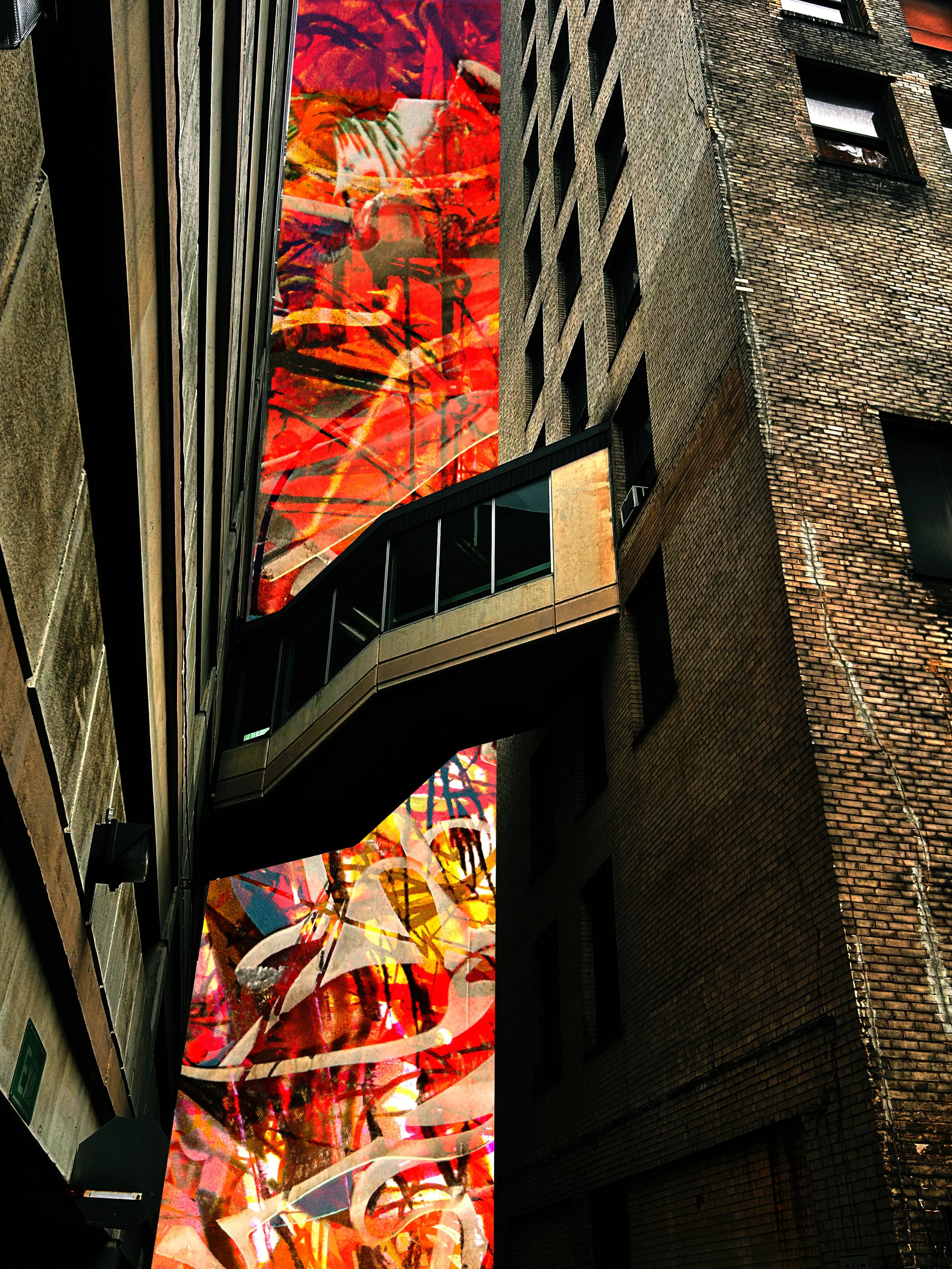
Photographer Joe Karlovec
Frankly
A neighbor of ours described himself as a futurist. I’d introduced myself to him not long after he moved into the house a couple of doors down. I was walking past the house. He was outside. “You’re the current owner,” I said.
“Yes,” he said.
“Congratulations.”
“Thank you.”
“Welcome to Temuchen.” Temuchen was the name of the borough. The borough was named after a Native American chief.
“Thank you.”
“My name’s Ian.”
“Royston.”
“Are you from the area?”
“No.”
“I’m not, either,” I said. “We moved here for employment-related reasons. My wife’s a professor.” Nearby was the campus of a public university. A number of its faculty resided in the borough.
“Of what?”
“Genetics.”
“Genetics has been a subject of debate in my field.”
“What’s your field?”
“I’m a futurist,” Royston said.
My instinct was to refrain from asking any questions. I wasn’t sure what a futurist was. The opposite of a historian? Was a crystal ball a tool of his trade? I nodded, though. I more or less feigned an absence of interest. Why? I figured I’d be annoyed if I were him and were prevailed upon to explain what a futurist was for the umpteenth time. I figured I’d spare him the obligation. I pointed out to him which house belonged to me and my wife. Not the yellow one. The blue one. I encouraged him to drop by if he ever were to need to borrow a cup of sugar or a pair of hedge trimmers or for any reason.
I bid adieu to Royston and continued on my merry way. My objective was to drop a letter in the box on the corner of West Avenue and Main Street. In front of the playground at the end of our block. The letter wasn’t a letter actually. There was a check inside the envelope. I was paying a bill. It would’ve been easier to place the envelope in the box on my porch. I preferred the security of dropping it in the box at the end of our block. I also was glad for the excuse to leave the house and add five hundred or however many steps to my tally for the day. And if I’m being honest for the excuse to take a five or ten-minute break from my work. I worked remotely. The dining room was my office. The table in the dining room was my desk. Fresh air was another benefit. It was sunny. Sunlight is vital for the body’s production of Vitamin D albeit also responsible for the majority of cases of melanoma or other cancers of the skin. At any rate I’d lucked into the opportunity to meet our neighbor. Valerie would be eager to hear every detail of my report of the incident. I was eager to deliver it.
“He’s a futurist,” I said.
“What’s a futurist?”
“I searched online for a definition.”
“Okay.”
“A futurist analyzes trends to identify a range of scenarios and assigns a probability to each.”
“A futurist predicts the future,” Valerie said.
“Not exactly.”
“How’s the world going to end?”
“With a whimper,” I said. I was alluding to a line from a poem written about a century earlier. I wasn’t a poet or an aficionado of poetry. It was one of the only lines from any poem I would’ve been able to recite. This is the way the world ends. This is the way the world ends. This is the way the world ends. Not with a bang but a whimper. “I don’t know. He doesn’t know, either. I believe he’d admit he doesn’t know. A futurist doesn’t predict the future. He monitors emerging developments. I imagine he’s assessing the risks of climate change. The prospect of a nuclear war. An asteroid impact.”
“Who isn’t?”
“I imagine he’s advising agencies of the government or non-profit organizations or corporations with regard to long-term strategies.”
“I’ll tell you how the world’s going to end,” Valerie said.
“How?”
“God’s going to destroy it.”
He told me he was a futurist. On a subsequent occasion I heard him tell another neighbor of both of ours he was a futurist. It wasn’t something he wasn’t forthcoming about apparently. It wasn’t a secret. There wasn’t any defensiveness in his tone of voice. Nor any pomposity. Unlike me Gloria peppered him with queries. Gloria lived with her husband in one of the houses beyond the playground. One day she was walking her dog. I was walking alone without the company of any animal. We converged in front of Royston’s house. Royston was on his hands and knees in the yard. Gardening. I’d met Royston and had been acquainted with Gloria for some twenty-odd years. I was the connection between them. Royston rose to his feet and ambled lankily over to where we stood on the sidewalk. He was about six feet and four inches tall maybe. Give or take. He joined the powwow and participated in it with a degree of skillfulness. His use of non-verbal cues particularly was above-average. He nodded. He smiled authentically. He touched my elbow. A few minutes later he touched Gloria’s elbow. The gesture signaled an affection for its recipient. Royston was tall. He was built solidly. His limbs were a little uncoordinated. There was nonetheless a physicality about him. He’d pat a pal on the back or grab and rub his or her shoulders. In response to prompting from her he informed Gloria he was a futurist.
Anyway she asked him what a futurist was. He was prepared. As a sort of opening gambit he provided a rote answer. Gloria wasn’t satisfied. She followed up. She asked him about his background. The origins of his passion for futurology. Whether he’d majored in it. Whether he’d been trained formally. The path and arc of his career. Whether he’d found it rewarding monetarily or otherwise. Every question she asked him was something I’d been wondering about privately. I was glad she wasn’t afraid to be nosy. He wasn’t put off. He explained there was a graduate-level program at the University of Hawaii. The director was quoted in an article about the birth rate projections of the world’s largest economies. Royston happened to be researching the effects of changes in birth rates on labor markets. He’d majored in economics. He’d landed a gig as an associate fellow at a public policy institute. He saw the article and was intrigued by the director’s affiliation. He contacted the director. A correspondence between them ensued. And the rest was history Royston quipped.
I departed from the encounter with a fuller sense and understanding of what a futurist was. In my mind I was turning my attention away from the nature of his occupation. I wasn’t hung up on his qualifications either. More and more I was curious about his vision of transformative disruptions with a significant likelihood to occur in the years and decades ahead that’s all. Years and decades and centuries and beyond maybe. I wasn’t sure about the length of the horizon he typically concerned himself with in his forecasting. At home later I relayed to Valerie an almost verbatim account of the whole, entire exchange.
Was he any good at his job? That’s what I wanted to determine. Was futurology a bunch of horse manure? Or was it legitimate? Was he legitimate?
We invited him over for dinner. I told him Valerie wished to elicit his opinion on something or other vis-à-vis genetics. Genetic engineering. Editing. Something. Genetic enhancement maybe. I pretended I wasn’t sure. Which wasn’t untrue. I knew furthermore Valerie would be happy to debate in favor of or against genetic enhancement. Either. Valerie was open-minded on many issues. Although there were exceptions. Royston accepted.
He brought a bouquet of flowers. Valerie made a fuss over them. Their beauty. Their color and fragrance. I knew she was acting. She hated flowers. Only because she wasn’t sure how to be responsible for them. And lacked any desire whatsoever to learn. And felt awful when they died as a consequence of her neglect. I retrieved a vase from the hutch in the dining room. I’d tidied up the dining room in anticipation of our company. I’d stuffed my laptop into a backpack and hid the backpack in the master bedroom. I knew the door to the master bedroom would remain closed throughout the duration of the evening because whenever there was a guest in the house Valerie always closed it. As a matter of privacy. Also to avoid being judged on her domestic competency. There were piles on the floor. Piles of clothes. Piles of books. The master bedroom was on the first floor of our house. If the door were left ajar there would be a line of sight into it. A guest moseying down the hallway en route to the powder room would be afforded a glimpse. The pile of clothes was a pile of clothes we were intending to donate. Valerie was planning to schedule a pick-up. It was one of the items comprising her to-do list. I knew her well and vice versa. Valerie offered Royston a beverage and told him the choices were wine and water and diet lemon-lime soda and coffee and apple cider from a local orchard. To her delight it was apple cider he picked. She poured it into a mug, heated it in the microwave and added a quill of cinnamon. We decamped to the living room for a prelude of casual hobnobbing and drinks and light nibbles prior to the sit-down meal.
We’d invited Melody too. Melody was one of Valerie’s colleagues in his department. She was sipping a glass of botanical seltzer infused with tetrahydrocannabinol. Which she’d brought. Her contribution. She’d brought a four-pack. On her way over Melody had stopped at a dispensary. There was a drive-thru lane. It was fast and convenient. She’d arrived before Royston to assist Valerie in the kitchen. They’d assembled a version of lasagna with white, creamy béchamel and spinach, which was bubbling in the oven. Melody had filled a glass with ice and a wheel of orange and the contents of one of the cans. The other cans were in the refrigerator. I’d noted the fact Valerie hadn’t mentioned to Royston their availability. Wine she’d mentioned. Weed she’d omitted from the menu. I’d noted the decision and felt it reflected a vestige of traditional, waning mores. I was a little embarrassed. I would’ve aspired to convey the impression we weren’t behind the curve.
Royston settled into one of the armchairs. I inhabited the matching armchair. We were facing Valerie and Melody, who were on the couch. Between the armchairs and the couch was the coffee table. On the coffee table was a platter of crudités and dip. Now and again I leaned forward and grabbed a radish or a tomato or a floret of cauliflower or broccoli. A vegetable to munch on. Royston admired the lamp next to him. It was an antique floor lamp. Freestanding. Valerie told him we’d purchased it at a garage sale. Royston asked her whether it was brass-coated. Valerie confessed her ignorance. She guessed it may have been manufactured in the 1950s. I leaned forward and grabbed a bell pepper. The conversation wasn’t flowing in the direction I wanted it to. Be patient, I thought to myself. In due course we’ll delve into holograms and robots and so forth.
My anxiety worsened as we went further in reverse. Melody asked Royston how he was acclimating to life in the borough. He spoke in positive terms of the vibrancy of Main Street, of the shops and restaurants. Valerie said it had undergone revitalization. Apartment buildings had been popping up. Which led to a tangent about the size of the population. Which was increasing. Which was straining the public school system. At this point I was optimistic we’d dive deep into the implications going forward. To my chagrin Melody interjected again and said once upon a time all of the boys and girls in the borough had attended a one-room schoolhouse. Which led to a tangent about the olden days. The days of yore. There was a cemetery in the borough in which veterans of the Revolutionary War were buried. And before the Colonial era Native Americans had been stewards of the land for millennia of course. Valerie had attended a lecture at the library. They spoke a dialect of the Lenape language. The men hunted and fished and the women foraged for berries and nuts and roots and tubers.
I was quiet. Not one of my finest, greatest qualities was a tendency to become pouty and sullen. I leaned forward and grabbed a stick of jicama. I inspected it for a while. Making a show of my disengagement. I bit into it. It was crunchy. I succumbed to my penchant for passive-aggressive behavior and grabbed another and tried to interfere by eating noisily. Valerie and Melody were holding forth on the geology of the region. Layers of sedimentary rock had accumulated during the Triassic period. Indulging in such intellectual digressions was routine for them. For us. I was wont to spout off on topics far afield of my expertise too.
Before he arrived Valerie and Melody had been boiling the noodles and whisking the all-purpose flour and butter and milk and seasoning the sauce with salt and nutmeg. I was in the dining room, which was adjacent to the kitchen. I wasn’t eavesdropping. I was within earshot though. I’d heard or overheard Melody ask about Royston’s status. “I’ll find out,” Valerie said. “Do you want me to?”
“Depends.”
“We need a code word.”
“Racism.”
“No.”
“Why not?”
“It must be a word you seldom use.”
“It is,” Melody said.
“Seldom, for example.”
“Are you implying it isn’t?”
“It was on the tip of your tongue,” Valerie said.
“I resent the implication,” Melody said.
“Propellor.”
“Go to hell.”
“The code word is propellor,” Valerie said.
“I resent the implication,” Melody said.
At any rate the code word was propellor. It had been prearranged. I wasn’t in cahoots with Valerie and Melody. I was in the loop though. I was privy to the workings of their scheme. But by the time the pan of lasagna had been baking for an appropriate duration and the timer had beeped three times in succession and the dish had been removed and allowed to rest and a spatula had been deployed to plate a serving each for Valerie and Melody and Royston and me and we were in the dining room enjoying forkfuls of pasta al forno and the pleasure of a social interaction I’d forgotten all about the code word. “I wonder whether racism will continue to bedevil our nation in the future,” I said out of the blue.
“Every nation,” Valerie said.
“Wonder no more,” Melody said. “Spoiler alert. Yes.”
“Your turn,” I said to Royston.
He dabbed the side of his mouth with a napkin. He frowned and appeared to concentrate for a moment. “Pass,” he said.
“A penny for your thoughts,” I said. I dug into my pockets for a penny or other coin. My pockets were empty except for my Android and an accretion of fibers and dust. Lint was about as valuable as a penny. “I’ll be indebted. What sayeth thou, Roy? Is it hopeless to dream of a society free of racism?”
“Pass.”
“C’mon.”
“Do you watch football on Sundays?”
“Religiously.”
“I don’t,” Royston said. “I was at a conference not long ago. I was at a bar in the lobby of the hotel. A game was showing on the television. I happened to notice there was a phrase stenciled on the white line underneath the goal posts.”
“End racism,” I said.
“Bingo,” he said.
“Are you suggesting it isn’t hopeless?”
“Define hopeless.”
“A zero percent chance,” I said.
“The distribution of the odds ratio would be skewed to the right,” he said. “Log- and back-transformation to normalize the data would be justifiable statistically. Is this what you want from me? Do you want me to speak in jargon? Is it technical enough? Is it insider-y enough? Let’s skip the math, Ian. Without any proof I’m confident asserting the chance is equal to or greater than zero percent. One or the other.”
“In other news,” Melody said. “Did you see the video of the ship pulling into the harbor and accelerating out of control and crashing into the dock? Its propellor was damaged.”
“I saw it,” Valerie said.
“I think I saw it,” I said.
“I saw it,” Valerie said. “It was a miracle there were no fatalities. Its propellor was damaged, Mel?”
“I don’t believe in miracles,” I said.
“Quit derailing,” Valerie said to me. “Another piece of garlic bread, Roy? Roy or Royston by the way?”
“I’m stuffed,” he said. He mimed a motion of rubbing his belly. “Everything’s delicious. Thank you, Val. Royston was my mother’s maiden name.”
“You’re welcome, Royston. It was a team effort. Truly. I cooked. Ian neatened. Thank you, Ian. Do you live with any roommates, Royston?”
“No.”
“There’s something to be said for flying solo. Independence. Freedom. Nobody to divide chores with on the other hand. Pros and cons.”
Valerie excused herself. Melody followed her into the kitchen. I stayed behind. Roy stayed behind. I’d resolved to call him Roy notwithstanding any guidance to the contrary. I wasn’t sure why. My motives often were obscure. Even to myself. Especially. We were immobile in our seats. Lumps on a log. We heard the jangling of dishes and cutlery in the sink and the faucet running. Why was the faucet running for fifteen or thirty seconds? To generate background noise I presumed. Above which they were joking and laughing. Ostentatiously or excessively. Exaggeratedly. It seemed a performance intended for our consumption. I wasn’t fooled. During lulls they were whispering between themselves I presumed. “Melody’s laboratory focuses on the development of model organisms,” I said to Roy. “She’s fortunate. Her multi-year grant hasn’t been rescinded by the regime.”
“Regime,” he said.
“Administration.”
“Are you backpedaling?”
“Are you a supporter of our evil president?”
“Google me. Enter my name into a database. It’ll reveal which campaigns I’ve given money to.”
“You’re entitled to your leanings,” I said.
“Leanings,” he said.
“Valerie’s open-minded on many issues,” I said. “She draws a red line at federal funding for basic science. It’s personal.”
“All politics is personal,” he said.
How’s this story going to end? There are permutations in which a romance blossoms between Roy and Melody. And there are sub-permutations in which they live happily ever after and sub-permutations with much, much darker outcomes. There’s a permutation in which I call him Roy and he punches me in the nose. There’s a permutation in which he comes over one day and asks to borrow a drill or saw or wheelbarrow. A permutation in which Gloria’s dog defecates on Royston’s lawn and Gloria neglects to pick up the waste even though ninety-nine times out of a hundred she would but in this instance she realizes her supply of bags is depleted and while she’s returning to her house for a bag Royston steps in the waste and while scraping the sole of his shoe with a twig becomes infected with a roundworm and weeks to months later begins to manifest symptoms including breathlessness, coughing and wheezing and years later loses vision in one of his eyes due to larval migration to and persistence within the retina. There’s a permutation in which one day I’m walking past Royston’s house and discover a lawn sign for a third-party candidate with a down-the-middle platform.
I don’t know.
I don’t know if it will end frankly.
Pete Riebling received a BA in English/Creative Writing from Emory University and an MFA in Creative Writing from George Mason University. His work has appeared in BirdHouse Magazine, Bookends Review, CafeLit, Cosmic Double, Dead Mule, Flash Fiction Magazine, NiftyLit, Ocotillo Review, and Quibble.
Joe Karlovec is an interdisciplinary artist and writer based in Wilmington, North Carolina. His work explores the metaphysical power of vernacular architecture through its historical, mythological, and sociological context. He has spent the last 10 years developing a nomadic style studio while living in Ohio, Florida, South Carolina, and now North Carolina. Karlovec currently works as the Facilities Coordinator for a museum where he manages the preservation of three historic buildings. His new video work will debut in Korea at the Czong Institute of Contemporary Art in 2026. His work explores sociological frameworks of struggle and survival under late stage capitalism through the lens of vernacular architecture.
