‘Zebeezadeel’
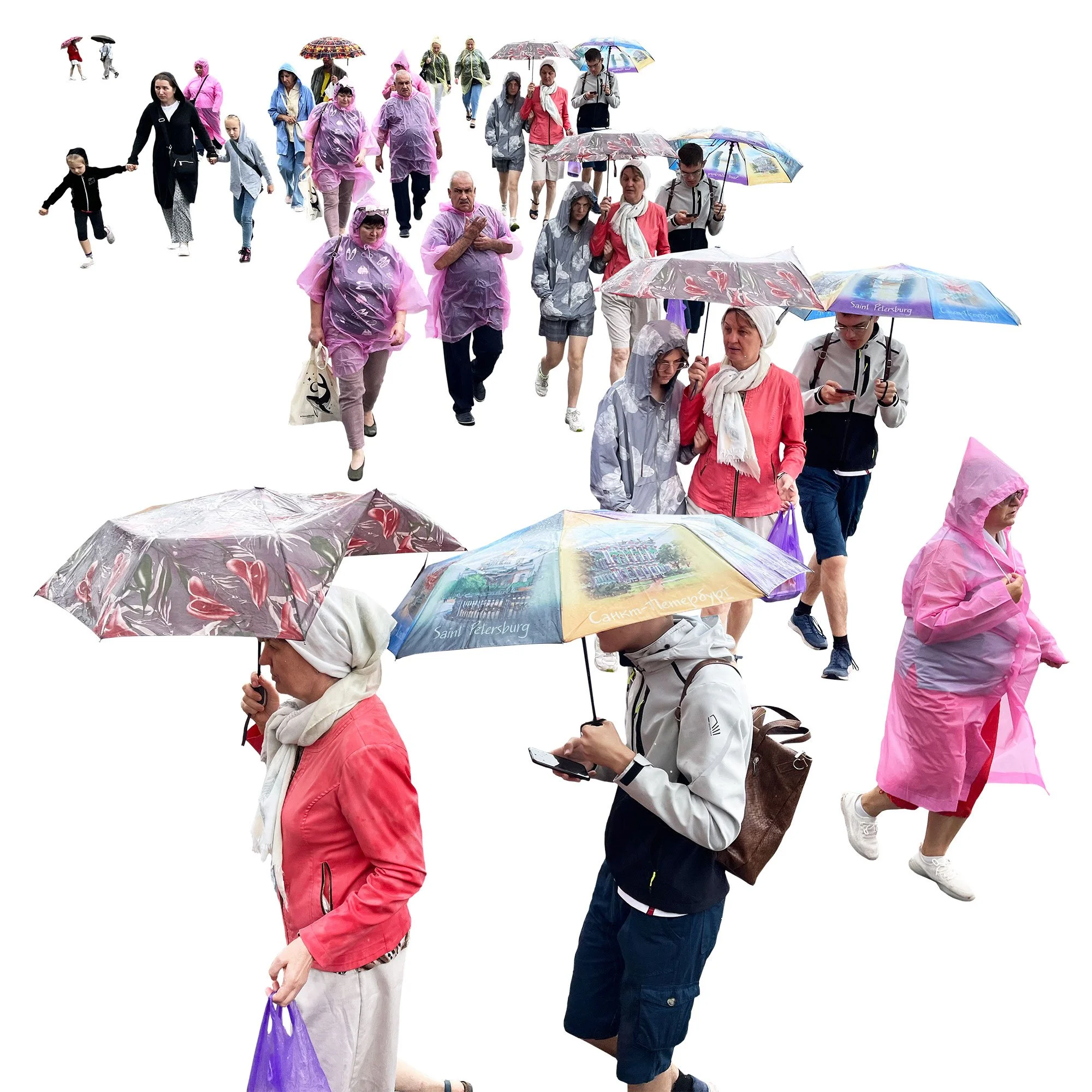
Ni Petrov is an artist whose work examines the complexities within everyday situations and the overlooked patterns of urban life. Working from candid moments, he employs digital manipulation, introducing cut-outs, glitches, and pixel distortions, to transform familiar scenes. This approach foregrounds themes of isolation and considers how digital overlays shape contemporary perception.
Zebeezadeel
Bram hears so many voices. He leans back, hands on hips, face upturned to accept the caress of the autumn sun, and listens to the traffic voice—the roll of tyres on tarmac. He breathes the ozone and vibrates with bliss. Existence occasionally brings a surge of unbound cheer and contentment, a delicate mood that’s difficult to maintain. He must make the most of it.
Coming up to noon, the day gets into its stride. Bram takes in the passersby and shopfronts. No question of cowering, not in his current state of exultation. He lays himself open to every sensation. Fried onions, the words dance in his head. He hasn’t eaten, not that morning or the evening before or the day before that. It could be two or three days since his last meal. If that’s the case, he should be hungry.
A woman inspects the display in the window of a butcher’s shop. She moves from side to side, swaying as if to get a better view. Bram is repulsed by her saggy face, her eyes full of sausages and pork chops and slimy liver. Impossible now to imagine eating, not even a morsel of the crumbliest pastry. He crosses the street to get away from the woman’s liver-eyes.
“What will I do with myself?” Bram says, not caring who hears him. “What should I do when my brain is chock-full of ideas?”
An aged couple shuffle in front of him. The woman has her hand in the crook of the man’s arm. It irks Bram, having his progress impeded by these oldies. He tries to pass them, but there’s not enough room. They’re killing what’s left of his magnificence.
“Damn it to hell. Can’t I be allowed to hold onto a shred of hope?” Bram squeezes his hands into tight fists. “I’m not putting up with this.”
He pushes past the oldies, ignoring their protests, and picks up the pace.
“Wait a minute. I can’t let them get away with that. Who are they to complain?”
Bram turns, and waits. The aged couple pull up in front of him. She, spongy cheeks, white bouffant and glasses. He, liver spots, bald and creased. Bram affords them his friendliest smile.
“What’s wrong with you?” she demands.
Bram extends his arm, and bows at the waist. “Zabeezadeel.”
The woman waves her hands, shooing him away. They continue their slow shuffle. Bram follows on tiptoes, gesticulating and gurning so hard his face aches. This is getting him nowhere.
He turns and continues in the opposite direction. People are watching him. His skin prickles. His guts grow heavy. A small dog, brown and skaggy, sniffs his shoes. A man leans out of a second floor window. Bram hurries on, pumping his arms and striding with apparent intent.
Five minutes later, he enters a shop and asks for directions to Second Street. The shopkeeper has a squint.
“Come with me,” he says.
The shopkeeper leads Bram back outside, points in one direction and launches into a complicated sequence of turns and junctions, bridges and underpasses. Bram is impressed by the excessive detail and feels beholden to the man and his squint. He must offer something by way of recompense.
“Zabeezadeel.”
Bram rushes away as though late for an appointment on Second Street.
“Nice day,” he says to passers-by.
He gets no response. Not everyone is as accommodating as the shopkeeper. Unless, of course, the man with the squint expected Bram to buy something in return for his directions. He can’t remember what the shopkeeper sold. Maybe wallpaper or staplers or possibly maps, which would make sense.
It’s just after noon. His sense of being watched has dissipated but not gone completely. Groups gather in the street.
“All these people, grinning and dancing through life without an apparent care. But look closely, and you’ll see their uncertainty. Coddling themselves, hiding from disappointment. Keeping a lid on their nasty thoughts, envy and spite.”
A pigeon pecks at a discarded cigarette butt. Bram rests against a lamppost. His head is crammed with thoughts like bubbles squeezed and ready to pop.
“Maybe there are others like me.” He examines the oblong light extending from the lamppost. “Standing under a streetlight. In Smirsk or Addis Ababa or Bogota.”
Wisps of cloud hang in the harsh blue sky. These others, at this moment, in Smirsk or Addis Ababa or Bogota are looking up at the sky. At the same sky or a different segment of sky—the sky they know. In Smirsk. In Addis Ababa. In Bogota.
“Is Smirsk even a place?” Bram scratches his chin. “Of course it is, a city at the foot of the Caucasus. And Addis Ababa and Bogota—they’re places, cities. Smirsk, Addis Ababa and Bogota.”
Bram continues walking, and thinks of the shopkeeper and the aged couple and the woman with liver-eyes. He recalls earlier events with an amazement bordering on admiration. His head is too full of thoughts. There has to be space in order to think. Like a lift with too many passengers, twelve instead of ten and exceeding the limit. Or exceeding the weight, too many fatties and sixty excess kilos. If you exceed the limit, the lift won’t move, immobile and no longer serving the purpose of being a lift. Same thing with thoughts—too many and you can’t think.
He must recapture his prior bliss. That lightness and clarity. That alien expectation. But such bliss can’t be manipulated. Maybe he should return to the shop, and the man with the squint and his selection of maps. Who knows how many secrets his shop holds? Strange maps and documents brimming with new ideas and crucial unknowns.
Bram goes into a bar, orders a vermouth and takes it to a window seat. A codger in a suit, shiny at the elbows and knees, joins him. They sit in silence.
“Are you from here?” Bram asks.
“No, I’m in from the country. I’m getting the two o’clock bus. I came into town to buy a shirt and pay my electricity bill and arrange for two masses to be said and…”
Bram raises a hand. “Stop talking.”
The codger goes quiet.
“This drink is very refreshing.” Bram points to his glass. “Beevil juice, made from the beevil berry which is native only to an area of two acres outside Bogota.”
The codger nods and smiles.
“So you think that’s funny.” Bram leans forward. “I live in a single room with a ceiling that is forty metres high. The floor is carpeted with moss. The walls are hung with tapestries from the Ming dynasty.
The codger continues smiling and nodding.
“I raise aphids and train them to compete in races held in a stadium in Addis Ababa. The winner receives blocks of vanilla ice-cream. I can speak eighty-two languages. One of the languages contains a single word. It expresses everything that needs to be expressed. Do you know that word?”
“I don’t.”
“Zabeezadeel.”
The codger slaps his knee. “The thing is,” he says. “I believe everything I’m told.”
Bram watches him drain his glass.
“I have to catch my bus. Before I leave, let me tell you about my neighbour who’s the smartest man I know. I think the likes of you will find it interesting.”
Bram taps his fingertips on the table. The likes of you—the audacity of this old fool.
“Every night before he goes to bed, my neighbour forgets everything he knows. That way, he starts the day with a clean slate. He gets up first thing to milk the cows and has to come up with a name for cow, a new name each time. Milking them feels like an adventure because every morning is a first time. Spreading manure is as wondrous as seeing the stars at night. My neighbour says names and objects are what you make of them. Forget the words, and start again, and everything is new.”
The codger leaves. Bram is empty, hollowed out. Drowsy, he reclines in the seat, his head flopping.
The barman prods him. “You can’t sleep here.”
Bram rouses himself. “Of course not. I’m just resting my eyes.” He stands and looks at his watch without registering the time. “I have an urgent appointment.”
He leaves the bar, eyes on the ground. Shrouded in sentiment, Bram oozes poignancy. He should have been kinder to the codger and the barman should have been kinder to him.
“That’s what it comes down to—an endless sequence of unkindness.”
Bodies push past, annoyed tutting and the clickity clack of metal heels and flippity flap of rubber soles on concrete. Bram steps aside to let the human river flow unimpeded. Above him, seagulls wheel and glide. Below him, beetles and ants come and go, planning or not planning or planning to the level of their ability. Maybe jeering and mocking other beetles and ants. And below them, microorganisms and the world of protozoans and amoebas with their amoeba ways.
His body turns cold, a frigid hand twisting his intestine. He goes down a lane and bends over, one palm pressed against the wall. Stomach heaving, he retches but nothing coming up, not even a trickle of bile. He hasn’t eaten in so long there’s nothing to vomit. Nothing but the impulse to vomit. Teary-eyed from the effort, he straightens his back and takes a deep breath.
“Not good. I’m not in good shape.”
He exits the lane, and passes a fruit and veg shop with a display of plums and cauliflowers and potatoes. He could take a potato just for the hell of it. But Bram is no thief, that’s beneath him. The concept of honesty fills his head, bursting through his ears and nose and eyes.
He continues walking. “Of course,” he says with each step. “Of course. Of course.”
Does he have his wallet? Yes, it’s there, in his trouser pocket, square and solid. What about his keys? He puts his hand in an inside pocket and pulls out a slip of paper with four numbers in his handwriting. They mean nothing to him. Too short to be a telephone number. Maybe the bank machine number. He has a pneumonic for that: high, zero, low, in-between. He can’t remember the first number. Without high, he doesn’t know low or in-between. All he knows is zero.
He finds his key-ring in his handkerchief pocket. So, his keys aren’t lost or haven’t been stolen by a pick-pocket. That wouldn’t have surprised him. Maybe the doors that the keys open have been stolen. That wouldn’t surprise him either.
If only night would fall and enfold him in darkness.
“Owls.” He imagines unblinking owl eyes and twitching feathers. “How good it would be to perch on a tree top and screech like an owl.”
A burst of elation, but nowhere near bliss. A sign nonetheless that he’s ready for a new experience. He stops at a postbox, his hand resting on the cylindrical round cap. Next delivery at 9:00 am. Useless information; no one writes letters anymore.
Bram is going to die, he’s convinced of it. Right this minute. He stops a woman on her way into a launderette, a wifey with a tea-cosy hat plopped on her head.
“Do you realise I am dying?” he asks. “Here and now.”
She looks at him, her eyes wide as saucers.
Bram laughs, then starts singing. “My poor weekins, my poor wee weekins.”
The wifey turns left and right, desperately seeking assistance. No one takes any notice. She sidles away from Bram.
What should he do next? Continue walking? Surely he can do better, try harder. He used to be more adept at this business of being.
“I don’t see any future in it,” he tells the sky. “I don’t have enough patience to hold out. Or maybe I have an excess of patience. The thing is that this is almost unbearable. But there’s a sliver of bearability, which has taken me this far. That and the distraction of thinking. If it had been simply unbearable I’d be done with it by now, thinking or not.”
He approaches a traffic warden in a stiff brown uniform. The warden is checking the registration of a parked car.
“What do you think of the weather we’re having?” Bram asks and doesn’t let the warden answer. “Can you feel the nip in the air, the redolence of autumn? Before too long it’ll be time to stock up on firewood and fire-lighters and coal. Maybe a new brush and pan. The accoutrement of the fireplace.”
A young woman smiles at him as she walks past. Bram leaves the traffic warden and follows her. He is enchanted by her long auburn hair, her elfin boots and the button on the back of her suede coat. His eyes moisten, touched by the generosity of her smile. He imagines sitting with her and conversing over coffee or a glass of beevil juice, nothing too grandiose. When she stops at a cross-walk, he asks if she is free to join him.
“No,” she says. “I must look after my mother who is elderly and infirm.”
She crosses the road. Bram walks beside her.
“There’s a lot of that,” he says. “I’ve heard of an entire street, if not an entire borough with elderly and infirm mothers that must be looked after.”
The woman sighs, and brushes a strand of hair from her face.
“Do you have siblings who can help?” he asks.
“Yes, but they don’t like our mother. She’s demanding and ungrateful.”
They continue walking, Bram acutely aware of her presence, her slightly upturned nose and fragrance of milk and pepper. Why is she putting up with him?
“Zabeezadeel.”
“What does that mean?” she asks and smiles.
Her eyes are like dancing lights. Her mouth is a little too large or her nose is a little too small. She exudes ease like a beautiful fever. Not crude or curious, but a pure humanity that fills him with excitement. She is not complicated, but he will never find out.
“Nothing for you to worry about,” he says. “I say zabeezadeel as a goodbye.”
The cracks in the pavement form the outline of a face with a pipe. The young woman is long gone. Why did he let her go?
The door between two shops stands out. A stout blue door, a door of character—they don’t make them like this anymore. The door needs a wash, the bottom third spattered with mud. A brass plate bears the number seventy-three. An excellent number, the only number it could be; indivisible except by seventy-three. Bram will always remember that this door is numbered seventy-three.
“Isn’t it strange how an unrelated detail clings to a tragic event? You see a poor sap run over by a bus in the street and then you notice a white cat sitting on a wall. From then on when you think of that accident or any accident, you picture a white cat. If ever I think of this day, I will think of number seventy-three.”
On he goes, past shops and restaurants and other doors with numbers. An individual covered in badges and stickers hands him a flyer.
“Vote for Councilor Cuffe.”
Bram studies the flyer which is dominated by a photo of Cuffe—bulbous head, flat nose, and a wart above one eyebrow. A vote for Cuffe is surely not a vote wasted.
A billboard mounted on the gable end of a building displays a poster with the same photograph of Cuffe, a hundred times larger than the flyer. Maybe Cuffe is inside the building. Bram could go in and ask him what he thinks about the number seventy-three. A man in a black suit stands under the Cuffe poster. He is half the size of Cuffe’s head. Bram goes over to him.
“Cuffe is a handsome man,” Bram says.
The man in the suit shrugs.
“What is your opinion of the word fellitons?”
Nothing from the man in the suit, apparently not the talkative type or he could be hard of hearing or mute.
“It may be something that interests Cuffe. Next time you see him, you should say, Councilor Cuffe, we must address the fellitons. See what he makes of that.”
A good word, fellitons, but no zabeezadeel. Bram tightens the belt on his trousers by one notch. He has lost a lot of weight.
“I must keep moving. No giving in to inertia.”
As he walks away from the building, he thinks about Cuffe. In his mind Bram sees a small animal, a squirrel or a hamster, nibbling constantly, gnawing mercilessly.
Walking, more walking, across a street, drawn to a green frontage. Everything is green: the wall, windows and a sign that reads, Bookmaker. A picture at the entrance shows a jockey in shiny green silks, green cap, green saddle, green grass and green fences. The two os in Bookmaker appear strange, too close together. The B also is peculiar; such a bizarre letter. The whole shebang is strange, alphabet and words. Book, why not Beak or Dand or Rxgv? Maybe Bram should find out where the codger lives and talk to his neighbour. They could discuss words and meaning and non-meaning. Zabeezadeel.
Metal trays in the window of Jos. Mellis Fishmonger are packed with ice. A square of cardboard taped to the window reads, Fresh North Sea Cuttlefish.
Somebody beside Bram says, “Not very appetising to look at. Those eyes, and that gaping mouth, and tentacles.”
“Otherworldly,” Bram replies, “the stuff of nightmares.”
“Braised in red wine and served with capers—a magnificent dish.” The unknown figure kisses his fingers. “You do realise that the cuttlefish bone is actually a shell.”
“Like I said, otherworldly.” Bram walks away from the know-it-all.
Mark Keane has taught for many years in universities in North America and the UK. Recent short stories have appeared in The Sunlight Press, The Interpreter’s House, Foofaraw, Inlandia, Paris Lit Up, Prosetrics, Twin Bird Review, For Page & Screen, Shooter, untethered, and Night Picnic. He lives in Edinburgh, Scotland.
