‘Winsome Spirit’
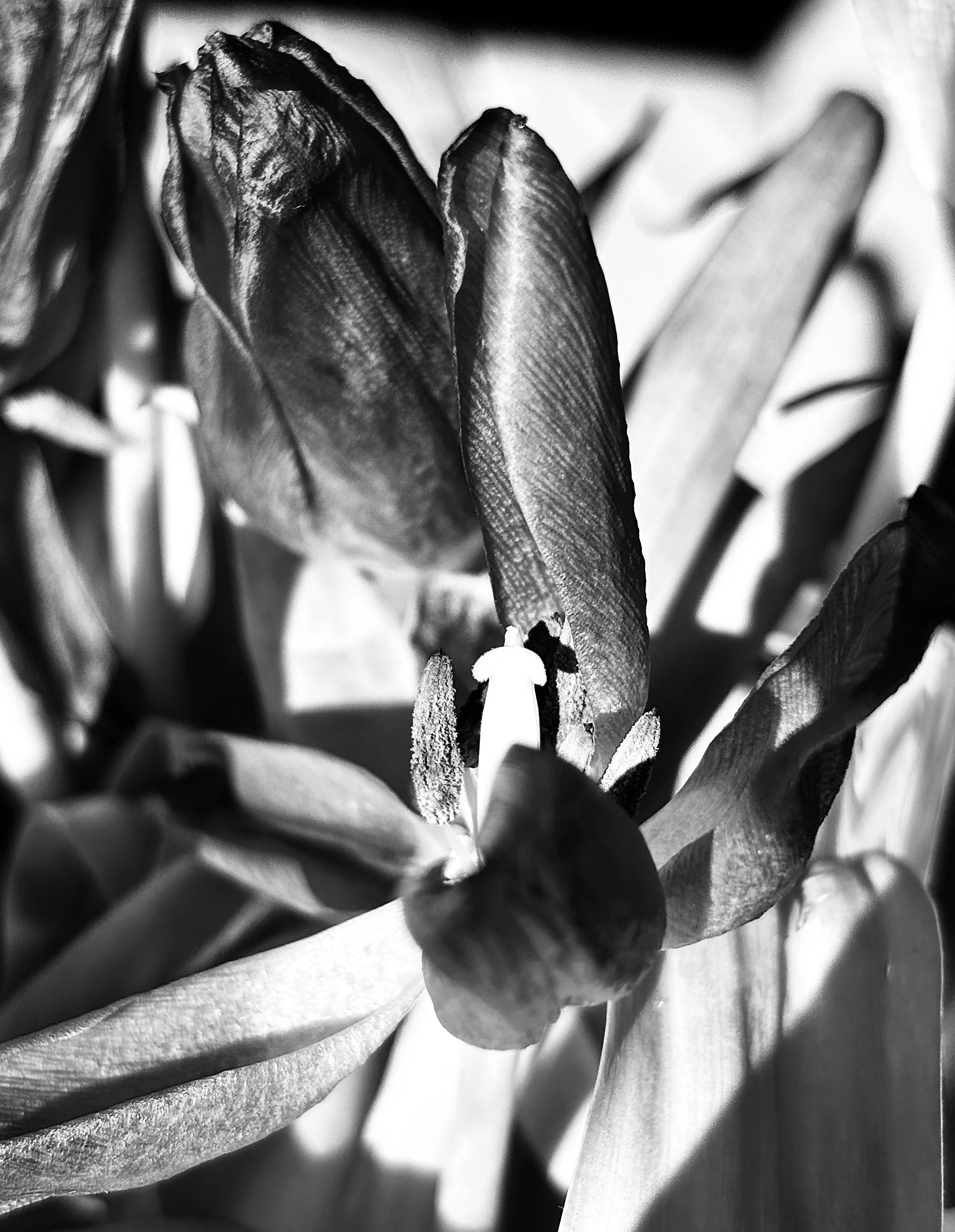
Tetiana Yatsechko-Blazhenko is a Ukrainian writer, poet, and visual artist. Her work has appeared in literary journals and magazines including Midway Journal, Shot Glass Journal, Gabby & Min’s Literary Review, Eleventh Hour Literary, Corncrake Magazine, Sheepshead Review, Plants & Poetry Journal, Red Ogre Review, Hearts of Thunder. She has contributed to anthologies such as Tidings, The Haunted Words Press 2025 Anthology, The Echoes We Make, Rituals & Remedies, and In the Language of Flowers. In 2025, she won in the prose category of the Odesa Miniature contest.
Winsome Spirit
There was a new Barbie doll that year that could rapidly grow or shorten her hair at the press of a button. Indiscreet mechanical sounds vibrated through her body as the plastic locks furled and unfurled at a little girl’s whim. A little girl who was learning her place in society, learning about her hair.
At seven, Dee was quite proud of her Barbie. Both she and Barbie were visiting from North Carolina with Dee’s parents. Dee’s mother, Cheryl, had grown up in Illinois and returned each Christmas to celebrate at her grandmother’s house. Having been there several times, Dee was familiar with the cozy old bungalow, its reach a mix of attic and porches, and she sparkled in the company of her great-grandmother. But this evening was a little strange, colored just a little anxious, because her uncle Dirk and Aunt Cara were coming for dinner. It wasn’t that she disliked them, just that she was confused about this aunt and uncle, the vague cousins. She stared at her uncle Dirk, trying to press him into the sibling childhood memories she had heard her mother recite. How was it that she didn’t know her mother’s brother?
In the opposite corner, looking over her own mother’s shoulder with barely a shortage of confidence, was Dirk and Cara’s little girl, Celeste. She and Dee were young enough that they fell together like peas in a pod, playful and relaxed. But Celeste didn’t know this house or this great-grandma. It was less than an hour away from her home in a newer, cushioned suburb of the fantastic but hard city of Chicago, but her family was only visiting because Cheryl and Chris were there. Cheryl always called Dirk when they arrived on the winter solstice or thereabouts; previously the families had exchanged gifts, but for the last couple years Dirk and Cara hadn’t even made themselves available. It was enough to render anyone a bit quiet. Cheryl offered Celeste some toys to play with, making sure the child felt welcome and appreciated. Celeste smiled for her, and considered talking to Uncle Chris, just to see if he was any fun, but mostly she was curious about her father’s other sister, Jessie. Jessie had Dirk’s sloping dark eyes and long, straight nose. She didn’t have any children, but seemed to still care for a bit of child within herself.
The door to the attic opened and there was Jessie, coming down from her mysterious room above the creaky stairs. She and Celeste smiled at each other in perfect synch, sharing a quiver of happiness. Cara had her back to the door, symbolically separating her child from Jessie.
“Hi Jessie,” Cara said, turning around a moment later, just in time to crash words with Jessie’s call of “Hello.”
“How’ve you been?” Jessie returned. She sounded genuinely interested. As the evening wore on, it would become harder to be interested. These occasions together always began with such optimism on her part.
“We’re fine,” Cara said. Then to Celeste, “Do you remember Aunt Jessie? Did you say hi?”
“Yes,” Jessie and Cara agreed aloud, for they’d had that smile, and now they got to have a brief hug. Then Dee invited Jessie to look at her new doll. Jessie couldn’t stand much of that though, and continued on to the kitchen to help her grandmother. She should have been there earlier, but she’d only just gotten dressed.
Dee seized the fleeting vacuum left by Jessie’s passing through and addressed her Uncle Dirk. Eyes round with anticipation in her earnestness, she was uncertain yet eager to try him out.
“Do you want to see?” she asked, holding Barbie out to where he was seated.
Dirk chuckled and received the doll, gave her a once over, and was trying to think of an apt comment when Dee told him, “I can make her hair shorter. Want to see?”
“You can make her hair shorter?” Dirk echoed. Of course he’d been hearing the ads in his sleep.
“Yep, I know how to make her hair shorter,” she told him, thinking this was going well, that she could impress him, and that it was fun to impress your uncle.
“I know how to make it shorter,” Dirk said, grinning. Dee was quiet, baffled. “Like this?” He made a scissor motion with his right hand across the shiny nylon hair where it fell about Barbie’s rigid pink neck.
The way Dee looked at him, hard, left Dirk uncertain as to whether she’d understood his jest. Watching from across the room Chris chuckled, not so much from amusement as in solidarity with the uncle act, how one interacts with Barbies.
Celeste didn’t feel too bad about the possibility of Barbie’s hair being clipped off. She was thinking that now she should go try out her uncle, say something to Chris, show him her sparkly bracelet. Like her cousin, she was casting nets to make some connections here. But just as she took the first step towards the easy chair where Chris was sprawled, he reached over and picked up her baby brother. Chris had said several times that he didn’t have a boy, but oh, how he wanted one.
Jessie came back into the living room calling in a background voice, “Drinks.” Then a little louder, more authoritatively, “I’ve come to see what everyone wants to drink. Cara? Coffee, tea, water...”
“I’d like tea.”
“Coffee’s fine,” Dirk said.
“I’ll just have water,” Chris told her. He was bouncing Everett on his knee, and both of their smiles were growing.
“Can I have water?” Celeste asked quietly.
“I think you get milk,” Jessie replied, sounding comforting.
“And milk for me, too,” Dee said. She made eye contact with Celeste to seal the deal: they were in this together.
Jessie turned on her heel, returning to the kitchen just as her older, much taller sister came out with the first covered casserole dish.
“Wash your hands,” Cheryl called, beckoning everyone to the table. “Ah, Dirk? I see you’ve got Barbie. You can bring her along to the table.”
Dirk tried to laugh, but couldn’t fall in with Cheryl’s snickers. He politely extended the doll to Dee, who insisted on showing him, in fast-forward speed, how Barbie’s hair grew shorter, then longer. A moment later she was in the bathroom washing her hands with Celeste, both resting their armpits on the sink’s wide ceramic rim.
In the dining room Gigi directed her guests to assigned seats: the two little girls sitting together and flanked by their mothers, Gigi herself at the head of the table where she could easily dash into the kitchen for refills or overlooked serving spoons. Jessie sat across from the little girls between her brother and brother-in-law. Cara was at the other end of the table with Everett in a high chair next to her.
“Be quiet, be a good boy while we say grace,” she told him. He raised his pale eyebrows, which made everyone laugh, then Gigi launched into a devout yet perfunctory acknowledgment of their good fortune in eating well. Jessie sat through one of these recitations every night, but after years she still could only lower her gaze and feel slightly annoyed.
“Amen,” Gigi said, and everybody squeezed hands, except for Celeste and Cara, the little one being rather startled by this, but laughing.
“Don’t you do that?” Gigi asked. “We always squeeze hands at the end. I don’t remember how that got started. I guess we’ve just always done it.”
“They’re different,” Celeste was thinking. Yet she liked having this balance in her family. She liked squeezing hands.
“Those are Jessie’s asparagus spears,” Gigi exclaimed proudly as Dirk scooted a few onto his plate.
“Oh, really? Oh!” The initial response, and then the reprise of, “Ewww,” from the children, including Everett, who thought he knew asparagus when he saw it.
“Why do you grow asparagus?” Celeste asked, her candor enough to make them all laugh again.
“Well, I grow a lot of other things, too,” Jessie replied. “I grow green beans and flowers, and even hazelnut bushes.”
“Hazelnuts would be fun to try,” Cara said. She sounded like she might actually mean it.
“But you never get any of the nuts, right?”
This was Cheryl’s interest in the hazelnuts pitted against that of her sister, friend to the squirrels.
“No, the squirrels get ‘em before they’re completely ripe,” Jessie admitted. She referred to “the squirrels” as if they were endearing neighbors. “But that’s okay. They’re really small nuts anyway, not like the filberts you see in the store. Those are the European ones.”
“We have well-fed squirrels,” Gigi laughed. The dining room light danced on her white hair and she glowed in the center of her family.
Jessie looked up from her plate and caught Celeste looking at her. They exchanged smiles again.
“If you’re ever around here in the summer, stop by and see my garden,” Jessie told her. Dee looked on, sensing the sadness of the fact that she knew her aunt so much better than Celeste did though she lived twenty-five times farther away.
“Where are you working now?” Cara thought to ask.
“I’m still at the botanic garden,” Jessie replied with a mixture of self-assurance and hurt pride.
“Still at the botanic garden, huh?” Dirk echoed. He sounded like he’d known all along despite the fact that they went years without regular communication. He and Cara were much relieved that the boyfriend they had last seen Jessie with was no longer around. It was nice nobody mentioned him, especially since he went by a punk moniker, and neither Cara nor Dirk had ever learned his real name.
“She’s making maps,” Gigi announced.
“Yeah,” Jessie nodded, “digital geography. It’s kind of fun.”
“That sounds interesting,” Cara said. She was no more interested in this than in the chunks of potato on her plate.
“What’s a botanic garden?” Celeste asked slowly.
There were murmurous beginning of definitions, but mostly Jessie laughed and said, “Yeah, how about that, I work at a garden too!”
The conversation drifted into a casual exchange between the two parent couples, talking about kids and t.v. and pets. Jessie and Gigi were left to the two little girls, forming a complement.
“Are you two in the same grade?” Gigi wanted to know.
The girls nodded.
“She’s in second, too,” Dee said.
“Second grade,” Gigi sighed as if she were saying “The Spanish Riviera.” “How do you like school?” Her blue eyes sparkled at Celeste just as they had sparkled at hundreds of kindergarten students across three decades of teaching.
“We do homeschool,” Celeste explained.
“Oh, that’s right,” Gigi remembered. The facts were vague, the connections frayed without being worn. Jessie felt herself wince for Celeste’s sake. The last Christmas letter they’d ever received from Dirk and Cara explained that they would homeschool their kids “because we just can’t accept some of the things they’re teaching now.” Jessie had always wondered exactly what those things were, but knew deep inside she admitted that if she knew it would only make her angry.
“What kind of things do you learn?” Dee asked. “Do you have subjects?”
“Yeah.” Celeste nodded her dusty brown curls. “There’s spelling, and writing...”
“Studying God’s word,” Dirk prompted.
“Studying God’s word,” the girl repeated after her father.
“Is that like Sunday school?” Dee asked at length. She hoped she didn’t sound disrespectful of “Studying God’s Word.”
Celeste looked to her father for help.
“I think so,” she replied when he nodded ever so slightly. “Do you go to Sunday school?”
“Sometimes,” Dee said brightly. “It’s usually fun. I like to go at Christmas.”
“I used to teach Sunday school,” Gigi told them proudly, “for high school girls.”
On hearing that, Jessie’s memory couldn’t help travelling the well-worn path of the fact that her Uncle Wes had gotten one of those sixteen year-old girls pregnant.
“Do you like to read?” Gigi asked Celeste.
Celeste nodded. “Reading is my favorite.”
“Mine, too,” said Dee.
“Mine too,” echoed Jessie. The girls laughed at that. Jessie bumped elbows with Dee and giggled.
Just then Jessie heard Cara say to Cheryl, “So my sister told him, ‘I’m driving that fast because my husband yells if I go too slow.’”
Cheryl and Chris both found that humorous, or at least odd.
“And so he didn’t give them a ticket,” Cara continued, her drone a sardonic honey of innocence. “Then while they were up there, Chip won eight hundred dollars at the casino.”
There was a thud of amazement from the listeners.
“Eight hundred!” Chris cried. “Oh, compare that to my paycheck!” As a high school teacher he knew sorry poor returns on wages for exhausting work.
Cara glanced at Jessie ever so furtively. She couldn’t bear the thought of actually touching her. She found it revolting, Jessie’s lack of God. Not that they’d ever talked about religion, but Cara had nearly blown a gasket when Jessie (now divorced) was married by a judge in a forest preserve. Neither she nor Dirk attended.
Jessie could feel Cara’s clammy gaze upon her, fleeting as it was, and turned back towards the little girls. They were enthralling anyway, their brand new universe darling and tender as a bold green shoot.
Soon Cara was laughing ebulliently again.
“Oh no, that was Heidi. Pam doesn’t do things like that; she’s always been the more responsible sister.”
“Heidi has the little girl you brought with you at Christmas a couple years ago, right?” Cheryl checked.
“Yes, Valerie. And she’s got another little girl now, too, Ruby, and just last month Tommy was born. This guy’s gonna marry her though, and adopt Ruby. Valerie’s dad doesn’t want her adopted.”
“Anyway, Heidi was at my house and complaining about not having a career, not knowing what kind of a career she could have, and she finally said, ‘Maybe just marry a rich man. Or marry a rich man and kill him. But I probably wouldn’t get away with that.’”
“And I said, ‘Mmm, I don’t know. That woman on the history channel did.’ And for some reason Heidi thought it was so funny when I said that, I guess because I was frosting a cake and I didn’t even look up, like it was the most natural thing in the world to kill your rich husband and get away with it. She said it was like something funny you’d see on t.v. Goofy things happen when we get together.”
Cheryl managed to laugh for hospitality’s sake. Chris chuckled uncertainly. Jessie squirmed. Now it was her turn to take a jousting glance at Cara. Her glance bounced off Cara’s face like hail hitting a windshield. Cara might have felt it.
When next Cara took a peek at Jessie, she saw her just as she’d been when newly graduated from U.C. Berkeley. The time she and that now departed boyfriend knocked at the door at 8:30 p.m., stoned and seeking remedy for an overheated radiator, and woke up the neighbors’ baby. What Cara didn’t know was that Jessie hadn’t been sure which house belonged to her brother. It was a wild and tattered trail, the rift ruthlessly landscaped.
Jessie looked hard at Dirk, sank back into the hollows from childhood that still lurked in memory, tried to sidle up against him from across the table, but he was shut tight and cold like a new storm door. A razor-sharp blade had severed him from his early life. Instead of reacting to his wife’s macabre anecdote, he called across to Celeste, “Make sure you eat some carrots, too.”
Celeste nodded, dove-like.
Gigi came to wondering whether everyone was enjoying their dinner, and so inquired as to that, which only interrupted their enjoyment. The reflections of lights and faces in the winter windowpane suggested a different scene playing out in a cohesive family on another plane. Incongruity tugged at the corners of the glass though the middle seemed flat and straight.
After they had finished eating, precisely 30 minutes of small and somewhat larger talk elapsed before Dirk whispered something to Cara. On his way back from the bathroom, he stopped to pick up their coats. Then everybody stood around for a long exit with lots of stiff hugs and suspicions, and even some tremors of hope. Gigi caught Dirk’s eye and winked at him, eliciting a weak but familiar smile. He still called her “Grandma”, but no longer felt it.
“We’ll call you, come visit you, at the botanic garden sometime,” Cara said to Jessie. She could still sound friendly even after years of disdain.
“Yeah, sure, anytime,” Jessie agreed. She had barely roused a spark of hope before she felt it slump into despair. Her heart almost broke when giving Celeste a goodbye hug. She was such a beautiful little girl.
“Goodbye,” Celeste said, waving. After she hugged Dee and Dee’s parents, her balance wavered, wondering when she would see this cousin again, the whole thing about them being part of the family yet not really belonging. In the backseat of the car she watched shafts of artificial light stripe the darkened, silent interior.
“Go to sleep,” her mother told her as the automobile followed rows of streetlights to the expressway. Celeste was pretty good at sleeping in a car, so she closed her eyes. It was hard to keep them closed on the wider streets where the stripes from the streetlights were wide and bright.
“I’m glad we only go there once a year,” Cara said quietly when she was pretty sure the kids were asleep.
“Hee hee,” Dirk laughed without any real feeling. Cara had been gradually cutting him off from his stepmom’s family, and it had been effective, would be completed. She shifted restlessly, vaguely angry that her husband didn’t argue. She sighed loudly, like a train heaving to a stop. Dirk merged to the right into the endless stream of northwest surburbs traffic.
“In fact, I don’t think I want to go again at all,” Cara declared.
“Oh.” Dirk’s response was surprise, but hardly argumentative.
“At least, not if Jessie’s there.” Cara could hate his hippie half-sister even more than she already did. Her bad feelings ran infinitely deep. “It was nice talking to Cheryl and Chris, but I don’t want my children around people like Jessie.”
Celeste’s eyes opened just a little, as if to hear better, to hear any tiny detail about why this aunt was bad for her.
“Was she….rude tonight?” Dirk thought he must have missed something.
‘She’s just….weird. And creepy. She doesn’t believe in God!”
Celeste’s eyes were closed again. In the dark, she wondered what that meant, someone not believing in God. How could that be true? She knew about all the scary stuff that went with lack of faith, but couldn’t recognize any evil within her amiable aunt.
“Well...” Dirk considered. He was driving a road he’d seen grow from a four-lane highway to an interstate racetrack. “She is my sister.”
“She’s your half-sister,” Cara snapped.
Celeste’s brow furrowed. She tried to relax it, but her thoughts were starkly agitated just then. She felt an odd sensation, something that seemed to be pushing her away from sleep.
“I don’t want her around the kids,” Cara said, regaining a steady tone. “And when the next baby is born, they don’t even have to know. That’s your stepmom’s family, and it’s time to break the ties.”
Dirk considered all this, both hands on the wheel. The road had grown like an alligator from hatchling to monster. He thought of his dad, of the way their dad loved Jessie. But he could try to forget that. If it would keep Cara from being sharp with him, he could do it. He thought of his own children. He thought of his wife.
Celeste dozed off just as they left the whining roar of the interstate. Cara had finally settled down, which she didn’t do until long after she stopped talking. Unable to sustain the utter outrage of Jessie’s non-belief casting aspersions on her own faith (which always reprised the humiliation she felt as a toddler when an older cousin hooted, “You still wear diapers?”), she had shifted to feeling outraged for her god’s sake. This was almost a nurturing kind of outrage, tepid warm and poodle fuzzy. While they zig-zagged, turn signal twinkling and chirping, through the lazy streets of the subdivisions, Dirk began to think into the future again. About going to work the next day. About how, if he focused hard enough on the job, he was bound to advance, climb the firehouse ladder.
Celeste began to awaken when they turned onto their street. When the car came to a stop in the driveway, she kept her eyes closed. A moment later, her dad opened the door and reached in, quietly saying, “We’re home.” She let him pick her up. The wind in the nighttime trees was epic, the huge sound rumbling across the sleeping landscape. The front door unlocked with a muffled click. Dirk stooped to set Celeste down, but she whimpered.
“Just take her up to bed,” Cara told him. Everett had slept all the way home and was still quiet in his mother’s arms.
Celeste smiled, riding on her dad’s shoulder. She liked to pretend he was taller than her mom. Dirk set his daughter on her bed and pulled her shoes and coat off. She opened her eyes and for a moment her aunt Jessie’s face was there so clearly in Dirk’s, profoundly a part of it, yet all her own. A face she would remember. It was like some kind of wonderful image, and Celeste couldn’t speak. She closed her eyes again.
Thirty miles away, Jessie lit her pipe just once, then settled in to play her guitar. An aura of plucked notes rang out in her drop-ceiling attic room. In the bedroom below, Dee lay staring at the same wallpaper her mother had faced down as a little girl under orders to nap at Grandma’s. It was a gentle pattern and hue. Dee fell asleep wondering what Celeste’s favorite color was, a dream that never came true.
Jenny McBride’s writing has appeared in Grub Street Literary Magazine, Common Ground Review, DASH Literary Journal, The California Quarterly, Streetwise, 300 Days of Sun, Rockford Review, Inscape, and elsewhere. She makes her home in the rainforest of southeast Alaska.