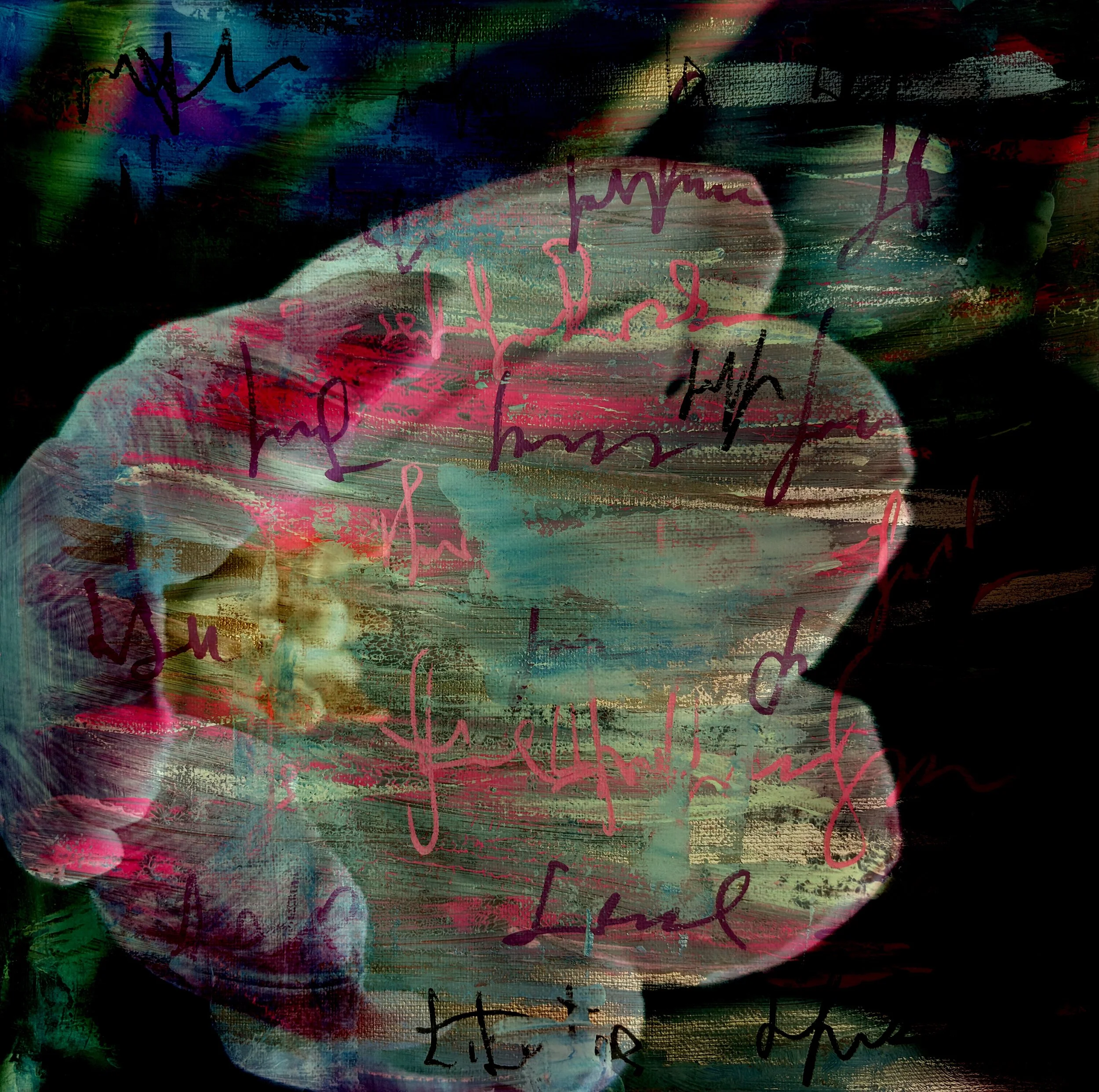
Tetiana Yatsechko-Blazhenko is a Ukrainian writer, poet, visual artist, and photographer working across painting, photography, digital art, fiction, poetry, and hybrid forms. Her practice explores fragmentation, memory, perception, and personal mythology, often shaped by urban space, travel, and the relationship between reality and imagination. Her work has appeared in literary journals, magazines, and anthologies internationally, including Eleventh Hour Literary, Midway Journal, RipRap Journal, Qwerty Magazine, Tint Journal and Red Ogre Review.
Paradise Valley
“I don’t trust this river,” Saoirse tells me. This statement alone sends a rush of panic through my
body, coming from her.
Saoirse drives motorcycles without knowing how, once driving off the side of a mountain. Her
sister survived a grizzly bear attack, leaving her unable to shower alone for months, and yet Saoirse still
refuses to bring bear spray on hikes out of principle. She’s faced countless abusive boyfriends. And still,
she is the person I would call to help me bury a body. Her willingness to admit she does not trust these
waters means there is a very real reason for concern.
She refers to the famous Yellowstone River. Filled with tourists--thanks to Yellowstone
National Park--one would think the river would be reliable and mild, easily guiding tourists through the
Montana and Wyoming scenery. But apparently the river contains its own tricks, though not always
visible.
The river begins in Yellowstone National Park, maneuvering through Paradise Valley,
eventually meeting the Missouri River, spanning Wyoming, Montana, and North Dakota. We are
beginning our float in Paradise Valley, outside of Yellowstone. Even though the river begins in
Yellowstone Lake, Saoirse’s Uncle Bill later tells me that tiny springs are actually the source of most of
the water.
“If you look closely as you float along the river, you will see tiny little waterfalls dribbling
down into the water from the ground every now and then,” he explains.
The hot, dry air and dust particles flutter around me as we lower the raft into the water, making
my mouth barren. When the raft finally reaches the surface of the water, I reach for a water bottle from
the cooler and quench my thirst. I begin to regret my decision to drink so much the night before after my
bartending shift—a job I applied for on a whim to make some cash while I spent the summer here before
my senior year, when I would finally be forced to confront my future. Awaiting me like a death sentence.
“Why not?” I ask about the river, finally responding to Saoirse. For once out of curiosity
instead of self-preservation.
Saoirse explains to me the many perils of the river, as if catching me up on well-known
neighborhood gossip: A kid from her high school who jumped in and became caught in a current below
the surface of the water, his body washing up on shore weeks later. Rafts stuck and deflating on branches
and rocks beneath the surface. Rafts crashing into bridges and instantaneously causing deaths.
“The bridges are the most dangerous parts of the river,” she assures me. “The interruptions of
bridges, rocks, branches to the river cause the most unpredictable and hidden of conditions. You don’t
want to get stuck on them or crash into them.”
She points to a family in a raft a little ways over from us in the river. Friends of her Uncle
Bill’s, they’re technically “floating with us” today, on a different raft a few hundred feet aways from us
but always in our eye line.
“You see those kids on the boat? I can’t look at them without thinking of that terrible incident,”
Saoirse says.
“The guy rowing—their dad—well, a few years back, we were all floating down the river
together, and their raft got pulled into a riptide and caught on a branch. They had just moved from the
East Coast and the dad wasn’t an experienced river guide yet. The raft started instantly deflating. He was
holding onto all of his kids—all babies at the time who couldn’t swim—with both arms, while trying to
get the raft unstuck from the branch. We had to row to shore, get out of our raft, and run as close to them
as possible, and Maeve and I basically had to catch all of his kids because he couldn’t carry them
anymore while the raft was deflating and sinking. We don’t know what would have happened if he wasn’t
with other people,” she explains.
“He’s gotten a lot better at navigating the river though. Still not perfect, but he’s learning,” Bill
says, still rowing forward, his eyes on the water ahead. “You have to understand there’s no rules to it, no
patterns to the river to memorize. You just need to keep your eyes alert and be prepared to focus on
whatever’s at hand.”
At the end of our float, we pass a foul smell, soon realizing a large, black mass lies on a small
island made of river rocks in the middle of the river. A moose. Dead.
“They go to the river to die,” Saoirse’s older sister, Maeve, tells us.
Why did I come here? Was it a last minute act of desperation, an urge to feel alive again? Or
did I come here in wake of my own death, aware I was losing myself? I make a note to remember to
research about moose going to rivers to die, finding this fact both poetic and beautiful. (When I look it up
later, I can’t find a single search result about it on Google.)
After we park at the waterside and put our equipment away, Saoirse and I drive through
Livingston, Montana, on our way to Bill’s lodge. He and Maeve will meet us there in a separate car.
Saoirse sits behind the steering wheel, while I sit in the passenger seat and stare out the window. Dust and
a sun-filled haze create a blurry, romantic vision of the streets, filled with old bars, movie theaters, and
hotels. Electric signs pop out of each store front. We pass multiple old but abundant book stores. As a
feverish feeling of nostalgia takes hold of both of us, we decide we need to rid ourselves of this
overwhelming feeling of sadness.
There are the many known physical threats of these mountains, but I finally understand how
it’s the threats that we cannot see which carry the real harm. Trapped in between these mountains, stuck
motionless in time, there’s something beautiful but also haunting in the air. The stillness gives way to
these veiled threats and allows them to fill the mind. We stop at an old bar for drinks and a bathroom
break and we order vodka cranberries for $3 each—unheard of back in New York.
We finally pull into the dust-filled parking lot of Bill’s inn, dust flying up in the air around us
and lingering in clouds. The air is crisp enough that I pull my jean jacket tighter around me and
goosebumps crystallize all over my bare legs, my yellow sundress feeling much too light for the mountain
air. As if they had been expecting us any minute, Saoirse’s other uncle Hank and his wife Casey are
puffing clouds of smoke into the abyss, dispersing with the dust clouds and creating a haze.
Hank hands Saoirse a piece of chocolate as we approach. Saoirse breaks off a piece and puts
her into mouth, closing her eyes and relishing the taste. As she chews, she hands the bar to me and looks
at me curiously. The vodka cranberry is beginning to rush to my head, making me feel foggy, so I quickly
break off a piece. It melts in my mouth but tastes slightly different than other chocolate I’ve had before,
more of the earth.
Saoirse begins to giggle. “Eva, these are shrooms.” I’ve never taken shrooms before, but I
shrug, trying to play it off. While they’ve been incredibly nice and welcoming, I know that Hank, Casey,
and Bill all think of me as the fragile and green girl from New York, the girl who loves to read the likes of
Thomas McGuane and Normal MacLean but has no real worldly experience. Earlier in the day when we
had briefly swam in the river during our float, the pull of the current caught me, causing Bill and Saoirse
to run downstream so they could catch me.
“She’s floating away!” they had screamed, howling with laughter, while chasing after me. I
lack a certain sturdiness and force that the rest of this group seems to have. I pray to myself this is a
quality that can be developed, rather than a permanent deficiency.
We approach Bill’s inn together, a large, wooden structure in the middle of a grassy field, with
the gray, snow-capped mountains watching over it from above. A stream makes its way through the field,
next to the main lodge, and smaller, quaint log cabins surround the main lodge. Though the lodge looks
still from the outside, and there are no other properties in sight, the door opens to the opposite—a
structure filled with life, lively to the point of chaos. Children between the ages of 4 and 10 run around,
playing tag. A band is set up in the corner of the main hall, playing country music. A table with catered
barbecue food runs through the far side of the room, followed by a long line of people chatting as they
wait to fill their plates with barbecue pork and cole slaw. At the bar, I see Saoirse’s mom and Bill doing
lines of cocaine off the mahogany wood-stained table, as the game of tag runs by. Seeing Bill, doing this
sends a sliver of anxiety down my spine. Maeve is behind the bar and pretending to be a bartender,
shaking a cocktail up and down. In the corner, a group of men in their 20s are erupting in laughter and
sipping beer. Out of this group, I notice a tall man, in his late twenties, with wheat-colored ringlets falling
over his face and big, green eyes that I haven’t met before.
“Hey, bartender, can I have a rum and coke?” Saoirse hollers at Maeve. Maeve rolls her eyes.
“And for you Eva?”
“I’ll have a vodka cranberry.” Maeve prepares our drinks and places them down on the counter
with an air of pride. “Here you go.”
Saoirse nudges me. “Do you want to come say hi to some people from my high school with
me?” I shake my head, perfectly content with my seat at the bar, which faces a giant, clear window that
allows me to see the yellow-orange hues of the sun setting behind the mountain. “I’m good,” I say.
“Okay, I’ll be back.”
I notice a man sitting next to me, the only person in the room, besides myself, that does not
seem to be engaged in a conversation with someone else. He appears to be in his mid-forties, with a
distant look in his eyes. We make eye contact and I introduce myself.
“Hi, I’m Eva, Saoirse’s friend from college. I’m staying with her for the summer.”
“Gavin,” he murmurs. “I’m Gavin. I’m one of Saoirse’s cousins.” Despite his lack of words, he
seems shy and well-intentioned rather than rude. He seems to be the only still, somber thing in the middle
of all this chaos. His face is slightly pink, as if he’s spent too much time outside or had too much to drink.
A mustache of thick brown hair coats this skin above his upper lip, and his t-shirt looks worn and faded
off-white. He appears to be in his mid-forties.
“What do you do for a living?”
“Er, I don’t have a job right now. I’m trying to be an artist.”
“Are you serious? That’s so cool.”
Gavin shrugs. “Not that cool. I mean, I can’t even find a stable job.”
“Yeah, but at least you’re doing something you love. Everyone I know back home is obsessed
with money. At least you’re holding out for something you really care about. I admire that.”
Gavin looks up from his beer. “What do you do?”
“I’m just going into my senior year of college. I’m an English major, but I really love poetry. I
have no idea what I want to be.”
I see Gavin open up behind the wall he has put up. His face lights up, and he sits up straighter,
opposite from the slouch he held seconds ago. He looks me in the eyes. “Whatever you do Eva, do what
you love. Don’t listen to those fake people that think it’s just important to make money. Do something
that counts.”
I nod. “What kind of art do you do?”
I realize I have cracked Gavin, as he goes into an elaborate description of his paintings. He
primarily paints Montana landscapes, but seeks to capture something deeper in them. The barrenness. The
barrenness that gives way to chaos out here. His words themselves begin to paint an image in front of my
very eyes, and I know exactly what he means. Maybe it’s the drugs, but I am the barrenness turning to the
collective chaos to escape.
Before I know it, I feel a pull on my arm. “Eva, do you want to come get some food with me?” I
nod and excuse myself. She whispers in my ear as we walk over to the buffet: “What are you doing?
Gavin can be...interesting.” I don’t answer, as we pass by the center of the room where people have
begun to dance. Before I can register it, the man I had seen in the corner with the big, green eyes takes my
hand and begins to twirl me. His hands grasp my waist and hoist me up, spinning me around in the air.
People begin to stare. His eyes seem to take on a life of their own, nearly popping out of his head, as he
smiles and laughs with me. I can no longer locate Saoirse, dizzy from the spins. This is the moment where
I give in to the wayward current of chaos swirling around me.
He asks me my name. “Eva,” I say.
“Pete,” he smiles before dipping me down low, my hair falling back.
I knock into one of Saoirse’s aunts, her name eluding me. She leans down and whispers into my
air, “Be careful. Pete can be a real player.”
“We’re just dancing,” I say defensively. “Just having fun!” She gives me a look like she’s not
convinced but backs away. I take off my jean jacket, beginning to feel the beads of sweat drip down the
back of my neck. In the corner, I see Saoirse raising an eyebrow at me and smirking, shaking her head, as
if she cannot believe this is happening.
A gust of air sweeps through the back of my dress, then cold. A cold that bites. Moving past my
underwear, down my legs. I think it’s the drugs, it must be the drugs, but I only see Pete stop as his mouth
drops, everyone pauses, no longer dancing, as if a movie has been paused mid-action, and rushes towards
me. I reach my hand to the back of my dress to feel ice cubes stuck in there, stinging against my flesh,
melting and dripping out the bottom of my dress in long streams of cold water.
I hear Bill call out, “What the fuck are you doing?” A loud crash, and Bill is on the ground, Gavin
on top of him, engaged in a struggle, a bucket of ice to the side of Gavin, the cubes now spilled across the
floor.
Saoirse takes my hand and pulls me outside. The last time I was outside it was dusk, the sun just
beginning to set, and now I see the sun rays peak out of the mountain caps. I should be waking up now,
but time doesn’t make sense anymore.
“I’m calling the cops,” Saoirse says, punching the numbers into her phone keyboard. “Excuse me,
we have a problem. We have a, um, physical altercation going on between two people. We’re at High
Point Ranch. Right off Ridge Road.” She hangs up, slides the phone into her pocket, then shoves
something into my hands.
“The drugs. You need to hide the drugs. While I wait for the police.” I nod, then look inside the
building to see multiple men holding Gavin down, him sprawled across the floor, pounding and yelling,
his pants falling down, exploding pale, sweaty flesh. “Eva? You need to go now. I don’t want Bill to get in
trouble.”
I run across the blank fields, towards the mountains, but no matter how much I run, the mountains
seem the same distance away. I find a meek-looking spruce tree, dig a small hole at the base of it, and
hide the drugs there. I try to remember this tree, knowing Saoirse will want to come back and look for it. I
have a feeling I won’t. There’s nothing else in sight, no way to mark it anyway.
By the time I sprint back to the ranch, out of breath and my legs feeling wobbling, I hear one of
the aunts sigh. “If only Eva hadn’t flirted with Gavin.”
My stomach turns. Flirting?
Saoirse walks over to me, holding a red solo cup of water.
“I don’t feel so good,” I say.
“Take this,” she says, handing me the cup.
The police are leading a limp Gavin away, one officer on each side of him, pulling him by each
arm, before stuffing him into the backseat of their car.
“I told you about Gavin.”
“I didn’t mean to—“
She cuts me off, her hand on my shoulder. “I know you didn’t.”
A steady of stream of bile spurts out of my mouth, directly into the red solo cup. My body can’t
consume anymore water, only rejecting it. Gasping for air, I ask: “Can we go home?”
Paige Elizabeth is a writer from New Jersey living in Germany, where she is completing a master's degree in English literature and anthropology. She is currently working on her first novel.
