‘MY STUDIO MEMORY’
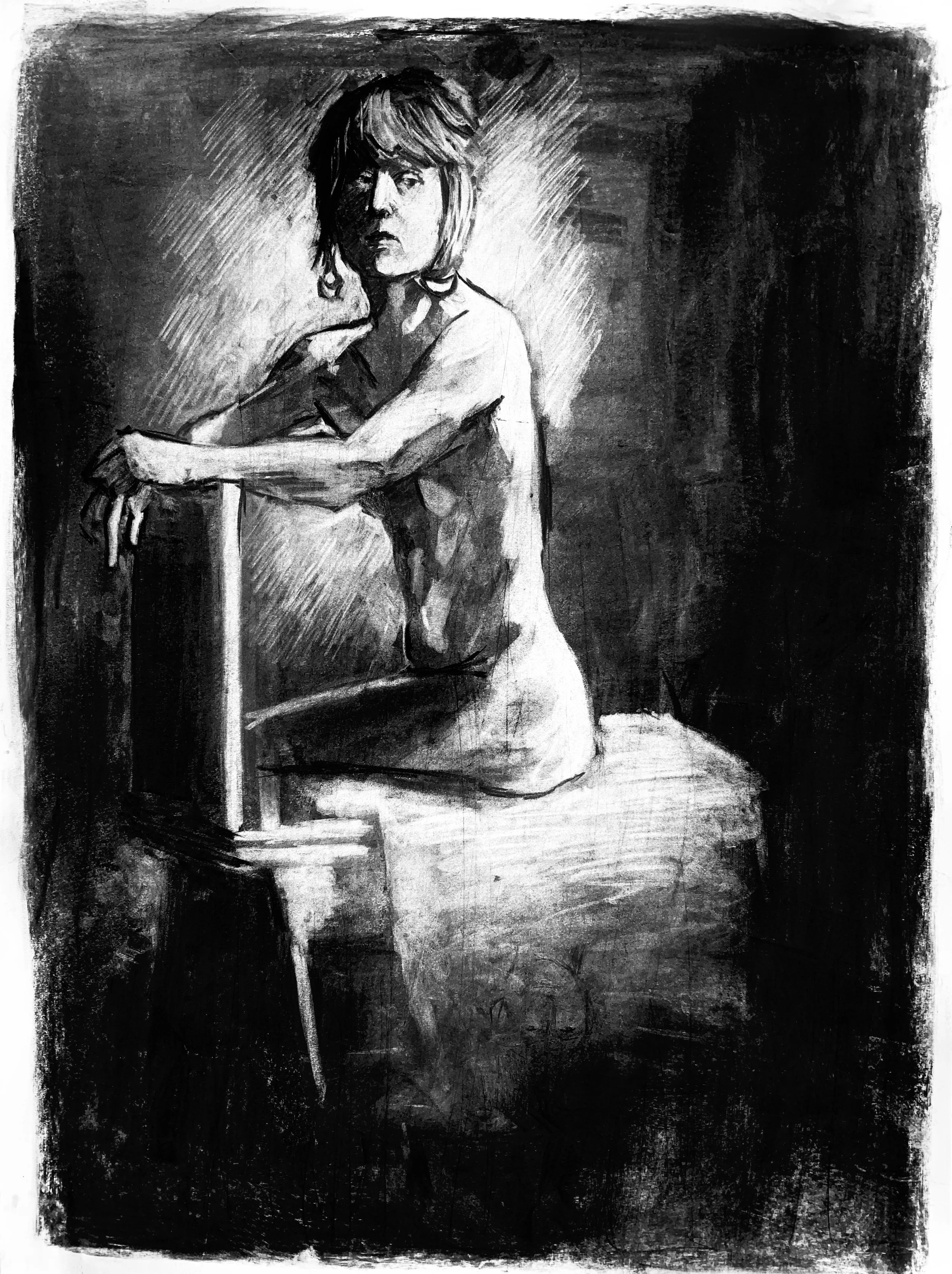
Donald Patten is an artist and cartoonist from Belfast, Maine. He produces oil paintings, illustrations, ceramic pieces and graphic novels. His art has been exhibited in galleries across Maine. His online portfolio is donaldlpatten.newgrounds.com/art
MY STUDIO MEMORY
I prefer not to talk much about it. The subject develops like something people who reminisce about ‘the golden era’ of night clubs might daydream into Technicolor. Stretching two dimensional tall tales in out-of-focus black & white, until convinced without question as being rainbows of fact.
When my age becomes a topic, locals as well as out of town guests have asked me: “were you ever inside Studio 54?”
I was an innocent young man when I came to New York City in the late 1970’s to attend NYU. I could have saved my parents a small fortune by majoring in Manhattan night clubs, since I spent significantly more time inside dark venues, dancing to a disco beat, than I did soaking up knowledge in any college class room. To confirm a personally true rumor, the first place I ever “made out” with another man was in the balcony of Studio 54, some months before my 20th birthday. What I remember about him was that he was pale white, dressed head to toe in midnight black.
Ironically, Studio 54 opened its doors on my 18th birthday: April 26, 1977. I didn’t know that statistic for years. Coincidence, yes, but it has no relevance to my story. We Studio snobs, those of us who are still alive — obviously — throw out dates to cement our self appointed status as “the originals.”
In the winter of 1980, Steve Rubell and Ian Schrager, the founders and owners of Studio 54, were jailed for tax evasion. If you were a true club kid (years before that term was coined by a young man who hung out at a city disco called Lime Light), you knew that since the guys lost ownership of 54, it no longer held any bragging rights worthy of acknowledgement. Though the club stayed open for a few more years, we arrogantly decided it was no longer ‘the place to be.’
There were other grungy yet glamorous elite spots: The Underground, Ice Palace (exclusively for gay men), The Mudd Club, Lime Light, as well as Danceteria, a westside club where my great friend (and roommate at the time) spent her late nights.
And then there was Xenon, whose interior was practically a replica of Studio. Both had previously been theaters. But the only place crowned as a 20th Century urban legend is Studio 54.
Secure in my memory’s accuracy, the first time I walked into the lobby of Studio 54 was hyperbolic and surreal. As I stepped onto the crowded floor, the song playing was Linda Clifford’s “Runaway Love.” Soon followed by her disco version of “If My Friends Could See Me Now.” Donna Summer, even to those who hated the genre, was the name most synonymous with disco music to the rest of the world. But Linda Clifford was one of our music goddesses during that short lived period. It seemed as if every vocal performer wanted in at the time. Whether it was the singer or the record companies, talent from Streisand to Deborah Harry went disco.
I also had the great honor of having little ole Steve Rubell tell me off. One night he walked up to me in the mirrored lobby of Studio 54 and said, “I told you to take off that hat.” At 19, I thought I looked fab. Truth be told, I probably looked like an pimply, underaged idiot. He had not previously asked me to remove the fedora. My response? “Fuck you.” He grabbed me by the arm and said, “I told you to take off the hat. Get out of MY club.” I hadn’t realized it was him. I quickly recognized to whom I was talking. Immediately I changed my tack and tone. “Sir,” I said nervously, “I swear you never told me to take off my hat.” He looked me up and down and said, “check the hat, button up your shirt. I don’t know how they let you in here. You look straight out of ‘Saturday Night Fever.’” He walked away. I burst into tears, but I didn’t leave. I climbed the black carpeted stairs to the mezzanine, where the original theater seating was still installed, and sat down in the second row, hat in hand.
A gorgeous woman and two of her male friends, each with high cheek bones and perfect skin came over and sat behind me.
Seeing me in tears, the woman said, “Honey, what’s the matter?”
I said, “Steve Rubell just yelled at me for wearing a hat.”
She said, “Oh, fuck him. Give me your hat.”
She put on the fedora and went down to the floor, where she danced to a few cuts. Then she came back up to the balcony, sat down and returned my hat to me.
“I’m sorry we can’t hang out with you tonight, but I have a plane to catch.”
At that, she and her two Ken doll escorts stood and walked toward the stage right staircase. One of the men stopped, turned around, looked at me, and walked back over to where I still was seated.
“Just so you know, the reason you’re not supposed to wear a hat in the club is because it’s the sign of a drug dealer. There are undercover cops everywhere, looking for any reason to bust the owners and close the place.”
I smiled. “Thanks for letting me know.”
Just as he was heading out, he turned and asked, “You don’t know who she is, do you?”
“No,” I said. “Is she someone I should recognize?”
He grinned. “She’s only one of the most famous super models around. Her name is Patti Hansen.”
She would later marry Keith Richards, of the Rolling Stones. Before Keith, she had been married to a soap opera actor, James DePaiva. In 1978, I don’t know if or with whom she had been partnered. Not that it mattered. She changed my entire outlook. And after nearly 50 years, I still recall her kindness. A minute flash in her life that I pretty much can guarantee she wouldn’t remember at all.
A while back, I ran into someone who had been a friend during the nightclub days. I wouldn't call it an affair, but we did sleep together on more than one occasion. He reminded me that he had worked at Studio 54, which is where he and I had met.
Back then, at almost every other nightclub, I got in the door without paying. Not at Studio. I wasn’t considered to be one of the pretty boys. I liked going on Thursday nights. The cover charge was $15. I often didn’t eat that day so I could afford the entrance fee.
I have a number of 12 inch vinyl singles that sit in the corner of my living room, separate from my “regular” record collection. I will never get rid of them for any price. A dormant but treasured memory.
It wasn’t Rubell’s down dressing that ended my time at Studio 54. I can’t remember why I no longer continued to hang out there. It didn’t curtail my spending nights inside clubs, which I patronized long past the elite enigma and seduction of disco music. Records thrown by deejays who were often placed above and separate from the populated, strobe-lit floors of that historic period. Mostly forgotten by the public or never included. The common feature shared on all dance floors was the pounding and addictive base, that I found difficult to fight. A perfect storm of music, lighting and an environment that was nothing short of transcendent.
Andrew Sarewitz has published a number of short stories (website: www.andrewsarewitz.com. Substack access is @asarewitz) as well as having penned scripts for various media. Mr. Sarewitz is a recipient of the City Artists Corp Grant for Writing. His play, Alias Madame Andrèe (based on the life of WWII resistance fighter, Nancy Wake, the “White Mouse”) garnered First Prize from Stage to Screen New Playwrights in San Jose, CA; produced with a multicultural cast and crew. Member: Dramatists Guild of America.