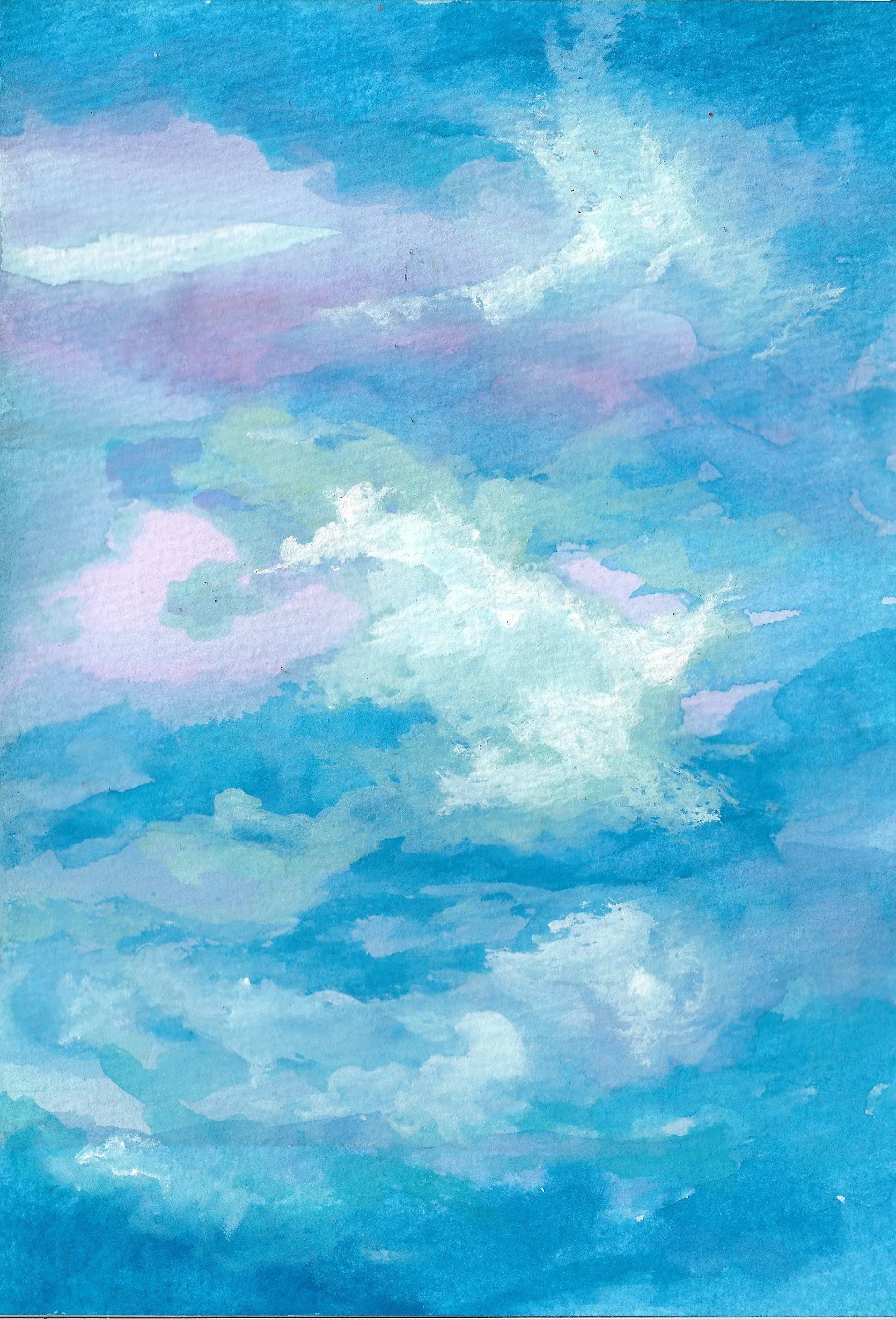
Zoe Nikolopoulou is a contemporary artist whose lyrical abstractions explore the quiet tension between vastness and intimacy. Working primarily in watercolor, gouache and acrylic on small-to-intimate scales, she distills landscapes, seascapes and everyday objects into luminous fields of color and subtle gesture. Light and atmosphere serve as emotional carriers rather than descriptive tools—soft turquoise and rose-pink horizons evoke renewal and solitude. Zoe Nikolopoulou lives and works in Athens, Greece. Her work has been exhibited at the Holy gallery, Athens Open Art (Art.Number23) at Michael Cacoyannis Foundation and at festivals (Handmade and Recycled Theater Festival, 3rd Athens Art Festival), and her artistry has been featured in publications including Inlandia Journal, Flora Fiction Magazine, Ignatian Literary Magazine, Sheepshead Review, Waxing and Waning, Obindo magazine.
Box Baby
You wake up. Your back aches. Your feet throb.
You sit up from your bed of stained and crusty blankets on the cement floor. You ignore the
sluggish yet rhythmic drip... drip... drip... of water leaking onto the mildewed walls, the only
sound in the hollow house. Unsettled, you leave the bedroom.
The house had been vacant when you, your mother, and your baby found it – a fleeting refuge.
Inside seemed to be paralyzed, boxes and bins cluttered the walkways, most half full with
sentimental junk. Your mother picked through every one, pocketing what she thought she could
pawn off. You simply soothed your baby, his cries reverberating against the peeling yellow
wallpaper.
You had placed your screaming baby inside an empty cardboard box and said, “Like baby Jesus
from that Christmas song. No crib for a bed.”
Your mother laughed and you flinched. She laughed when your father signed the divorce papers,
when the landlord nailed eviction threats to her door, when the cops found a note from your
brother on a bridge saying he just couldn't do it anymore.
“If only that baby was Jesus,” she said, “Then maybe God would pull us out of Hell.”
You almost told her that maybe God would if she just asked Him herself. But you didn’t, because
she would just tell that sob story from her childhood– how that such-and-such preacher molested
the so-and-so’s little girl. Besides, you hadn’t asked anything of God in a long time either.
Now, you return to the room with the gloomy yellow wallpaper. It’s quiet. Your mother hunches
in the corner, encircled by the belongings of the former owners. She holds up a pink knitted
sweater with garish blue ribbons woven into the wrists. You think it’s too cheery for her. The
cardboard box with your baby inside is about a yard away from your mother, blending in among
the other idle boxes and bins. Your mother says something about how lazy you are for sleeping
when the sun is in the middle of the sky. Instead of responding and starting another useless
quarrel, you go to see your baby.
He is still. His face had been red before, now it’s waxy and colorless, his skin cold and stiff. You
place your hand on his chest to feel the determined beats of his little heart, but there’s not any life
left in his stunted body. Unmoving, frozen, paralyzed just like this house.
“My baby’s dead.” It felt like somebody else had said it, like you aren’t really the one sitting on a
carpet riddled with black mold with a selfish, callous mother who didn’t care, and a dead baby in
a box.
“Has been for hours,” your mother says, “Finally stopped bawling.”
She didn’t even look up as she spoke, continuing to fold a stranger’s clothes as if she had said
she forgot to buy eggs from the grocery store or that the neighbor would be stopping by with a
casserole.
“Why didn’t you wake me up?” Your voice wobbles, like you were about to hiccup but it’s
caught in your throat. Hot tears cut through the grime on your cheeks, dripping like the leaks
from the roof before you realize you were crying.
“Didn’t think you cared so much, always complaining about breastfeeding and all that. And I
never agreed to be your babysitter. I didn’t feel like wrestling a screechy baby, so I didn’t.”
You always knew your mother wasn’t a good person. There was never a time you modeled after
her, or when people smiled affectionately saying “you look just like her!” Almost as if nobody
wanted to speak those words over you. You never fully understood why your father and brother
left the ways they did. You had hated them, envied them. She was your mother, and she had
always been there, it had felt wrong before to abandon her like everyone else. It didn’t feel
wrong anymore.
You fold down the flaps of the box, closing it with the intent to never be opened again. You pick
up the box, lighter than you thought it would be, and walk out of the stagnant house with nothing
else in your hands. You walk down the street carrying the box, passing rolling hills populated by
cud-chewing cows and soybean crops. Cars and trucks blow by you, and you clutch the box so
tight it crumples the cardboard, as if the vehicles would rip it from your hands.
When the sun begins to set, the blue sky morphing into swathes of orange and purple, you see
three crosses mounted on a bare hill. Their shadows elongate across the pastureland as the sun
sinks leisurely behind them. You set the box on the ground.
“Goodbye. I’m sorry I wasn’t a good mother,” you whisper.
You climb under the barbed wire fence, hike up the hill to the crosses, and kneel in front of them.
Maybe the Lord would help if you ask.
Shayna Goehring is a writer from a no-where town in the Flint Hills of Kansas. She simultaneously longs to be anywhere else, while also being completely content with where she's at right now. @shaynagoehringwrites on instagram.
