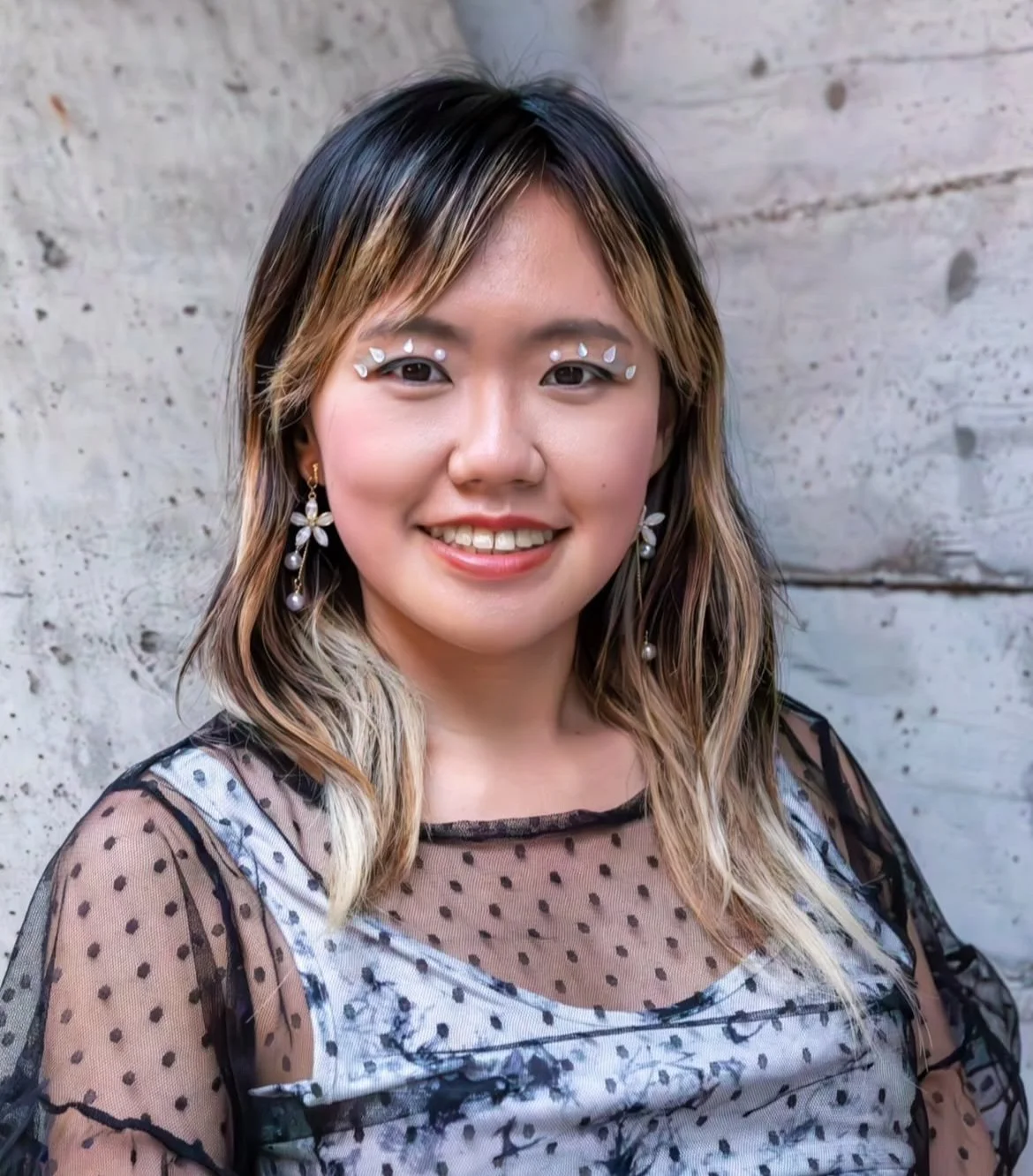
Michelle Chen takes inspiration for her writing from the events that occur in and around her home, New York City, though her birthplace is Singapore and she hopes to return and visit someday. Her work appears in Prairie Schooner, the Asian American Writers Workshop's The Margins, Kinsman Quarterly: Winds of Asia, Deep Wild, LIBRE, and elsewhere. She has been recognized by Ploughshares Emerging Writers, the City College of New York, Brooklyn Public Library, and Penguin Random House, among others. She is an alumni of the Juniper Institute for Young Writers, the Iowa Young Writers' Studio with the support of the National Society of Arts and Letters, Girls in Icy Fjords, the Adroit Journal Summer Mentorship, Girls Write Now, and the Teaching Artist Project. She is currently a graduate student at NYU while acting and modeling, and enjoys less ice and less sugar in her winter melon milk tea. You can follow her collegiate book blog at https://silkwormreading.blogspot.com.
Michelle’s poem ‘Breathwork Meditation for Reparations’ is the winner of the 2026 Exhibition Poetry Prize. Read the poem here.
Q. As a poet, what works inspired your pieces that you included for UMWELT? If no direct inspirations, will you tell us about your process when approaching a new poem idea?
Michelle: My creative piece analyzes the sensual descriptions of Undrowned by Alexis Pauline Gumbs in a more holistic manner, combining major facts and themes from the entire book and crafting new imagery describing an ocean marked by imperial conquest and the destruction of marine animals. For example, I use the neologism "husbandwifemotherfatherdaughterson" from the book in “Chapter Five: Collaborate” to demonstrate the idea of transcending societal roles for more species-wide forms of attachment, where beyond obligation and duty there is an appreciation of how identifying with marine mammals might free new ways of thinking about social justice. The compelling landscape of multiple species of marine mammals transforms our perception of the environment into something much more richer and engaging, as I experienced when I was taken on an internationally selective wilderness program the summer after high school in Seward, Alaska and the Kenai Fjords National Park area. While a commercial tour would have been limiting in the density and significance of information we learned about the landscape, hiking and immersing within and above water in kayaks helped me internalize the beauty of the outdoors as well as scientific concepts which spurred our curiosity about flora and fauna. It was a life changing experience that I appreciated being reminded of while reading Undrowned, knowing that I was returning to an environment I had become out of touch with in the big city where I grew up.
It is also stimulating as a woman of color to think that the natural world has a special place for me, where environmental exploration can be barren and isolating for those not identifying as white men. Luckily, Gumbs provides a safe space for contemplation and Black joy, whereas other forms of literary creation may often focus on trauma or tragedy as the sole area of interest for people of color. The interactions between the ice and the ocean suddenly became familiar to me again upon writing my poem, forgotten memories from my youth emerging but with far more forms of life than I had known existed before. While writing I recalled glaciers above a blue lagoon, and the buoyancy and reinvigoration of complete immersion like a seal in a drysuit in the bay and ocean, by nine teenage girls wandering the Alaskan wilderness together. While Undrowned is a “book-length meditation for the entire human species,” as AK Press describes, utilizes lyrical prose and fragmented stream-of-consciousness sentences that appear to mimic the burbling of marine animals and the incompleteness of cross-species communication, my poem draws upon a few mentor texts including poetry written by college students and fictional biographies in its tone and mood. I hoped to convey a lengthy expression per line as well as four-line thirty stanzas, in order to mimic the long drawn-out breaths of meditation. The liberal use of the em-dash I hoped would give a sense of predictability and structure throughout many scattered images, with occasionally raw grammar to make the reading more intuitive and less constrained as prose might be. I also used frequent line breaks implying run-on sentences, and tried to have the ending words of each line have assonance and consonance, a technique I remembered from the Adroit Journal Mentorship for Poetry, and at the Iowa Writers' Workshop for high schoolers. As someone who is a relatively serious poet who has been invited to present at many different venues since I was young, I found the writing process rejuvenating and emotionally rewarding, able to distract me from an isolating and stressful day and into a new universe structured by Undrowned.
Some of Gumbs’ major arguments which I hope to replicate in my poetry in general are the importance of collectivity, listening across species, proper breathing which heals instead of stressing one out, remembering historical trauma which does not wade in misery but relates to other struggles in other species beyond the human, evolutionary development of animals’ physical traits, observation and being present, capitalism causing suffering and endangerment of marine mammals, commercial fishing industry’s abolition, and the intensity of love for animals, across generations, and through queerness. The long lines of my poem help engage with ideas such as slowing down, resting and breathing, with italicized mantras inspired by the book’s ending list of solo activities that I am interested in such as breath tracking and recording my own meditations and mantras. If we all had the extreme levels of love that Gumbs expressed here, the most repeated concept, there would be far fewer ecological problems and violence as charted throughout all of history and today, which is what makes her work innovative in making the black female experience positive and inspiring against the metaphor of racialized trauma imposed onto marine mammals’ exploitation. I reference many moments from the author's father identifying with Atlas, to her great grandmother's history in Anguilla, to obsessing over manta ray mouths and narwhal "unicorn horns" as well as identifying whales by their scars and those who drowned in the transatlantic slave trade.
After reading, I have realized that I have been too far away and disengaged from the natural world for too long, and wanted to include even more natural details such as plant names and lots of movement and action in my poem. I also enjoyed her references of Audre Lorde, an alum of my high school, who spoke on "our children," the concept that "all third world lesbians share in the responsibility for the care and nurturing of the children of individual lesbians of color” in “Chapter Nineteen: Take Care of Your Blessings.” Mammals who model "revolutionary mothering" was a compelling idea for me, as well as having ancestors and Blackness in solidarity with the marine mammal world. It is only through identifying with marine mammals that new solutions can be dreamed up for Black freedom movement strategies that incorporate solidarity, love, chosen family, and new traditions that are essential for survival through patterns of violence and oppression that is intensified for both animals and queer people of color.
Q. What has been your journey with publications like? What is your favorite piece you have made?
Michelle: I have this astounding love for publication ever since my creative writing was first published in sophomore year of high school in a “real,” non-school publication because of the affirmation and publicity it grants my work, which is often hypervivid, dramatic, tonally precise, linguistically rigorous, and more recently epic-length in the tradition of Greek pre-classical and classical poetry and its successors such as Derek Walcott. The gatekeepers of publishing have not always been kind to this type of innovation due to line limits and the minimalistic efficiency of postmodern poetry, but instead of mimicking poems found in Poetry or The New Yorker, I always felt more fulfilled creating the work I wanted to see in the world but could never find. Throughout twenty years of actively submitting and publishing, from the fantasy novel with magical polar bears I hoped to send to the fiction agent of an assistant teacher who was a published novelist in elementary school, to the Prairie Schooner issue with my personal essay I handed over to my favorite teacher to celebrate high school graduation, and most recently the full-length poetry collection I submitted to the Academy of American Poets First Book Award this year as well as small presses such as Kaya Press and those outside of the United States such as AFTERIMAGE in Singapore for accelerated opportunities.
Some of my favorite notes which come through more frequently than not nowadays on Submittable include "best of luck," "special note: our editors and readers admired your work. We want to offer you our sincere respect and encouragement," "unfortunately, your submission was not selected for publication. However, our team was particularly compelled by the poems you sent, and would like to offer our affirmation and encouragement as you continue writing," "We're looking forward to considering more of your work in the future” and more words of support, in accordance with the social media trend of publicizing rejection letters. Publishing should be open access and so I always submit to free submission calls or those with fee waivers, and encourage social media posting of poems to instantly get one’s voice in front of more eyes than the readerships of literary magazines. The favorite piece I have created is an epic poem titled “Turtle Island” which begins with the epigraph “FIELD NOTE // SOUTHERN ISLANDS / LOCATION: Kusu Island / SUBJECT: Black Turtle Transformation Myth” and narrates the transformative experiences of the castaways on Kusu Island, a Chinese fisherman and a Malay fisherman caught in a violent storm who were rescued in mythology by a giant turtle who transformed its body into an island.
I go into their survival adventures and conduct historical and scientific research about the region, which is both a celebration of my birthplace Singapore and an evocation of ecocriticism, human-nonhuman relationships, and the phrase "minor devastation" repeated throughout as part of the contest prompt which inspired its creation. This poem is very similar stylistically to the one which won this contest and reclaims landscapes and religion through interactivity amongst all human-nonhuman elements present in each dramatic scene. My most significant innovation to poetry would be actively expanding research and observation to craft endless poetic landscapes with epic structure and audible rhythm, and vivacious action-packed scenes similar to those of fiction, but which are realistic enough to also take place in reality. The fun challenge is compressing all these ideas within the limited line constraints of a poem and providing a complete narrative arc which is often missing from contemporary poetry.
Q. What do you hope people feel when they read your works?
Michelle: My readers should feel spectacular, as if they are experiencing creative joy in every corner of their bodies while simultaneously absorbing new and real knowledge, all suspended within clear and clever turns of phrase. Enlightened is the word I would use for a poem of mine to feel successful, and the ability to appreciate my poems for qualities less found in modern poetry such as narrative completeness, character development, and intensive research.
Q. Who is your favorite poet? Do you have any recommendations for people who would like to read more poetry like yours?
Michelle: I have so many favorite poets and many of them are young, college-aged published writers who popularize poetry using confessional intimacy and first-person narration which simultaneously evoke universal themes including climate change, racial justice, physical and mental health, and how to create healthy relationships with the world and people around you. ONLY POEMS, The Adroit Journal and of course, NYU student publications (don’t mind the self-promotion) are accessible archives of poems that in my opinion often outstrip those by professionals and professors in gravitas and clarity.However, my all-time favorite poet has been Sylvia Plath since high school for her vivid walkthroughs of the everyday, known for her courageous depictions of her inner life and confrontational voice, and while we often separate the text from a creator’s life, using a writer’s personal life to understand their writing empowers those experiencing mental health issues as well. Currently, I have been obsessed with many collections, including The Sky Was Once A Dark Blanket by Kinsale Drake, the Complete Ci-poems of Li Qingzhao by Jiaosheng Wang, Dictée by Theresa Hak Kyung Cha, Night Sky With Exit Wounds by Ocean Vuong, Tripas by Brandon Som, The Glass Constellation by Arthur Sze, Omeros by Derek Walcott, Bluets by Maggie Nelson, The Complete Poems of Sappho by Willis Barnstone, and anything by Shakespeare.
Q. What is your favorite poem? Favorite line? Favorite word?
Michelle: If Anthony and Cleopatra by Shakespeare could be counted as a dramatic poem that definitely is my favorite just because I couldn’t choose from amongst the shorter poems in the world! My favorite line is “No fear” and my favorite word is “supercalifragilisticexpialidocious.”
Q. What are your future goals and dreams with your writing?
Michelle: Writing is a form of dreaming and I believe if I can continue that train of thought, whenever I write anything I will be able to overcome any obstacle such as procrastination or perfectionist pressure from the outside world, the anonymous readers, the critical audience. I hope to create endless content without stopping by adhering to this philosophy so that I worry less about the quality of my writing and instead on mass production, while currently I often do the reverse, write short pieces while refining them on the first draft as much as possible. I hope to use my writing to attain community and contribute towards a humanities MFA or PhD yet am currently content with my education level, and to bridge cultures with empathy and understanding. Readers will transcend their lives through the adventures and feelings I create for them, and understand the world in ways that truly matter in this day and age.
Q. Where can people find more of your work?
Michelle: Some recent publications include Singapore Unbound where my poem “End It” was nominated for Best of the Net this month and my fiction story “Bad Student” is in the works there as well, inspired by American Gothic fiction such as Joyce Carol Oates’s expansive psychological landscapes and contemporary fiction such as Jenny Zhang’s casual cultural wisdom. Prairie Schooner, the Asian American Writers’ Workshop’s The Margins, The Evergreen Review, Kinsman Quarterly: Winds of Asia, Deep Wild, LIBRE, and elsewhere have also made snug homes for my work. I always write in all genres and contribute to exhibitions and galleries at the universities and programs I am an alumni of such as YoungArts and Girls Write Now. You can follow my collegiate book blog at https://silkwormreading.blogspot.com and I post writing updates on my Instagram @michmashedpotatoes along with my simultaneous ventures as an educator, teaching artist, model, and actor!
Q. Do you have any advice for creatives/poets/writers who are just starting out? What was the best piece of writing advice you ever received?
Michelle: “If the sky falls in use it as a blanket,” my English literature professor told me in one of the darkest moments of my life in my undergraduate years, and I believed him so much that I commodified my endless resilience into a source of comfort instead of shouldering the weight of the world on my shoulders. Creatives and poets should know that rejection is frequent and acceptance depends as much on timing and connections as much as writing skill, where playing the long game requires having a holistic perspective on your major and minor goals. First-time writers should understand that unwavering persistence and determination will allow them to generate content before requiring perfection. And that content should be what they always wanted to read but could never find.
Q. Is there anything else you want to share with us?
Michelle: My favorite drink is less ice and less sugar in my winter melon milk tea and I know kindness can save us all, especially in poetry.