‘Bird Math’
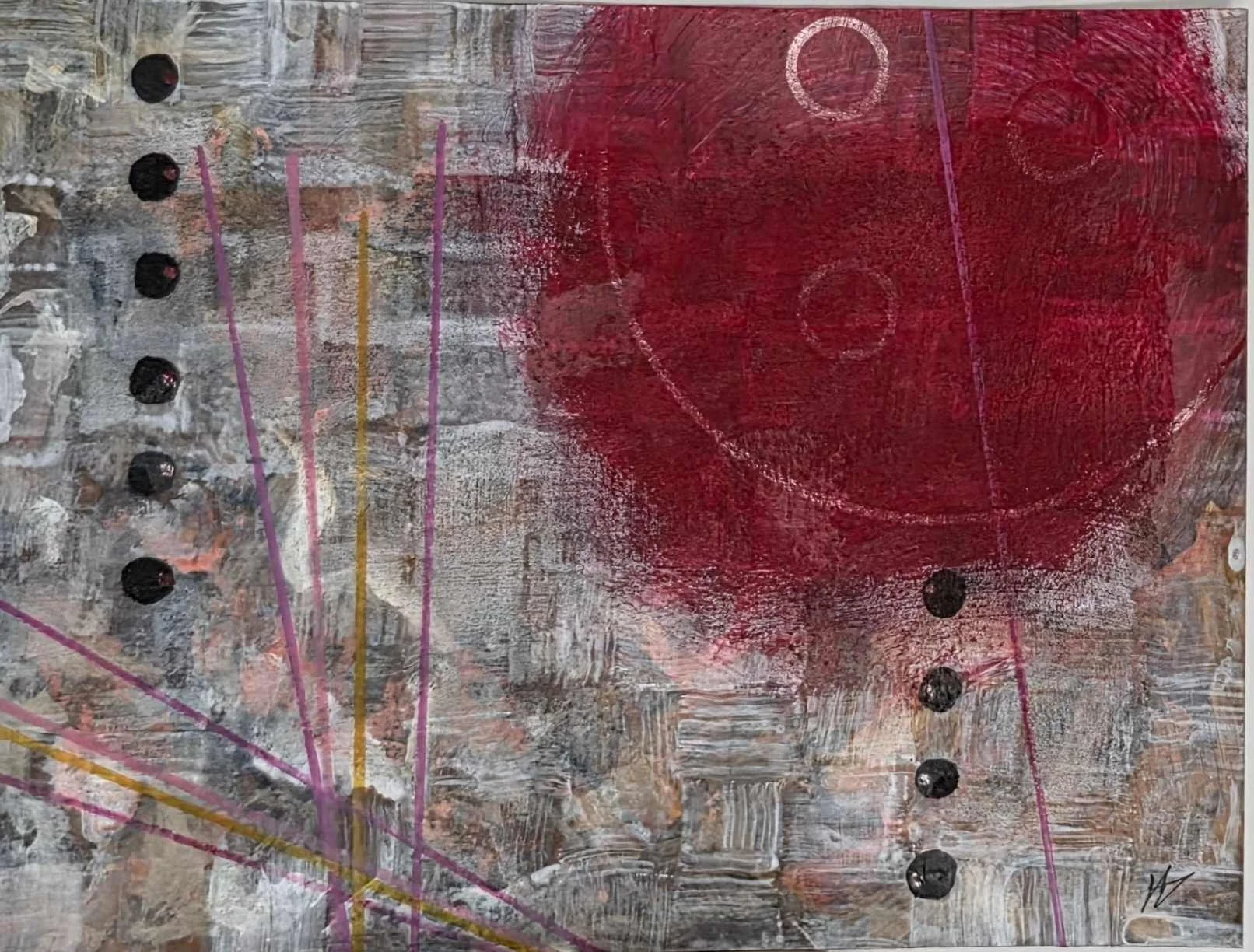
John Bishop is an abstract expressionist painter based in Houston, Texas, who creates gestural mixed media work in acrylics, ink, collage, pencil and marker. His work centers on layering color and mark-making to create works that allow a different experience up close than at a distance. His art draws one deeper into discovery and recognition. Though his passion for art began as a teenager, he was steered away from an artistic career by well-meaning parents. Instead, he became an English teacher and later a librarian, working in five different countries over the course of three decades.
Bird Math
Ethan had never seen swans in the park, but that day a pair drifted on the pond. They looked giant, sculling in tandem with rippled reflections gliding below. Their orange beaks and black eyes faced the dark water, making them look shy like eye-linered scene kids peering through fringes. Subtle wakes smoothed behind them, restoring the tangle of bare trees on the mirrory surface.
Before he’d seen only ducks—swimming in groups, shaking off water, and huddling on the pond’s narrow strip of sand. Never a swan, or a pair of them. Small birds often filled the trees overhead—brown and chittering—but he didn’t know if they were sparrows or finches or something else. He hardly knew birds. But he recognized swans, which, it turned out, were huge and saurian with muscular necks and boat-like bodies.
Did the swans show up, or did the town buy them? If the town bought them, how could they guarantee they wouldn’t fly away? Would the town, already small and losing population, really spend its tax dollars on swans?
He looked around for someone who might have answers. It was a Tuesday afternoon, overcast and misting. Hardly anyone was at the park.
An old man sat on a bench with a small dog on the far side of the pond. Ethan decided not to walk over and bother him, whom he’d seen before walking with his terrier off-leash against park rules.
The drizzle chilled Ethan, and he left after seeing that without adequate foliage there was nowhere he could piss.
At home Ethan searched swans for sale on the internet. A pair of swans, their standard unit, cost $3,000 from a company that sold and shipped birds across the country. This seemed like an extravagance. He didn’t know the town’s budget, but he knew they didn’t have the money for swans. Hardly anyone, considering the price of rent and groceries, could afford swans. Elsewhere on the website he found that for the same price he could buy 1,200 baby chickens, which came out to $2.50 per bird. This felt like a better deal and something worth considering. He could start a farm and eat eggs for life, though his apartment would grow cramped and foul and his neighbors would complain about the noise. There was something American about chickens too, more so than other birds. They were loud and boisterous and clucked and pecked with impunity; unlike swans which, although muscular, were coy and slightly European. He could also buy 160 turkeys for the price of two swans. With that many, he could eat roughly three turkeys a week for a year. If he worked out during that time, using the weights his dad bought him and taking scoops from his tub of creatine he could probably grow huge, swole. The words “all turkey diet” came to mind, but he decided not to search it, knowing it would lead to the predictable content of skullish guys musing on martial arts and protein intake.
Turkeys sometimes wandered through the woods behind his building in small violent gangs. When a male turkey, a tom, was with a group of females, it could act aggressively, puff its chest and give chase while gobbling a war cry, threatening to maim with taloned feet. He knew this because he’d been pursued. Last month, he climbed on top of his car after dropping his keys in the street, while a tom pecked and cracked his taillight.
He looked up from the computer, but there were no turkeys outside. He saw his neighbor’s bird feeder where small birds gathered and plucked seeds off the green platform, spreading some into the grass below.
He could buy 12 peacocks for the price of two swans. He added to cart then removed from cart.
If he bought 12 peacocks, or even one, he would become known as the peacock guy in his building and probably neighborhood, which felt like an eccentric, possibly cool guy to be. He imagined a peacock in his apartment then another and another. He would turn the empty bedroom into a peacock aviary, or whatever that word was.
Do peacocks smell? Do they make good pets? Which was worse, being the peacock guy or being Ethan, the nothing guy?
He added to cart then removed from cart.
He didn’t have $3,000, but if he asked 100 friends for $30 he would have enough to buy 12 peacocks, two swans, 1,200 chicks, or 160 turkeys, whichever he liked. But he didn’t have 100 friends. He had two, both of whom were mad at him. It had to do with Mark’s sister’s baby shower, which he was invited to under the condition he talked mainly to his friends, Mark and Sean. But he was offered champagne on top of his solitary pre-game beers, and he said to a crowd of mostly pregnant women and mothers, that having babies was untenable to the environment and would lead to the collapse of the global ecosystem and the eventual death of all life on Earth. If you have a baby in 2026, you should either kill someone or kill yourself to balance the global scale. It made the most sense, if you looked at it purely logically.
They stared at him with mouths open or looked down, eyes tracing the floorboards.
The human population, he went on, filling the silence, will likely peak around 2050 before plummeting as disease and disaster ravage the planet. By 2080, this town and maybe the whole state will be ash and rubble, and most people—our families and loved ones—will be dead. Those remaining will live in primitive hunter-gatherer bands. And your baby will either become a notorious warlord or its head will be lanced on a ceremonial pike. He cleared his throat and took another sip.
Remembering that day he winced and closed his eyes. He wished he hadn’t said all that. He wished he hadn’t watched the video by the guy who’d made those predictions. And he wished he hadn’t had those beers and flutes of champagne which made him feel confident and loose, like a better version of himself.
He thought about texting Sean and Mark asking to borrow $1,500 from each, but he knew they didn’t have that kind of money, and he felt things were still tense between them. They hadn’t talked in almost three weeks.
If he bought just two turkeys he could breed them and produce unlimited ones, which he could eat instead of going to the grocery store where he often ran into Evelyn, his ex who worked at the fish counter with Dave S. from high school. Fuck Dave S!She would have never heard about polyamory if it weren’t for Dave S.
Ethan had no money for the swans, the chickens, or the turkeys. Several carols worth of birds. But he remembered the unused Visa gift card from his grandmother in the desk drawer. He poked through pages and pages of purchasable birds, some at appealing prices.
He found one he liked (small, well-priced), added it to cart, entered the card information, and clicked ‘confirm purchase.’
The next time he walked to the park the swans were missing. He looked in the reeds on the northern edge but they weren’t there. No flattened grass or signs of a nest.
He stuffed his chapped hands in his pockets. The park looked brown and gray like a Wyeth painting. He followed the path around the pond.
If the town had bought the swans, it was just like the town also to lose them. The town lost everything: the big grocery store on Champlain, the movie theater and shops on Combray. There was almost nothing to do but drive an hour to Columbus, and it was sometimes hard to find a completely sober hour to do this.
He saw the old man sitting on the bench wearing a green raincoat, gazing over the rain-pecked water, while the dog sniffed patches of dying grass. The dog trotted up to him and began to inhale his shoes.
The old man called the dog, which ignored him, then he said to Ethan, “He’s friendly.”
Ethan looked down at the dog nosing his shoelaces then looked at the old man. “What do you think happened to the swans?”
“Sorry?” The man smiled.
“I mean—The swans that were here a few days ago. You probably saw them.”
“I don’t think so. I would’ve remembered seeing a swan.”
“But you were here. I saw you.”
“Must have been my twin!” He laughed, rocking on the bench. “Have a good day.” The old man nodded.
Ethan felt something was off. There was no chance the old man hadn’t seen the swans, which were eye-catching and memorable. Ethan knew when to dig deeper and when not to trust certain narratives, no matter how straightforward. He asked what felt like the obvious follow-up: “Are you working for the government?” His own lack of vocal tremor impressed him. The old man couldn’t sidestep such a question. It wasn’t accusatory but definitely assertive, in-charge. It demanded a basic truth from which a trusting exchange of information could—
“What do you mean?” The man frowned.
Ethan’s throat dried. “What do you think?”
“I think you should be mindful how you speak to people.”
The dog looked up from Ethan’s shoes, its black lip snagged skeptically.
Ethan walked away, looking down. Every patch of grass he crossed was dead dead dead dead.
When he got home, he researched doves, mourning doves specifically, on his computer. He chose the species for its coloring—roseate gray and brown with black bands and specks—and its affordable price. Its image on the website had looked exotic, like nothing he’d seen. But it turned out to be nothing special. Its range covered most of the country. He sort of remembered seeing similar birds tear-dropped on telephone wires and hearing booming roucoules on haunted mornings before school.
He read that paloma meant dove in Spanish. It was Taube in German. Голубь in Russian. Rock dove was the real name for a pigeon. This made him think of pigeons differently. Cities were filled with doves and he hadn’t known it. Mike Tyson owned thousands of them, which he liked to kiss on their small heads. There were 337 million mourning doves in the United States, almost one for every person. Doves were monogamous, selecting one mate for life. A pair of mourning doves was considered good luck. One by some was considered bad. The words Columbus and Columbine both derived from the Latin word for dove. It was strange how often dove words were associated with death: genocide, shootings, cemeteries.
Domestic doves lived in dovecotes or columbaria. A columbarium was also where dead people’s ashes were stored, which was a momentarily confusing overlap in meaning. When he searched the word, hoping to see images of dove housing, he was shown marble halls walled with cubbies marked with gilded names and dates. Afterwards he stuck to ‘dovecote.’ He didn’t have space for a real dovecote, although the extra room was extra again since Evelyn had picked up her last box of things more than a month ago. At least the dove would have its own space.
That afternoon he bought a large iron cage with multiple perches and trays for food and water from someone on Craigslist who used it to house a cockatiel for eleven years. The cage, with tiers and a mansard roof, resembled a stately Victorian, with white bars instead of wood shingles. He rolled it into the empty room and placed a bag of seeds next to it.
At a pet store, he bought necessities while trying to enter the mind of a dove. He picked up a knotted blue rope and turned it over in his hands, wondering if he would perch on it, enjoy its texture between his toes; then he picked up a plastic ball with a bell inside, considering whether he would push it along the ground with his beak and relish its chime. He grabbed a block of dyed calcium, essential to a bird’s nutrition, and licked it, wondering if a dove would like its taste.
He didn’t know how it would arrive, which an email said would take three to four days. The dove might appear perched on his mailbox one morning, having flown over night, and he’d know instantly it was his. A tag on its foot would confirm it.
Instead it arrived the next day in a cooing box chucked on his building’s front step despite stickers which said ‘live animal’ and ‘fragile’.
“Hroo hroo,” the box plained, as he scooped it up.
He carefully cut open the top while sitting on the floor.
When he peeled back the flaps, he saw the dove resting on a thin bed of straw, its head twisting in the sudden light. The overhead glinted on the long barbules of its folded wings. Smooth lavender feathers. A beautiful thing. He observed the dove like it were an expensive antique he’d just inherited.
The dove breathed rapidly, its cherry-pit heart batting its ribs. It must have been in shock. Its pinprick black eye looked at him, but he could read nothing of what it felt seeing the brachycephalic face of his strange species. Was it fear?
His hands lowered slowly, and the dove’s claws scritched the straw. He grasped it lightly with his fingers, barely exerting pressure, as he’d read on the internet to do. Its heart drummed through its airy body into his fingertips. He expected it to be dense, like a cat or something valuable. But the dove felt like holding an empty plastic bottle.
He sat the dove in the ditch of his pressed thighs and squashed the urge to pet its head and back like a dog. Without thinking, he imitated the sound he heard from the closed box.
“Hroo hroo,” he said, rolling his tongue and shaping his lips into a small, tense O.
“Hroo hroo,” the dove replied, its body vibrating like a called phone.
The dove’s beak poked the air, twitching in a circle like a seconds hand. Ethan hoped its new surroundings looked more appealing than the dank box, with its white-green droppings encrusting the straw substrate. He could only imagine what world the dove had come from: a wire pen filled with uncountable birds flapping, eating, and crapping on each other. He hadn’t thought to research whether the website he bought from was humane. There was almost no chance it was, considering the lack of ethics in farming under capitalism, and the dove could be traumatized. He weighed whether, by purchasing the dove, he had contributed to or reduced suffering in the world.
Ethan cooed again, but the dove stayed silent. It must have been exhausted, terrified from its journey through the cruel and inefficient postal system and wracked by the season’s clingy cold. It needed rest, some time alone.
He lifted the dove from his lap and carried it down the hall to its cage. He reached inside, set it on the sheet of newspaper spread over the bottom, and closed the door. He lifted the old blanket off the ground and draped it over.
It was only six when the sun set. A purple square of sky hung in the window. While waiting for the dove, he’d hardly eaten. A yogurt in the morning, a sandwich sometime after. He couldn’t decide if he wanted to cook something for twentyish minutes when he felt like it didn’t matter. Hunger faded when he laid in bed, and he smiled knowing he’d see the dove in the morning, like an early Christmas. When he fell asleep, he dreamed of doves, thousands in every color.
In the morning Ethan heard it calling from bed. For the first time, his apartment with its shoddy walls felt pleasant, like being in the park. The call sounded like wind whipping through a tree hollow: “HOO-hoo-HOO, HOO-hoo-HOO.”
He followed the sound to the spare room and stood in the doorway listening. The call sounded so different from yesterday’s trilled coos. The dove announced the day to itself or anyone who listened, which was only Ethan, eavesdropping like an eager fan on a prima donna warming up backstage. He dragged the blanket off the cage, and the dove went quiet. He stepped back and waited, hoping it would recognize him and start again. It shifted its pink feet on the blue rope and watched him.
He stepped forward, lowered his head, and whistled softly. It cocked its head and made an almost inaudible bubbling sound with its throat.
Shy, he thought.
Ethan’s face neared the bars, almost brushing them with his nose. The dove looked calmer than yesterday. He was glad it perched on the blue rope and had eaten some seeds. He noticed the scaly turquoise around the dove’s eyes, teasing the taut reptilian skin under its feathers. The skin suggested the dove’s prehistoric past, when scales covered its body. The dove had descended from velociraptors and archaeopteryx, and some of their traits—hollow bones, wings, pointed claws—persisted millennia later in the dove and its relatives. There was a time when the world was dominated by the dove’s ancestors, huge and powerful. Now the dove was locked in a cage by the distant nephew of some jurassic mammal, something that had looked like a dormouse which archaeopteryx had gobbled off the ground. Advantage had shifted to mammals in the last bajillion years, with homo sapiens emerging on top. He wondered if the dove felt this loss of primacy somewhere in its pistachio brain. If it remembered its dinosaur past while staring at its hominid captor. It was a human world now. Dinosaur world, bird world, was gone, though it must have been nice while it lasted. He thought he saw a microscopic sigh, a puff of air, released from its ruffled chest feathers, but it was impossible to know for certain.
He rolled his tongue at the back of his throat, hoping to encourage a coo.
The dove shuffled awkwardly like a sober party-goer.
He walked to the kitchen, deciding to give the dove space and try again later. Yesterday they bonded, now the dove clammed up like they were strangers.
Click, click, click. Blue burner flames burst below the kettle, forming a gaseous nest. He dropped slices of bread in the toaster and poured a bowl of cereal.
The kettle rumbled like a million glass beads whirled inside. The spout chuffed transparent vapor then erupted into a screech, releasing a cone of cumulous steam.From the kitchen, he heard the dove’s scream spread through the apartment, mimicking the sound: “Eeeeee!” it shrilled.
He plucked the kettle and poured the boiling water into his mug and stirred in a spoonful of instant coffee. The kettle fizzled as he set it down, and the dove quieted again.
His heart sank. The dove liked the kettle more than him. He reminded himself he needed to be patient, let the dove warm up to him. Doves were sensitive and finicky, he remembered reading on the internet. It needed to get used to his voice.
He sat on the floor on the other side of the room from the dove’s cage and read aloud from a book about a woman who raises a hawk. He’d read it before in high school and remembered only the part when the hawk flies off her owner’s glove and never returns. The owner looks for weeks before giving up, trusting the hawk will come back when it’s ready. But the hawk doesn’t return, and she fears it has died in the woods.
Despite that, the premise made him feel optimistic about human-bird relationships. He hoped he and the dove might grow as close as the author and the hawk. As he read, he wished the words meant something to the dove.
He thought about sporting the dove on a leather glove, like the woman and her hawk, and carrying it to the park, impressing those who saw him. Maybe in the spring, if they’d grown necessarily close. But he worried the dove would fly away and join its own flock, or disappear like the swans. His throat dried, and he closed the book only a few pages in.
He stood up on numb feet and unlatched the small cage door and inserted his hand. There was nothing he would’ve liked more than to hold the dove again, but he knew it was too soon. It risked shattering their fragile trust. The dove observed the limp, dangling fingers, and pecked a wrinkled knuckle. It tickled.
In the morning he pulled the blanket off the cage, and the dove cooed: “Hroo hroo.”Patience’s reward. The dove’s head nestled into its rounded body.The coo sounded polite, a bit perfunctory, but he was fine with that. He cooed back, “Hroo hroo.”
He opened the cage door slowly and filled the water tray using a crinkled plastic bottle and scooped seeds from the bag into the food tray. The movement of his body felt meaningful as he enacted the new routine. He was helping something, and something was better off because of him. He gathered the sheet of guano-spattered newspaper, folded it, and dropped it in the trash. He snapped open another and smoothed it across the bottom of the cage. He closed the door and stood back. The dove flapped its wings and perched on the lip of the water tray.
Ethan faced the window which filled with morning light. He felt that he and the dove looked out the window together. The trees held the sky in their naked fingers. Clouds raced like horses across orange plains. The grass shivered and glittered. The swans migrated from his thoughts; he didn’t need to wonder anymore. They stood on the rimy lawn, grabbling seeds off the ground under his neighbor’s bird feeder. They looked better than $3,000.
Ryan O'Toole is a writer living in Chicago. He earned an M.A. in Writing from the University of Galway. His work appears in HeartWood Literary Journal, storySouth, Two Thirds North, and elsewhere. He can be found online at realtowersrealbridges.substack.com