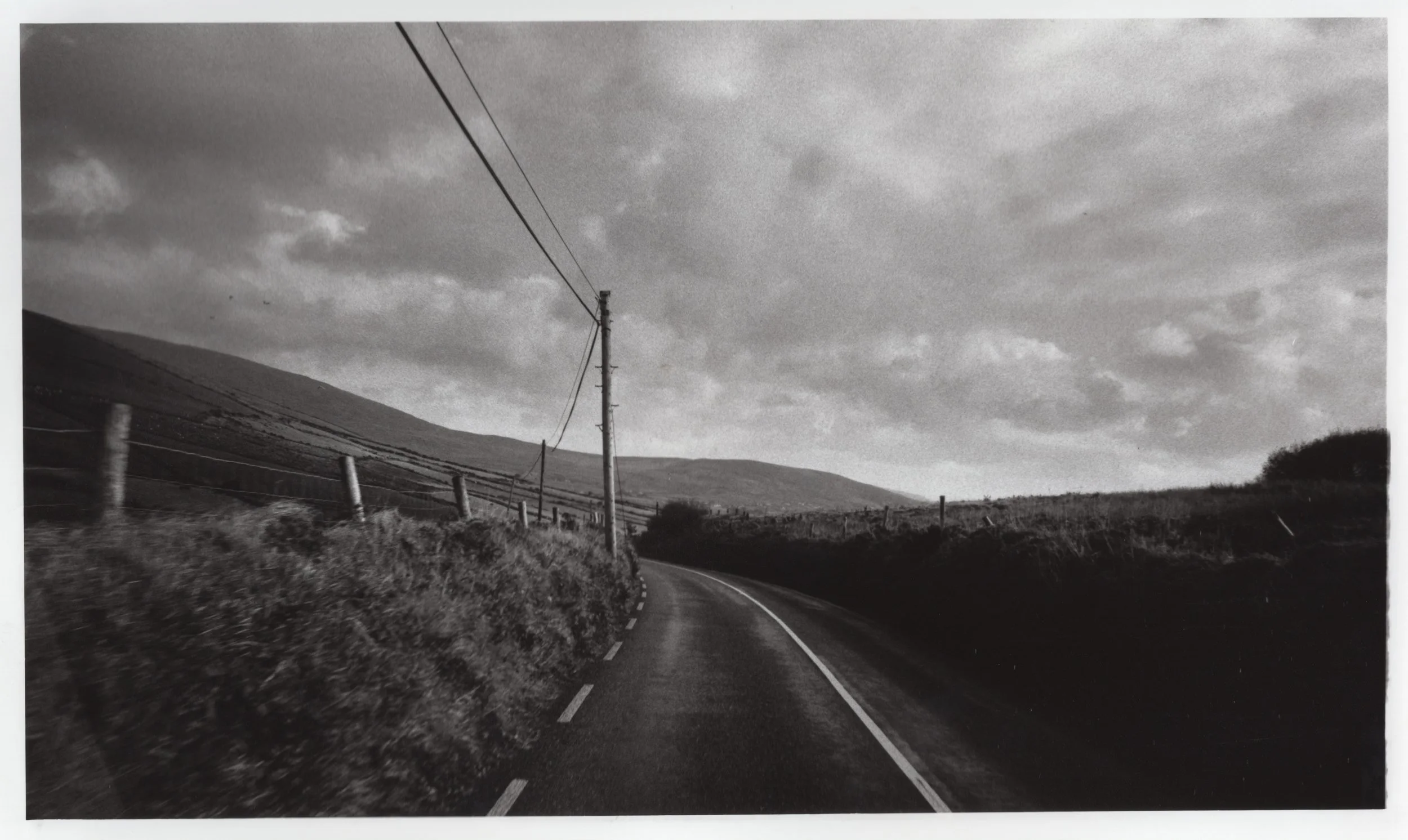
Robert McGuire is a Evanston, Illinois photographer who works exclusively with film and traditional photographic processes, drawing inspiration from landscape, architecture, and the character of everyday places. After a 30-year career in information technology, he has rededicated himself to a lifelong involvement with photography, approaching it as a new vocation centered on traditional film and darkroom practice.
It Might As Well Be Me
Half an hour early, and barely a spot left. I’d never seen the county parking lot so full. I eased my dilapidated Ford Focus into the only place I could find, between a cockeyed minivan and an enormous red truck, leaving barely enough room to shimmy out the door.
A gauntlet of protestors lined the sidewalk that snaked toward the old stone courthouse, chanting, “Say no to Green Mountain Development,” while waving signs that said the same. Protest photos always beat meeting shots. I lifted my camera and snapped a few frames as I walked past.
“If you oppose the development, make sure you sign up to speak,” said a woman with a blonde ponytail and close-fitting green shirt stationed at the end of the line.
She pressed a half-sheet cardstock of bulleted talking points into my hand. Damn, they were organized. This was going to be a long meeting.
“Actually, I’m here as a reporter,” I said. “Sean Miler, for The Whitford Times. You the organizer of all this?”
She nodded, causing her ponytail to snap behind her like a whip.
“One of them. My name’s Melanie. Melanie Jones.” She reached into her pocket. “Here’s my card, in case you have any follow-up. I’d love to get coffee later, talk about next steps for our group. They’re sure to approve the development, but we’re not done fighting until the last resident moves in.”
She handed off the card, and for a brief second her cool fingers touched mine, a welcome respite from the summer heat. A pleasurable chill climbed my spine, and my shoulders twitched. I cleared my throat, thanked her, and hurried inside.
A signup sheet stood on a podium beside the door. More than 30 people had already scrawled their names, claiming their three minutes to address county commissioners. I sighed. At least I’d eaten dinner already, and this boardroom was one of the few in the county with comfortable, padded seats. I slid Melanie’s card into my pocket, flipped open my laptop, and settled in.
The five commissioners were already sitting at the dais, waiting for six o’clock. Chairman Murray reached over his enormous belly to bang the gavel, calling the meeting to order.
“Our first order of business tonight is a public hearing for the proposed development on Green Mountain,” he said, squinting at the agenda. “The board will consider whether to grant a variance to the subdivision ordinance found in Section 123-54(d) of the zoning code. First name on the list, Gary Wheeler. You have three minutes, sir.”
A white-haired man in overalls stood up in the front row, leaning on a four-pronged cane as he made his way to the microphone.
“My family has been in Balsam County since 1831,” he said in a voice as creaky as his walk. “I’ve spent my whole life walking that mountain, and let me tell you something. It’s a great place to gather ramps in the spring, but a god-awful place to build a house, let alone 50 houses. It’s mighty steep, and mark my words, if y’all approve this, you’ll have mud in the water and a landslide halfway down to Asheville.”
The crowd applauded as Wheeler inched back to his seat, forcing Murray to pause before calling the second name.
“My husband and I have been looking for a house all year,” said the next speaker, a young woman in a blue t-shirt and jeans. “We’re both teachers, and there’s nothing in our price range. Nothing.”
She spread her hands out in a flat line, a minus sign in the air.
“We need affordable housing,” she said, “not a bunch of million-dollar mansions tearing up a beautiful place like Green Mountain.”
The crowd clapped louder with each successive speaker, but to me it all sounded the same after a while. The sunlight through the big window across the room faded to darkness, and my notes became progressively sloppier and halfhearted. I wondered how reporters had handled this sort of thing before the invention of the voice recorder. Coffee could only do so much.
But then Murray called Melanie’s name, and I jerked awake.
“Mr. Chairman and commissioners, you have heard from citizen after citizen tonight telling you why the Green Mountain Development should not be allowed to proceed.”
She paused to look each of the five men in the eye.
“I will not use my time to repeat their points, but rather to define the choice you have before you today. You can keep caving to the demands of rich out-of-town developers and approve this application, accepting the environmental damage, permanent eyesore, and exacerbated housing crisis that it will bring to the county you’re supposed to lead. Or you can reject the Green Mountain Development and actually do something good to serve the people who elected you — and the future generations who will call Balsam County home.”
The room broke out in applause, and Melanie’s blonde ponytail bounced an exclamation mark as she turned to take her seat. My own stomach jumped in unison. I glanced up at the all-male board, amazed to see that their expressions remained static as ever. Chairman Murray cleared his throat and tapped the gavel.
“Thank you, Ms. Jones,” he said. “That concludes our public comment. Now we will hear from the developer. Mr. Benson, please come to the podium.”
Benson was an athletic-looking guy, probably in his early 40s, his tailored charcoal suit a loudspeaker blaring the fact that he was wealthy enough to spend $500 in alterations on a $2,000 Italian suit. A blood-red tie rested on the buttons of his crisp white shirt.
“Good evening, commissioners,” he said, placing his hands on the podium as though he owned it. “And many thanks for the opportunity to come address you tonight. As you know, we’ve properly submitted a complete application for this project and clearly demonstrated that it satisfies the requirements of all applicable state and county statutes.”
A smattering of boos rose from the room. Benson paused, a derisive smile playing on his lips as he leaned on the podium, waiting for the reaction to pass.
“What you have heard tonight is nothing but emotion and speculation, neither of which should factor into your ultimate decision. To those who oppose the project, I would remind you that undeveloped land like this is exceedingly valuable in today’s market, and no current county ordinance prevents this type of project from happening on this location.”
He cleared his throat.
“In short, somebody will eventually develop this land. It might as well be us.”
Murray looked around to his board members.
“Any motions?”
Commissioner Taylor, the skinny bald one to his left, leaned forward.
“Move to approve the requested zoning variance, Mr. Chairman.”
Murray nodded.
“Those in favor?”
All five hands went up.
“Motion passes, 5-0.”
Murray’s next words were buried in an outbreak of boos and moans. He banged his gavel, and the security guard at the door took a step forward as though ready for action. A momentary silence settled, swiftly broken by the shuffle of 50 people leaving the room at once.
***
I woke up the next morning groggy, exhausted, and cursing the pizza restaurant next door. In their latest middle finger to the tenants of the drafty apartment building where I lived, last week the owners had parked an enormous refrigerator truck in the alley next to my window.
The constant roar combined with the suffocating summer heat of my unairconditioned third-floor apartment to ensure that I barely slept. That morning the four-block walk to the office felt more like a sleepwalking episode than a rejuvenating morning stroll. Even a text from Melanie, asking to get together for coffee the next day, wasn’t enough to wake me up.
When the paper’s ad rep Allison opened the door to the office I shared with Ben, the city reporter, I was on my third ineffective cup of coffee — and it was only 9:30 in the morning. My khakis were wrinkled and my hair rumpled from dragging my fingers through it, a gesture of frustration as I struggled to string words together for my story about last night’s vote.
“Powerball jackpot is up to $1.5 billion!” Allison said, poking her head around the door. I winced at the sunniness in her voice. “Want in on the office pool? It’s two dollars by the end of the day.”
“I’m in,” said Ben, swiveling in his chair and slapping two one-dollar bills in Allison’s palm.
I sighed. Seemed like Allison always came around when I was stressed out and on deadline, and then pretty much always about the Powerball. I’d lost count of how many times she’d popped in over the years, asking for my two dollars. I always said no, and so far that decision had made me several dozen dollars richer than everybody else at The Whitford Times.
“Come on.” She turned my way, wheedling. A saleswoman to her core. “You never know.”
“Well, I think I do, really,” I said. “The odds of winning are what, 1 in 300 million? So basically zero.”
I reached for my coffee, drained the last sip, and set it between my change from the café and the collection of empties at the back of my desk.
“Well, the way I figure it, somebody’s going to win,” she said. “So it might as well be us. But sit it out if you want. If we all get rich, I imagine we can throw you a few thousand at least.”
I’d paid for the coffee with a five-dollar bill. My change, $2.42, was sitting right in front of me. Sure, I was trying to save for a down payment, but what difference would two dollars make in the scheme of things? And imagine if I won. It was almost worth two dollars to fantasize about buying my dream home, leaving that crappy apartment, and taking out giant billboard ads telling people to never, ever eat at Angelico’s Pizza.
“Fine, I’ll play,” I said, grabbing the bills and handing them to Allison. “Pick some good tickets.”
“Oh, I’m feeling lucky,” she said. “See you when we’re rich.”
“Can you imagine winning $1.5 billion?” Ben said as Allison closed the door. “Like, how crazy would that be, if everyone at The Whitford Times suddenly became millionaires? You think everybody would just quit?”
I looked down at my laptop and the half-finished story I was supposed to turn in within the hour. Did I like spending my evenings in the commission boardroom and my mornings feverishly writing to meet a deadline? Not really, at least not most of the time. But it felt like important work. A community service. I liked knowing that my days were spent doing something worthwhile.
“I mean, we all practically work here for free anyway, don’t we?” I answered Ben, laughing.
“True enough,” he said. “But if I had $1.5 billion divided by twelve, I’d be out of here riding a sailboat around the Caribbean faster than you could blink. What about you?”
I shrugged.
“That’s a hard one. Hopefully we get lucky enough that I’ve got to come up with an answer.”
I was lying, though. The Caribbean sun sounded a hell of a lot nicer than this fluorescent-lighted office.
***
To the surprise of no one, the Powerball numbers they read out later that night had no resemblance to the strings of numerals on the tickets Allison had copied for me. I’d stayed up late to watch the draw, later for a round of text messages with coworkers disappointed that their plans for life in the lap of luxury had been destroyed — again — and even later in search of something resembling sleep as the refrigerator truck next door ground my dreams into little globules of white noise.
I was more disappointed than I’d expected. One in 300 million is terrible odds, but in this housing market that had seemed my best chance of escaping this hellhole apartment. For now, my only escapes would be momentary, like the coffee with Melanie that I was already late for.
She was waiting for me at the café, looking tired but not grumpy like me. An air of anticipation hung around her, which surprised me considering how the vote had gone.
“Good morning,” I said, ordering a large coffee from the bar and sitting across from her at the small wooden table. “Still recovering from the other night?”
Her lips stayed closed, but the corners of her mouth turned up, a sly smile. She took a sip of coffee.
“You know, I almost blew you off this morning,” she said, locking her eyes to mine. They were blue, with little flecks of yellow-green around the pupil.
“I wouldn’t have blamed you. Tough loss, Monday.” I took a deep breath, weighing my words carefully. “But I’m glad you didn’t cancel.”
She didn’t say anything, but the sly smile was back. What was that about? Did she think I was hitting on her? Did she want me to hit on her? I let myself remember the feeling of her fingers brushing mine as the business card changed hands. My spine tingled, an echo of the shiver that had raced along it Monday night.
I took another sip of coffee, looking out the window and inhaling the richness of fresh-ground beans while I waited for the chill to pass. I could see Green Mountain from here, its leafy top standing head and shoulders above the next-tallest ridgeline overlooking downtown Whitford.
“So.” I cleared my throat. “You wanted to talk about next steps? Commissioners approved it already, so what’s left?”
“Nothing,” she said. “We’re done.”
The espresso grinder behind me smothered our conversation, sending a fresh surge of scent through the shop. Melanie smiled, savoring the aroma. I just stared, waiting for the noise to stop.
“What do you mean, you’re done?” I asked when the grinding ceased. “What happened to ‘it’s not over until the last resident moves in?’”
“Well, let’s keep this off the record, but some things have changed since Monday night.” She leaned forward, dropping her voice to a low, conspiratorial tone. “Hence why I almost blew you off. Did you play the Powerball this week?”
“Yeah,” I said, squinting at her. “Didn’t win anything, of course. Why?”
Even as the question escaped my mouth, I knew the answer. I set my coffee down hard, sloshing a brown ring around the bottom
“No,” I said, smacking my palms on the table. “You’re joking. You won?”
She nodded, a half-crazed energy circulating around her. She leaned forward and touched my arm.
“The jackpot,” she said. “The whole thing. It still doesn’t seem real.”
She straightened up, but I stayed frozen in the leaned-forward position where I’d been when her fingers had landed on me.
“Well, congratulations,” I said, finally unfreezing myself enough to sit upright. “That’s crazy. And exciting.”
The bell at the front door jingled, and when I glanced over I caught sight of Green Mountain again. Its rounded top was bright and puffy with summer foliage.
“But I don’t understand,” I said. “If you’re suddenly rich now, you’ve got all the time you need to work on projects like the Green Mountain protest, right? Why quit?”
Melanie looked down at her coffee and shook her head, smiling.
“Sean, have you seen the renderings for the houses they’re putting up there? They’re gorgeous, really, and just about the only new construction like that anywhere near Whitford.”
The chill that had just climbed my spine became a ball that sank deep into my gut.
“Wait, you’re not serious? All that stuff at the meeting about environmental damage, the housing crisis, creating an eyesore — that was you, right? Or did I just dream that part?”
As I spoke, I could see her say it all again, as though I’d captured the whole thing on video. Her blonde ponytail and the shelf her breasts made beneath her green shirt, but also her confidence and resolve, the air about her that said her cause was righteous and she’d never quit until she’d seen it through.
“Oh Sean,” she said, placing her hand over mine. “Who are we kidding? Those houses will get built, and somebody’s going to live in them. It might as well be me.”
Then she pulled her hand away, and I felt nothing.
Holly Kays lives and works in the Great Smoky Mountains region of Western North Carolina and holds a degree in creative writing from Virginia Tech, currently serving as lead writer for Smokies Life, a conservation nonprofit and boutique publisher. Previously, she spent over a decade in newspaper journalism. In addition to publishing award-winning news stories, features, and columns in multiple local and regional outlets, she is the author of two books: "Trailblazers & Traditionalists: Modern-Day Smoky Mountain People," a compilation of stories profiling the diverse people who call these mountains home, and a novel, "Shadows of Flowers."
